


EN
Quarterly Earnings Drop Might Change The Case For Investing In Cincinnati Financial (CINF)
- Cincinnati Financial reported third quarter 2026 revenue of US$3,047m and net income of US$459m, while nine month revenue reached US$10,184m and net income totaled US$1,988m.
- The quarter showed weaker headline earnings than a year earlier, yet nine month basic EPS from continuing operations of US$12.88 exceeded the prior period.
- We will now explore how Cincinnati Financial’s investment narrative might be influenced by the mixed third quarter and stronger nine month earnings.
Scan how Cincinnati Financial’s earnings pattern compares with peers by putting it alongside a hand picked 32 resilient stocks with low risk scores built to highlight resilience when quarterly results send mixed signals.
Cincinnati Financial Investment Narrative Recap
To own Cincinnati Financial, you need to be comfortable with an insurer that leans hard on underwriting discipline and investment income, even when quarterly results are uneven. The third quarter showed a step down in revenue and earnings compared with last year, yet nine month profit and EPS from continuing operations remained higher. That combination suggests the near term focus is still on underwriting quality rather than chasing premium volume at any cost.
The immediate swing factor is whether recent catastrophe experience and expense trends can be kept in check so that the long underwriting profit run is not put at risk. The biggest watchpoint remains loss volatility, especially after the property and casualty combined ratio ticked above 100% in Q2 2026. The latest earnings do not materially change that central tension between protecting margins and accepting slower premium growth.
The most relevant data point for this earnings story is that nine month net income reached US$1,988m, up from US$1,717m a year earlier, with basic EPS from continuing operations at US$12.88 versus US$10.99. That sits alongside a property and casualty book that recently reported a 100.8% combined ratio, including 2.3 points of extra catastrophe losses. You are seeing the tug of war between underwriting pressure and stronger investment income at Cincinnati Financial.
Those earlier catalysts still matter. Management has been leaning into higher yielding fixed income, with a 5.08% portfolio yield in Q2 2026 and new bond purchases yielding 5.66%. The balance sheet carried US$8.6b of net appreciated investment value and record book value per share. For you as a shareholder, the question is whether that investment engine and a profit first personal and commercial book can comfortably offset catastrophe risk, slower personal lines growth and a higher expense ratio over the next stretch of results.
Cincinnati Financial's current revenue outlook points to US$12.7b of revenue and US$1.0b of earnings by 2029, based on analyst estimates that include a 1.5% yearly revenue decline and a move from US$2.7b of earnings today to the US$1.0b forecast. This represents an earnings decrease of about US$1.7b by that same 2029 estimate year.
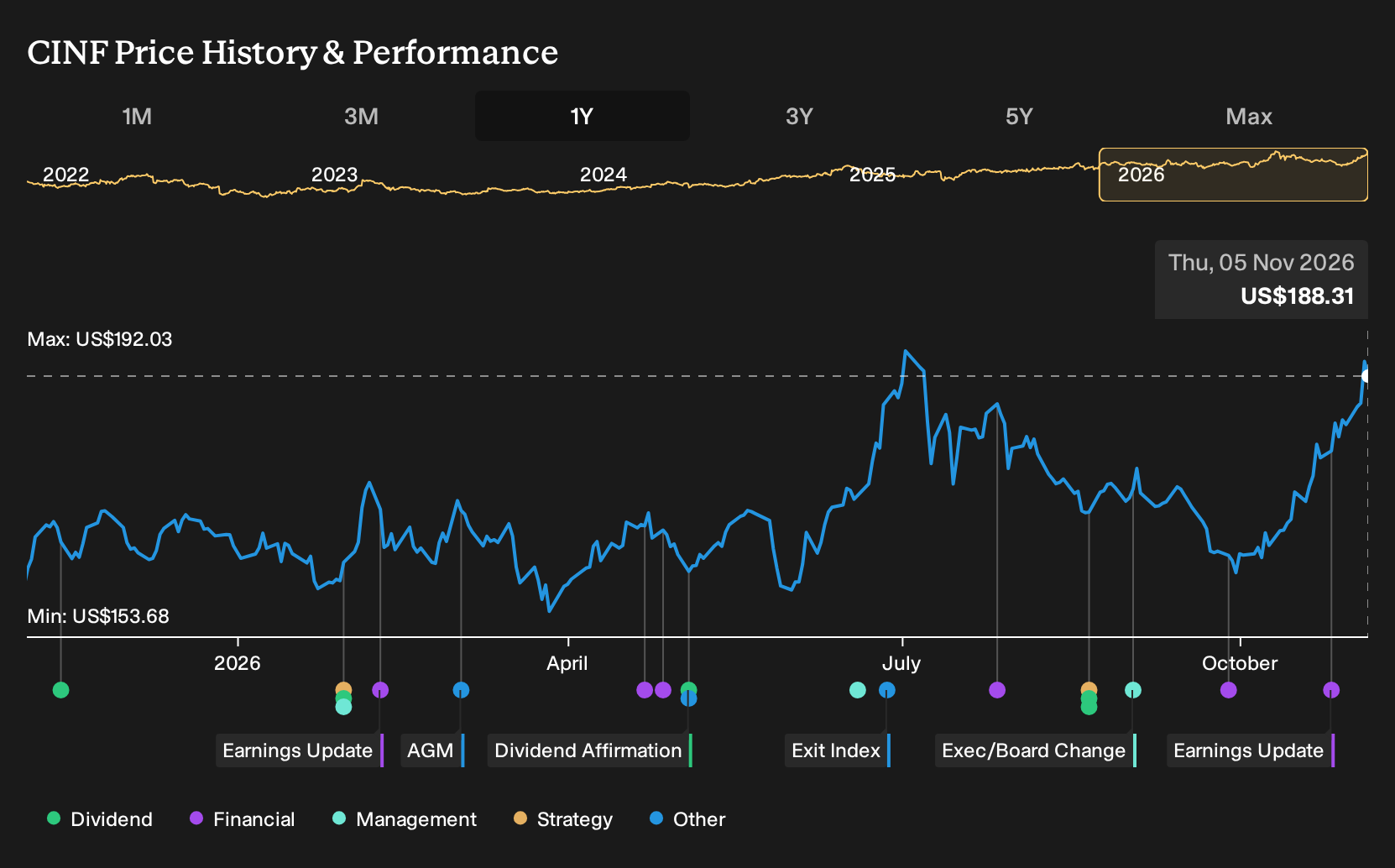
Uncover why Cincinnati Financial's fair value indicates that Cincinnati Financial is broadly in line with its current price.
Exploring Other Perspectives
Three fair value views from the Simply Wall St Community cluster between roughly US$155 and US$187, so you are seeing a tight band rather than extreme outliers. Those opinions do not reflect the latest earnings drop in the third quarter of 2026. New information on catastrophe losses and underwriting expenses could shift how Cincinnati Financial is assessed, so it is worth scanning several viewpoints before forming your own stance.
Explore 2 other Cincinnati Financial fair value estimates, including one that suggests as much as 18% downside from the current price.
The Verdict Is Yours
Disagree with existing narratives? Extraordinary investment returns rarely come from following the herd, so go with your instincts.
- A great starting point for your Cincinnati Financial research is our analysis highlighting 3 key rewards and 1 important warning sign that could impact your investment decision.
- See our latest analysis for Cincinnati Financial. The report includes a comprehensive fundamental analysis summarized in a single visual, the Snowflake, making it easy to evaluate Cincinnati Financial's overall financial health at a glance.
Looking For More Ideas Beyond Cincinnati Financial?
If this earnings story has you rethinking concentration risk, it can help to widen the lens and line Cincinnati Financial up against other opportunities with different strengths and payout profiles.
- For investors who want income to play a central role in returns, start with a curated group of higher yielding payers through 6 dividend fortresses that have already cleared a basic financial health screen.
- If balance sheet strength matters most to you when results get choppy, compare Cincinnati Financial with a broader list of solid balance sheet and fundamentals (24 results) that focuses on companies carrying less financial strain.
- Prefer hunting for less crowded situations, where attention has not fully caught up with the numbers? Then scan a 21 high quality undiscovered gems that filters for quality fundamentals away from the usual watchlists.
Have feedback on this article? Concerned about the content? Get in touch with us directly. Alternatively, email editorial-team@simplywallst.com