


EN
Did Earnings Beat Just Shift ResMed's (RMD) Investment Narrative?
- ResMed reported first quarter sales of US$1,414.81 million and net income of US$418.41 million, along with basic earnings per share from continuing operations of US$2.93. The company also declared a US$0.66 ordinary dividend per share payable on December 17, 2026, to holders on record as of November 12.
- The combination of higher revenue and earnings per share, together with a cash dividend, highlights how ResMed is currently funding both shareholder returns and ongoing investment in its sleep and respiratory care platform.
- We will now look at how this earnings and dividend news might reshape ResMed's investment narrative related to sleep apnea demand.
Scan how ResMed's latest earnings and dividend update compares with other income focused opportunities by reviewing the hand picked 6 dividend fortresses in the market right now.
ResMed Investment Narrative Recap
To own ResMed you need to believe its sleep and breathing health platform remains central to treating conditions like sleep apnea, even as weight loss drugs change how some patients are managed. The latest quarter, with US$1,414.81 million in sales and US$418.41 million in net income, signals an operating base that still supports that thesis.
The more immediate swing factor is how quickly ResMed can offset headwinds from Astral ventilator corrective actions and input cost inflation through productivity gains and its connected device ecosystem. The declared US$0.66 dividend does not materially shift those near term catalysts or the key risk around execution on remediation.
The most relevant update here is the first quarter earnings report. Revenue of US$1,414.81 million and basic EPS of US$2.93 from continuing operations are being assessed against expectations that earnings can grow over time and that supply chain initiatives can support margins. For readers, this report offers a clearer view of how the core sleep and breathing health segment is tracking after the MatrixCare sale.
That quarterly snapshot also shapes how you might think about ResMed’s catalysts. Connected devices such as AirSense 11 and the wider digital health suite are intended to support adherence and recurring mask and resupply revenue. These factors may be more significant if Astral related revenue faces a drag in FY2027. The earnings outcome provides new data on whether those initiatives are beginning to offset known pressures.
What Analysts Are Building Into The ResMed Story
ResMed is not just reporting a strong recent quarter. Analysts are also sketching out what the next few years might look like for the sleep and breathing specialist and then asking whether the current price lines up with those expectations.
On the top line, the current consensus assumes ResMed can lift revenue by 5.4% each year over the next three years. That kind of mid single digit annual clip would be doing a lot of the heavy lifting behind the long term sleep apnea and respiratory care narrative you see in recent broker reports.
Earnings are where the forecasts get more specific. Analyst models currently point to profit of about US$1.6b today and a move to US$2.0b by around 2029. That is an increase of roughly US$400m in annual earnings, with the more optimistic forecasts looking for as much as US$2.2b if things break in ResMed's favor on margins and device uptake.
Alongside that earnings step up, margins are assumed to improve from 27.8% now to 29.7% in three years. That margin uplift is closely tied to the idea that ResMed can keep supply chain savings, pricing, and connected device economics working in its favor, despite Astral remediation costs and component inflation.
ResMed's narrative projects US$6.7b revenue and US$2.0b earnings by 2029. This requires 5.4% yearly revenue growth and an earnings increase of about US$400m from US$1.6b today.
Those earnings forecasts then feed directly into how brokers think about valuation. For investors to agree with the current consensus price target of US$265.11, you would need to be comfortable with ResMed trading on a P/E of 20.8x those 2029 earnings. This is slightly lower than the current multiple of 21.2x being implied today for the stock.
Analysts also highlight that their implied 2029 P/E sits below the current 23.9x level quoted for the wider AU medical equipment group. That gap effectively builds a margin of safety into their models if the sector keeps its present rating and ResMed just converges toward it over time rather than pushing to a premium.
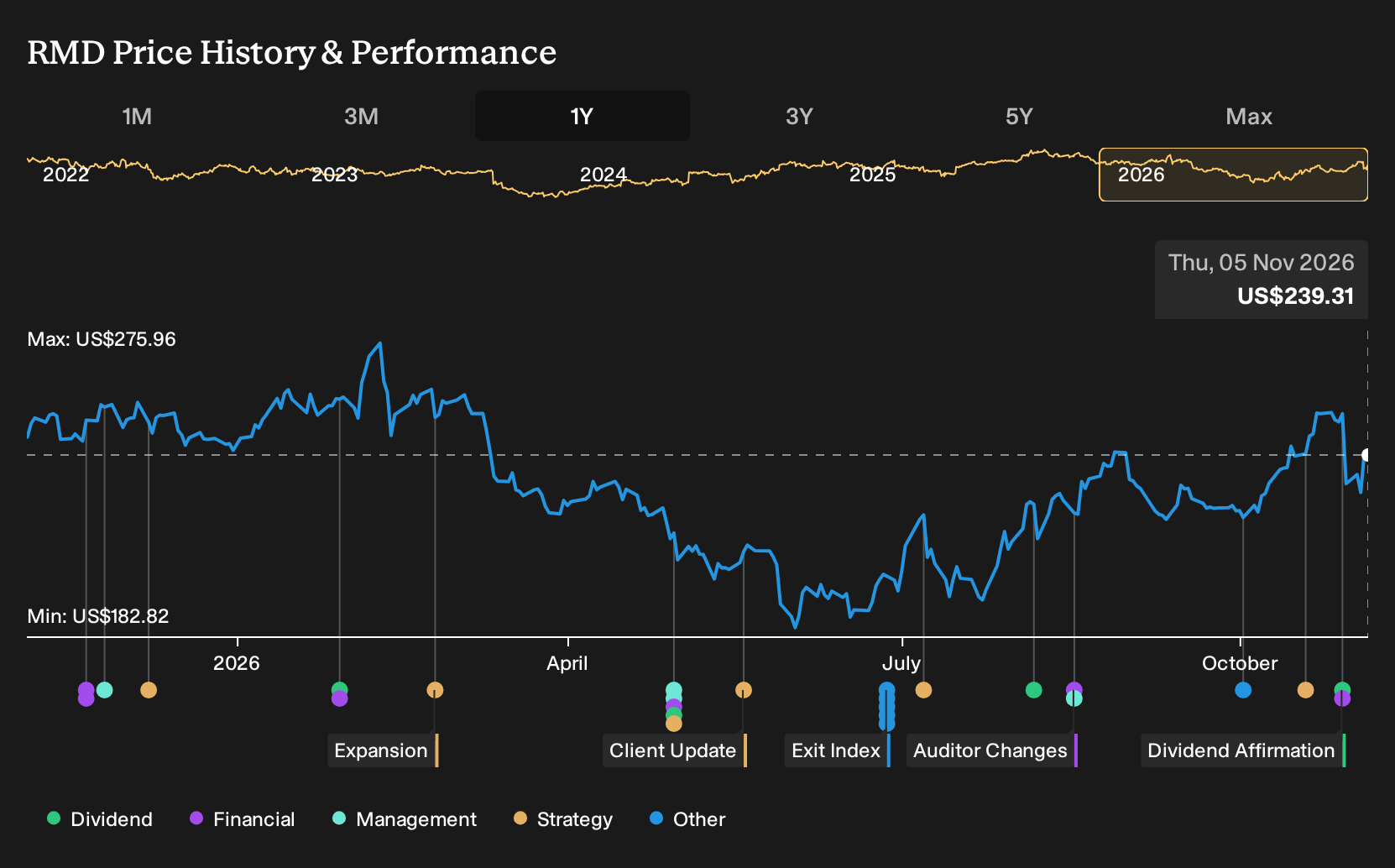
Price targets themselves span a wide range. The most optimistic analysts are at US$320.0, while the most cautious sit at US$210.0. Compared with the recent share price of US$240.51, the consensus target of US$265.11 implies a 9.3% difference that you can treat as a quick sense check against your own expectations.
ResMed's share count assumptions also matter, because they shape how that US$2.0b in forecast earnings translates into earnings per share. The current models bake in a 3.64% annual decline in shares outstanding over the next three years, which points to ongoing buybacks or lower equity issuance as part of the capital allocation mix.
Discount rates are another key input that can be easy to overlook. The Simply Wall St report uses a 7.52% rate to bring future cash flows and earnings back to today's terms, while the valuation summary references a 7.5% discount rate in its fair value scenario. Small tweaks to that number can move fair value estimates, so it is worth checking whether you would use something similar for ResMed given your own view of its risk profile.
All of these moving parts, from the projected P/E and margin uplift to the expected buyback driven share reduction, give you a framework rather than a verdict. The useful step as a reader is to plug in your own assumptions on GLP 1 adoption, Astral remediation timing, and connected device uptake, then see how far your version of ResMed's sleep apnea story sits from the consensus path sketched out here.
Uncover why ResMed's fair value indicates an 11% potential upside to its current price before that discount narrows.
Exploring Other Perspectives
One tension point that really splits opinion is GLP‑1 driven weight loss and what it could mean for long term CPAP demand at ResMed. The most cautious analysts were only pencilling in 3.2% yearly revenue growth and about US$1.8b earnings by 2029 before this dividend and earnings update, so their story is far more restrained than the consensus. Use that spread in expectations as a prompt to test several viewpoints against your own read of the new numbers.
Explore 5 other ResMed fair value estimates, including one that suggests as much as 6% downside from the current price.
The Verdict Is Yours
Don't just follow the ticker. Dig into the data and build a conviction that's truly your own.
- A great starting point for your ResMed research is our analysis highlighting 4 key rewards that could impact your investment decision.
- See our latest analysis for ResMed. The report includes a comprehensive fundamental analysis summarized in a single visual, the Snowflake, making it easy to evaluate ResMed's overall financial health at a glance.
Looking For More Investment Ideas Beyond ResMed?
Once you have a view on ResMed, it can help to compare that thesis with other listed businesses that share similar traits in quality, income, or balance sheet strength. The Simply Wall St Screener lets you quickly filter for those kinds of profiles so you can pressure test your ResMed conclusions against a broader opportunity set.
- For investors who want income with fewer surprises, consider reviewing a curated 32 resilient stocks with low risk scores that may offer steadier return potential.
- If capital preservation and financial resilience sit at the top of your checklist, scan a list of solid balance sheet and fundamentals (25 results) that can serve as a starting universe for further work.
- When you want to widen the search beyond well known tickers, use a 21 high quality undiscovered gems that surfaces companies with strong fundamentals that may not yet be widely followed.
Have feedback on this article? Concerned about the content? Get in touch with us directly. Alternatively, email editorial-team@simplywallst.com