


EN
Capital Plan Expansion Might Change The Case For Investing In Fortis Stock (TSX:FTS)
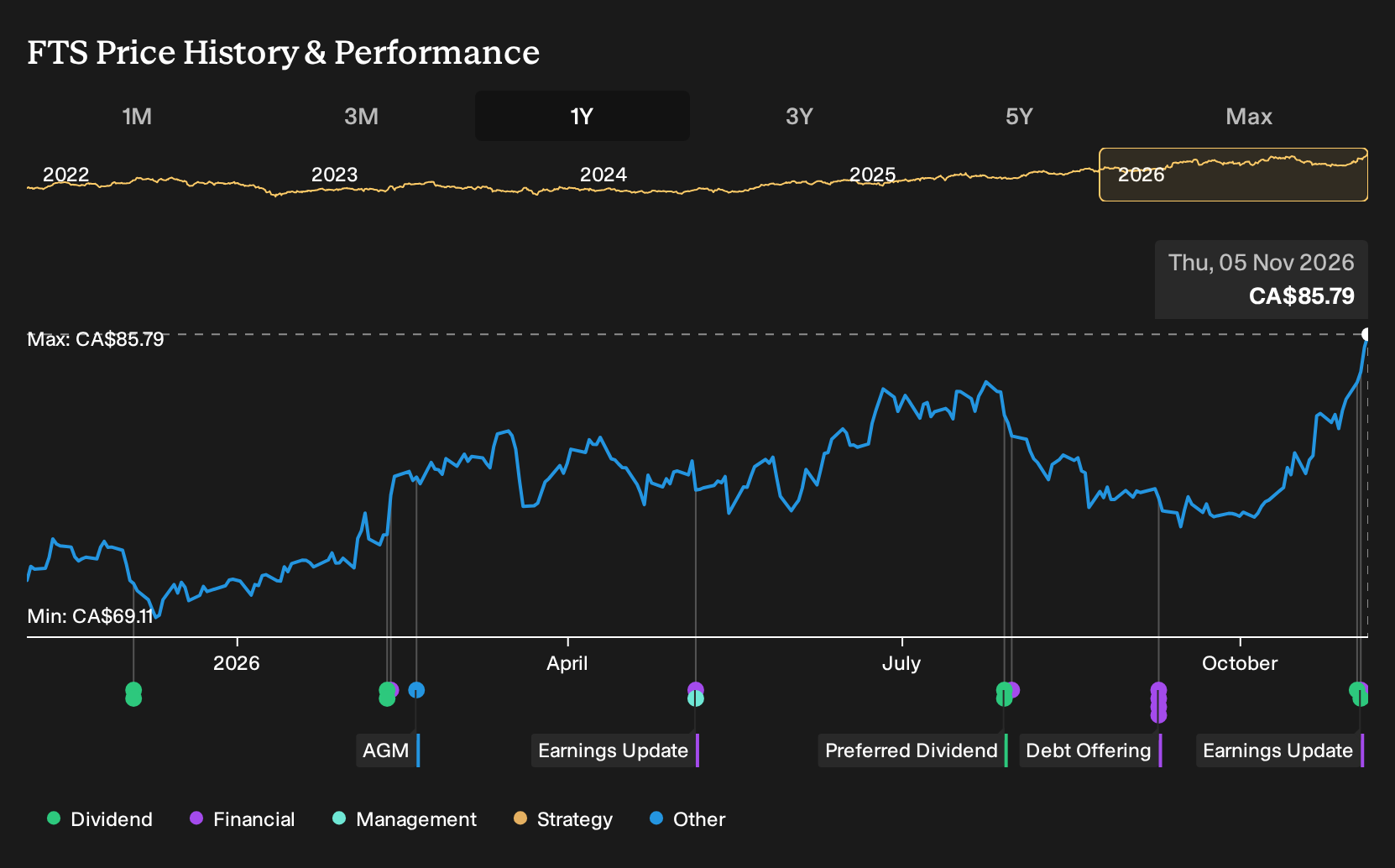
- Fortis reported past Q3 2026 sales of C$3,115 million and net income of C$496 million, alongside Q3 EPS of C$0.92 from continuing operations and a 4% increase in the quarterly common dividend to C$0.665 per share.
- The new C$32.2b fully regulated capital plan, centered on transmission, distribution and LNG infrastructure, extends Fortis’s dividend growth guidance through 2031 and highlights management’s focus on long term regulated asset expansion and funding discipline.
- This article examines how Fortis’s existing investment narrative is affected by the record C$32.2b regulated capital plan that has just been announced.
Fortis Investment Narrative Recap
For an investor in Fortis, the core belief is that a largely regulated utility can keep adding rate base through long life projects while holding its financial profile together. The third quarter results, with C$3,115 million of sales and C$496 million of net income, show that current operations are supporting this build out. The short term hinge point still sits with execution on existing projects and timely regulatory decisions, especially at UNS Energy.
The biggest operational risk right now is that heavy capital spending, paired with interest costs that already strain earnings coverage, makes funding the larger C$32.2b plan more demanding. Fortis expects to lean on operating cash flow, fresh utility debt and some equity, so any delay in adding projects to rate base could magnify that pressure.
The most relevant update for that story is the C$32.2b fully regulated capital plan. Management has framed it around transmission, distribution and LNG, which ties directly into the expected 7.5% rate base growth through 2031 and underpins the extended 4% to 6% annual dividend growth guidance. The scale of this program is also the main operational catalyst, because it drives future regulated earnings if delivered as outlined.
This same announcement concentrates the key risks. Funding such a large build with operating cash flow, regulated debt and some new equity leaves less room for cost overruns or regulatory lag, especially at ITC, UNS and FortisBC where many of the projects sit. For a shareholder, the practical question is whether Fortis can keep projects on budget and on time so that the balance sheet does not carry the strain for too long before earning a return.
What The Fortis Forecasts Are Asking You To Believe
Fortis' narrative implies that by 2029 the business reaches about C$14.8b of revenue and C$2.3b of earnings. That path is built on analysts assuming 6.2% yearly revenue growth and an earnings increase of roughly C$600m from about C$1.7b today.
Uncover why Fortis' fair value indicates a 6% potential downside to its current price. This valuation premium leaves little room for error.
Exploring Other Perspectives
Three fair value estimates from the Simply Wall St Community span roughly C$81 to C$152 per share, which shows how far apart private investors can be on Fortis. Some focus on the enlarged C$32.2b capital plan and data center and LNG opportunities, while others keep regulatory lag and higher debt costs front of mind. Use that spread as a prompt to explore several alternative viewpoints before deciding how Fortis fits your own expectations.
Explore 2 other Fortis fair value estimates, including one that suggests up to 77% potential upside from the current price.
Reach Your Own Conclusion
Disagree with existing narratives? Extraordinary investment returns rarely come from following the herd, so go with your instincts.
- A great starting point for your Fortis research is our analysis highlighting 3 key rewards and 2 important warning signs that could impact your investment decision.
- See our latest analysis for Fortis. The report includes a comprehensive fundamental analysis summarized in a single visual, the Snowflake, making it easy to evaluate Fortis' overall financial health at a glance.
Looking For More Ideas Beyond Fortis?
Once you have formed a view on Fortis, it can help to compare that thesis with other listed utilities, income names and lower risk opportunities. The Simply Wall St screener gives you a structured way to find companies that line up with your own preferences on dividends, balance sheet strength or valuation.
- If income is your focus, scan for companies that combine higher yields with resilient fundamentals using our curated set of 3 dividend fortresses.
- If capital preservation matters more to you, filter for historically steadier businesses with fewer red flags by working through the 8 resilient stocks with low risk scores.
- If you want to hunt for mispriced opportunities backed by solid data, start with the 6 high quality undervalued stocks and see which candidates deserve a closer look.
Have feedback on this article? Concerned about the content? Get in touch with us directly. Alternatively, email editorial-team@simplywallst.com