


EN
How Third Quarter Earnings Will Impact American Assets Trust Stock
- American Assets Trust reported third quarter 2026 revenue of US$114.28 million and net income of US$7.73 million, alongside a US$0.34 per share cash dividend for the fourth quarter, now scheduled for payment on December 17, 2026.
- The combination of higher quarterly earnings per share from continuing operations at US$0.13 and a maintained cash dividend illustrates how American Assets Trust is balancing current income for shareholders with its operating performance through 2026.
- The following section considers how American Assets Trust's investment narrative is affected by the stronger quarterly earnings per share just reported.
Scan beyond American Assets Trust's latest earnings and dividend mix by comparing it with 6 dividend fortresses, which may offer income potential along with financial resilience.
American Assets Trust Investment Narrative Recap
To stay invested in American Assets Trust, you need to be comfortable with a simple trade off. The portfolio is built around coastal office, retail, multifamily and mixed use assets that can support relatively steady rental income, while the main upside hinges on leasing up projects like La Jolla Commons Tower 3, One Beach Street and the Bellevue offices. The latest quarter shows higher revenue and quarterly earnings per share from continuing operations, which supports that thesis but does not fully settle it.
The short term catalyst still sits in turning signed and yet to commence leases into occupancy and cash flow that helps fund leasing capital, interest costs and the dividend. Net income for the nine month period is well below the prior year, and profit margins have compressed, so the biggest current risk remains balance sheet pressure. Elevated leverage and interest coverage make any setback in leasing or NOI more visible in earnings.
The most relevant fresh signal is the third quarter 2026 earnings print itself. Revenue reached US$114.28 million for the quarter with net income of US$7.73 million, and basic earnings per share from continuing operations moved to US$0.13 from US$0.07 a year earlier. For anyone tracking American Assets Trust, that is where you see whether the office and mixed use leasing pipeline is starting to show up in reported numbers.
Looking over nine months, the picture is more mixed. Revenue of US$334.36 million is modestly above the prior year, but net income of US$18.04 million is well below US$52.5 million, and earnings per share from continuing operations are lower. When you line that up against catalysts like the La Jolla Commons and Bellevue lease up and very high retail occupancy, it underlines how important execution on future rent commencements, cost control and interest expense management will be for the story from here.
What The Analyst Forecasts Assume For American Assets Trust
Analyst models around American Assets Trust are fairly explicit about what has to line up for the current narrative to hold. Revenue is assumed to increase by 2.4% each year over the next three years, with profit margins moving from 4.1% today to 8.0% on roughly the same timetable. On that footing, consensus forecasts point to earnings of US$37.6 million by about 2029, compared with earnings today of about US$18.0 million, which is roughly a 2.1x step up. That profile translates into an earnings per share figure of US$0.42 in 2029, while some analysts on the more optimistic end of the range are penciling in up to US$43.3 million of profit if leasing and occupancy fall into place faster than the base case.
On the revenue side, the same models imply American Assets Trust could be doing about US$467.3 million of annual turnover by 2029. That figure is consistent with the mid single digit top line lift implied by the current run rate and the 2.4% yearly growth assumption referenced in the research. Forecasts also layer in a small 0.41% annual increase in the share count over the next three years as equity based compensation and potential small issuances come through. This means per share progress leans on both margin repair and modest sales expansion rather than heavy financial engineering.
Putting the earnings bridge in context helps you see where the moving parts sit. Today, earnings of roughly US$18.0 million are paired with a high multiple and compressed margin structure. By 2029, the consensus line has that scaling to US$37.6 million on an 8.0% margin, with the gap between the two periods explained by lease commencements, cost discipline and interest expense management. That is a sizeable dollar uplift, but the path relies on American Assets Trust converting its current pipeline of signed and targeted leases into durable cash generation that can actually show up in the income statement.
Valuation work in the research wraps these assumptions into a single anchor point. Analysts cluster around a US$23.50 price target, using an 8.1% discount rate and a 2029 P/E of 49.1x on those US$37.6 million of earnings. That prospective multiple is lower than the current P/E of 73.7x, but still well above the 24.7x level cited for the broader US REITs group. In plain terms, the scenario assumes American Assets Trust remains on a premium footing relative to peers while margins and earnings roughly double from where they are reported today.
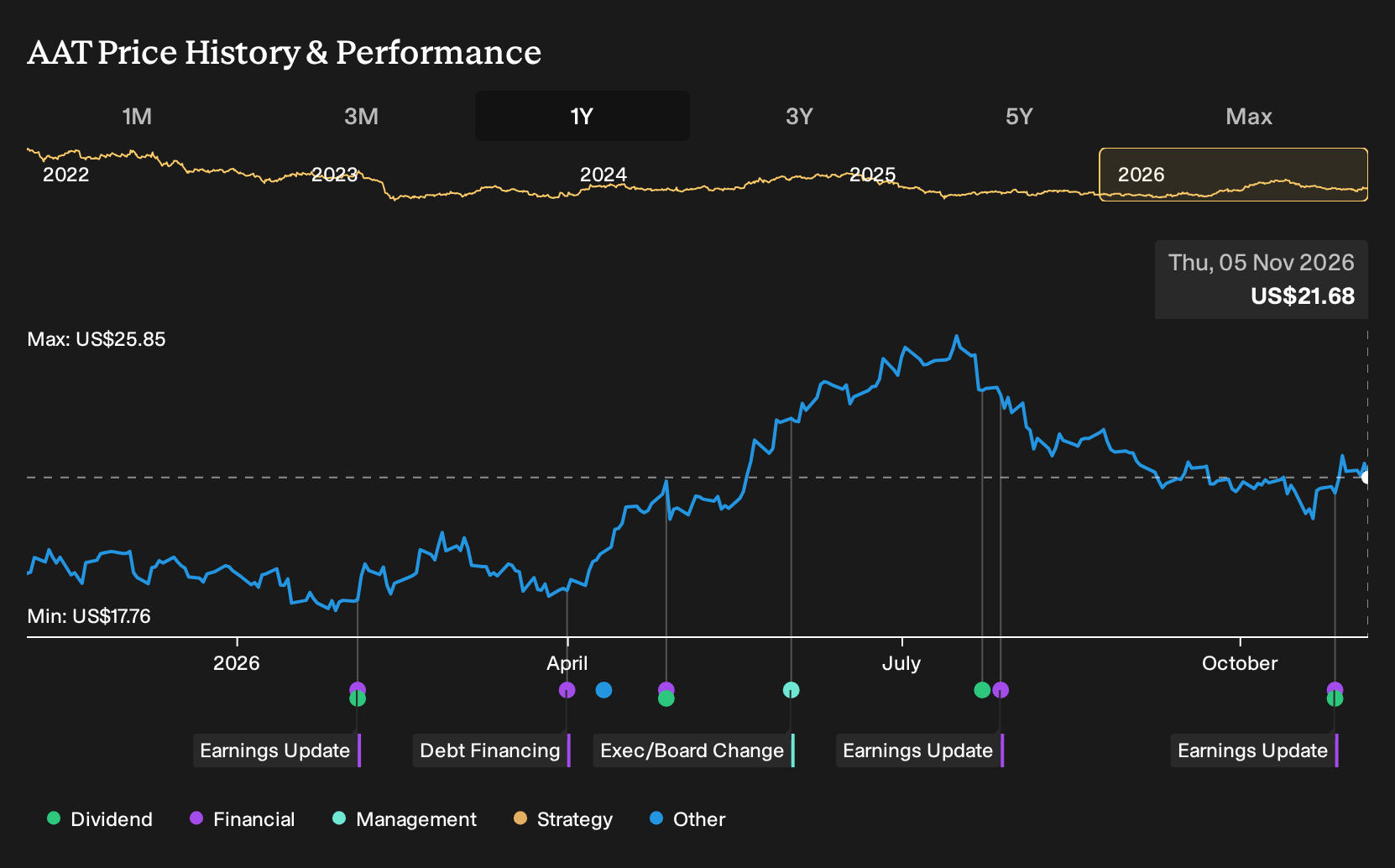
The spread between the current share price of US$21.55 and the US$23.50 consensus target sits at about 8.3%. That is not a huge gap, which suggests the market price already reflects a chunk of the optimistic case built into the models, including higher occupancy at La Jolla Commons Tower 3 and the Bellevue assets, as well as steady performance from the retail and multifamily segments. For a reader weighing the story, that limited upside buffer makes the quality of the underlying assumptions around revenue growth, margin expansion and financing costs especially important.
American Assets Trust's narrative projects US$467.3 million revenue and US$37.6 million earnings by 2029. This rests on 2.4% yearly revenue growth and an earnings increase of about US$19.6 million from current earnings of about US$18.0 million.
Discover how American Assets Trust's fair value indicates an 8% potential upside to its current price that may not last much longer.
Exploring Other Perspectives
For a different angle on American Assets Trust, focus on the risk around the US$0.34 dividend. The most optimistic analysts were already working with payout ratios near the upper 90% range and earnings forecasts up to US$44.8 million of profit by 2029, versus about US$28.9 million on the bearish side. Those projections were set before this latest earnings and dividend announcement, so some analysts may revisit their payout and earnings stories as fresh numbers filter through. Use that spread in opinions as a prompt to compare a few viewpoints before deciding how this dividend profile fits your own income expectations.
The Verdict Is Yours
Disagree with existing narratives? Extraordinary investment returns rarely come from following the herd, so consider forming your own view based on thorough research.
- A great starting point for your American Assets Trust research is our analysis highlighting 2 key rewards and 3 important warning signs that could impact your investment decision.
- See our latest analysis for American Assets Trust. The report includes a comprehensive fundamental analysis summarized in a single visual, the Snowflake, making it easy to evaluate American Assets Trust's overall financial health at a glance.
Looking For More Investment Ideas Beyond American Assets Trust?
If American Assets Trust has sharpened your focus on income, valuation and balance sheet strength, it can be useful to widen the lens and compare it with other businesses using the Simply Wall St Screener.
- For investors who want potential mispricing with solid fundamentals, scan through 42 high quality undervalued stocks that combine quality metrics with attractive valuations.
- If resilience matters more than excitement, filter for 32 resilient stocks with low risk scores that score well on financial strength and earnings stability.
- Those hunting for fresh ideas with cleaner accounts can review a list of solid balance sheet and fundamentals (25 results) to see which companies pair manageable debt with consistent cash generation.
Have feedback on this article? Concerned about the content? Get in touch with us directly. Alternatively, email editorial-team@simplywallst.com