


EN
Should You Buy Sandisk Before Its 8-for-1 Stock Split on Nov. 19?
Key Points
Sandisk's growth has boomed over the past year.
Sandisk is repurchasing shares to make some of its gains permanent.
Sandisk (NASDAQ: SNDK) announced huge news with its latest quarterly results: It will be enacting an 8-for-1 stock split on Nov. 19. This shouldn't come as a huge surprise, as Sandisk's stock trades at over $1,000 per share.
But is this a good enough reason to buy the stock? After all, even after a big selloff, it has risen 240% this year. I think Sandisk stock is a strong buy here, but not because of a stock split.
Missed AI’s "Act 1"? Act 2 Could Be 15x Bigger. Most investors think they missed the AI boat because they didn't buy Nvidia in 2005. But according to our analysts, we’re only at the end of "Act 1"—the R&D phase. "Act 2" is the global rollout. Continue »
Image source: The Motley Fool.
Stock splits are cosmetic
Stock splits really don't do anything to the underlying business. When a company is public, ownership of the company is sliced into several small pieces. A stock split just makes these slices even smaller. Years ago, when brokerages didn't have fractional shares, a $1,000-per-share stock may have been cost-prohibitive, as you would've needed $100,000 or more in an account just for a stock to make up a 1% position in the portfolio. However, many brokerages now offer fractional shares, so the actual stock price hardly matters.
But one area it does matter is the options market, as options strategies can get quite pricey when a stock is over $1,000 per share. This also helps Sandisk compensate its employees with stock options. Using company stock as a salary component can be a great driving factor for employees, so this might provide some performance boost.
But if you've followed Sandisk's business over the past year, it's clear it doesn't need much of a boost.
Sandisk's business is booming
Sandisk makes NAND memory, which is used for long-term data storage in devices like solid-state drives (SSDs). SSDs are in massive demand due to the AI build-out, and production capacity for these units has been reached. So, prices on these units have soared, which equates to straight profit for Sandisk because its input costs have remained steady.
During its first quarter of fiscal year 2027 (ending Oct. 2), Sandisk saw revenue soar 378% year over year to $11 billion, which was a 23% rise quarter over quarter. With Sandisk projecting $12.2 billion to $12.6 billion in revenue for Q2, that indicates a 13% quarter-over-quarter growth rate. This means that Sandisk's growth is cooling off, but a 13% quarter-over-quarter rate is still faster than many companies see on a yearly basis.
Still, the market doesn't respect Sandisk's strong results. It trades for 8.3 times trailing earnings and 4.5 times this year's estimates.
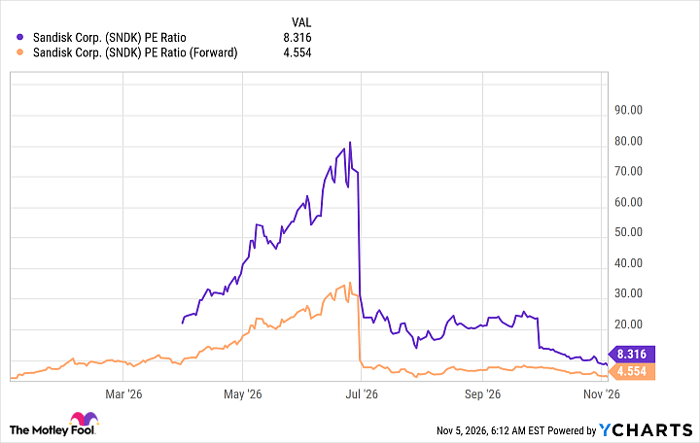
SNDK PE Ratio data by YCharts
For comparison, the S&P 500 (SNPINDEX: ^GSPC) trades for 24 times earnings and 19 times forward earnings. That's a huge discount, and it all has to do with the cyclical nature of the memory chip industry. Investors are concerned about a downturn eventually coming, which could harm Sandisk's business. This is a fair concern, but it may not happen for several more years due to the strength of the AI build-out.
As a result, management is doing the smart thing and repurchasing shares. Last quarter, it bought about 3.2 million shares. Considering the company only has 144 million shares outstanding, that's a healthy percentage of the company repurchased in just one quarter. This will boost earnings per share as the number of shares declines, and help sustain some of the gains Sandisk made during the AI boom when times aren't so great.
I think the AI build-out will last long enough to warrant buying Sandisk shares now, and it has nothing to do with the stock split. While this is a nice touch, the real reason to invest in Sandisk is the business, and it's doing great.
Keithen Drury has no position in any of the stocks mentioned. The Motley Fool has no position in any of the stocks mentioned. The Motley Fool has a disclosure policy.