


EN
The Bet Intel Holders Made
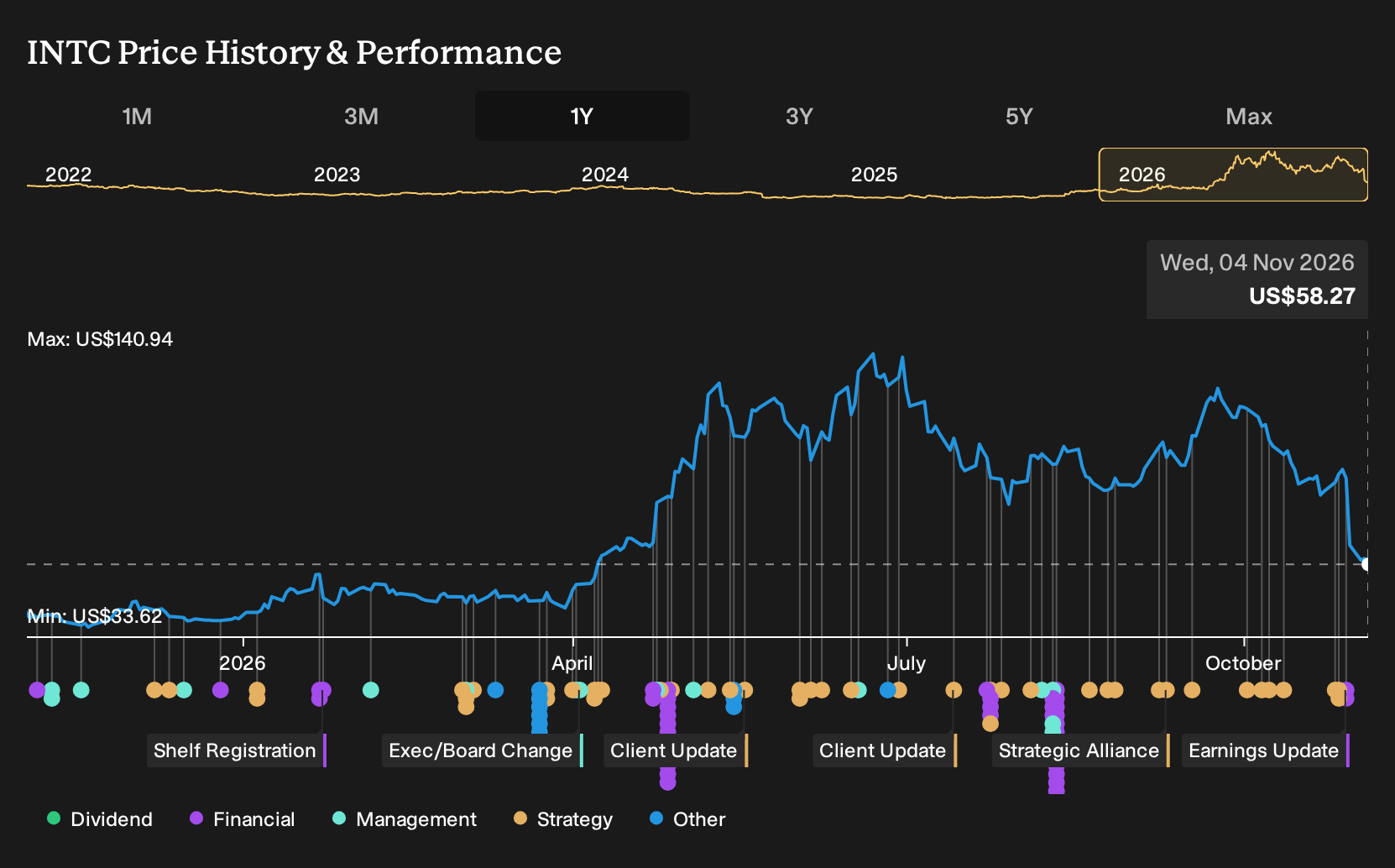
If you only skimmed headlines about Intel’s AI partnerships, the Google TPU order and the Apple foundry talks probably dominated your attention. Holding Intel over the past year would have returned 51.8%, including dividends. If you had been weighing a purchase back on 4 November 2025, you needed to judge whether an ambitious PC and data center roadmap, plus a slow, messy restructuring, could really justify that later payoff.
The move put Intel in the middle of this trade. Scan 53 AI infrastructure stocks for other companies exposed to it.
The Two Intel Stories Investors Had To Compare
The shares cost US$37.03 at the start of the period, and anyone looking at Intel then had to pick between two very different futures.
On the optimistic side, the roadmap thesis pointed to a Fair Value of US$79, a notional destination if a specific earnings path played out. That view leaned on assumptions like 10.0% revenue growth and a 22.0% profit margin within five years.
The more cautious restructuring story saw Fair Value at US$25.18, again only if its own forecasts proved right. That camp focused on execution risk, including whether Intel’s complex organization could actually simplify fast enough to reach a 7.8% profit margin.
What The Results Changed For The Intel Thesis
Intel’s AI driven contracts with Google, Tesla’s Terafab project and early Apple foundry talks all pointed toward the ambitious roadmap case. Reported figures told a tougher story. Revenue reached US$16,513m in Q3 2026 compared with US$13,653m in Q3 2025, yet net income excluding extra items fell and net margin moved from 29.8% to 20.1%. The evidence cut both ways.
The hinge assumption here was not just whether Intel could win AI and foundry work, but whether those wins would support higher profitability. When you assess another chip producer, track both the size of new contracts and the direction of net margin in the years that follow those announcements.
What Intel’s Current Price Already Assumes
Intel now trades at US$58.27. The selected Narrative’s Fair Value sits below that level, which signals a view that recent progress and AI enthusiasm already bake in more than enough optimism.
A buyer today effectively assumes Intel can rebuild manufacturing credibility and earn a durable AI role. How do the execution hurdles in the Narrative color that bet?
"Intel encountered significant manufacturing delays in years past, and there is no guarantee that it can execute well in its aggressive aspirations to develop five process nodes in four years. Even if Intel can regain manufacturing parity with TSMC, AMD now sits as a far more credible chip designer in the x86 space for PC and server CPUs."
One Narrative has put a figure on that disagreement. → See the Narrative with its lower Fair Value, assumptions and all
Find Your Own Contrarian Opportunity
What if your next investment idea came before the headlines? Go straight to the companies whose prices and our estimates still disagree. Three places to start, with the names waiting behind the link.
- Company 1 - 25% below our estimate - builds an AI stack that ties infrastructure, office software and coding tools together.
- Company 2 - 21% below our estimate - turns a copper-cable niche into an optical connectivity platform using silicon photonics.
- Company 3 - 31% below our estimate - expands device recommerce volumes as trade-in subsidies push more users to resell.
That is three of the list. See the full list of 35 companies trading below our fair value estimates →
Have feedback on this article? Concerned about the content? Get in touch with us directly. Alternatively, email editorial-team@simplywallst.com