


EN
Where Will Ethereum Be in 3 Years?
Key Points
Ethereum trades near half its 2021 peak despite years of institutional progress.
Stablecoins, tokenized funds, and AI agents could drive that more usage of the Ethereum network.
Developers plan to adopt quantum-resistant Ethereum signatures by 2028 or 2029.
I own some Ethereum (CRYPTO: ETH), so you know where my heart is. My head keeps staring at a five-year chart that starts around $4,500 and ends near $2,400. That's a long wait for a coin that was supposed to have changed everything by now.
Here's the thing, though. Ethereum isn't broken; it's just slow. Those are two different problems.
Missed AI’s "Act 1"? Act 2 Could Be 15x Bigger. Most investors think they missed the AI boat because they didn't buy Nvidia in 2005. But according to our analysts, we’re only at the end of "Act 1"—the R&D phase. "Act 2" is the global rollout. Continue »
Ethereum's long, slow road
Crypto has a reputation for speed, and the price charts certainly deliver. The plumbing doesn't. Ethereum's switch to a proof-of-stake architecture was discussed for years before it finally happened in 2022. Spot Ethereum ETFs showed up in 2024 after a long regulatory staring contest. The Clarity Act, which would finally settle who regulates what, just tripped and fell in the Senate. It gets a fresh start with a less crypto-friendly Democratic Congress in January. Nobody should hold their breath for that particular bill.
So what do three more years buy?
Not a halving, for starters. Bitcoin (CRYPTO: BTC) runs on a four-year clock, with the next halving of mining rewards due in 2028. Ethereum doesn't have one. It may follow Bitcoin's market-defining mood swings in the short run, but over the long haul, Ethereum's value comes down to whether people actually use it.
Boring is where the money hides
On that front, I like Ethereum's setup:
- Stablecoins. The GENIUS Act gave dollar-backed tokens a rulebook in 2025, and many of them live on Ethereum. Standard Chartered projects call for a $2 trillion stablecoin market by 2030. Boring? Sure. Boring is where the money hides.
- Tokenized funds. BlackRock put its tokenized Treasury fund on the Ethereum blockchain. Then again, Uber and HSBC just ran a tokenized fund trade on a private network called Canton. Wall Street doesn't owe Ethereum anything. It's still hard to bet against the sector's 800-pound gorilla.
- AI agents. Software that buys things on its own needs programmable money. As the first and leading smart contracts platform, Ethereum is the obvious candidate.
Ethereum's plan for the quantum threat
Then there's the quantum problem, the one that keeps me up at night (a little). A strong enough quantum computer could crack the cryptography protecting crypto wallets. Ethereum's developers plan to swap in quantum-resistant signatures by 2028 or 2029, as part of a roadmap that ships a major upgrade roughly every six months.
Bitcoin upgrades the code about as often as I replace my winter boots (and I live in Florida). Ethereum has a habit of rebuilding its engine while the car is running. That flexible approach could matter a lot.
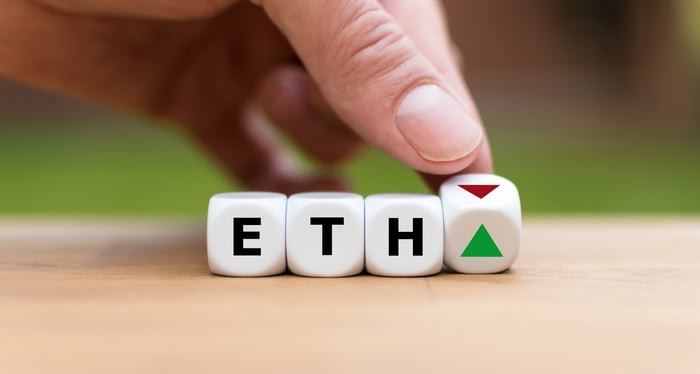
Image source: Getty Images.
My 3-year outlook for Ethereum
So here's my guess for late 2029: a faster, cheaper, quantum-hardened network sitting under far more stablecoin and tokenized-fund activity than today. If that usage shows up in the price, retaking the 2025 highs near $4,800 doesn't sound impossible; that's a double from here. If it doesn't, Ethereum could spend another three years repeating the same round trip.
I'm holding, but it will take a lot of coffee and self-reflection.
HSBC Holdings is an advertising partner of Motley Fool Money. Anders Bylund has positions in Bitcoin and Ethereum. The Motley Fool has positions in and recommends Bitcoin, BlackRock, and Ethereum. The Motley Fool recommends Uber Technologies. This disclosure statement is growing long. The Motley Fool has a disclosure policy.