


EN
Intel Is Getting Hammered on Wall Street. Now It’s Looking Beyond the Rivalry With AMD.
For years, AMD (AMD) has been the rival Intel (INTC) dared not ignore, steadily chipping away at its dominance in the CPU market. Now, in an unexpected twist, Intel may be looking to its longtime rival for cooperation.
INTC stock has plunged 42% over the last five days following a disappointing outlook, and CEO Lip-Bu Tan has hinted at potential cooperation with AMD CEO Lisa Su. After years of battling for CPU supremacy, the two chipmakers could be exploring common ground.
For Intel, the timing couldn't be more intriguing.
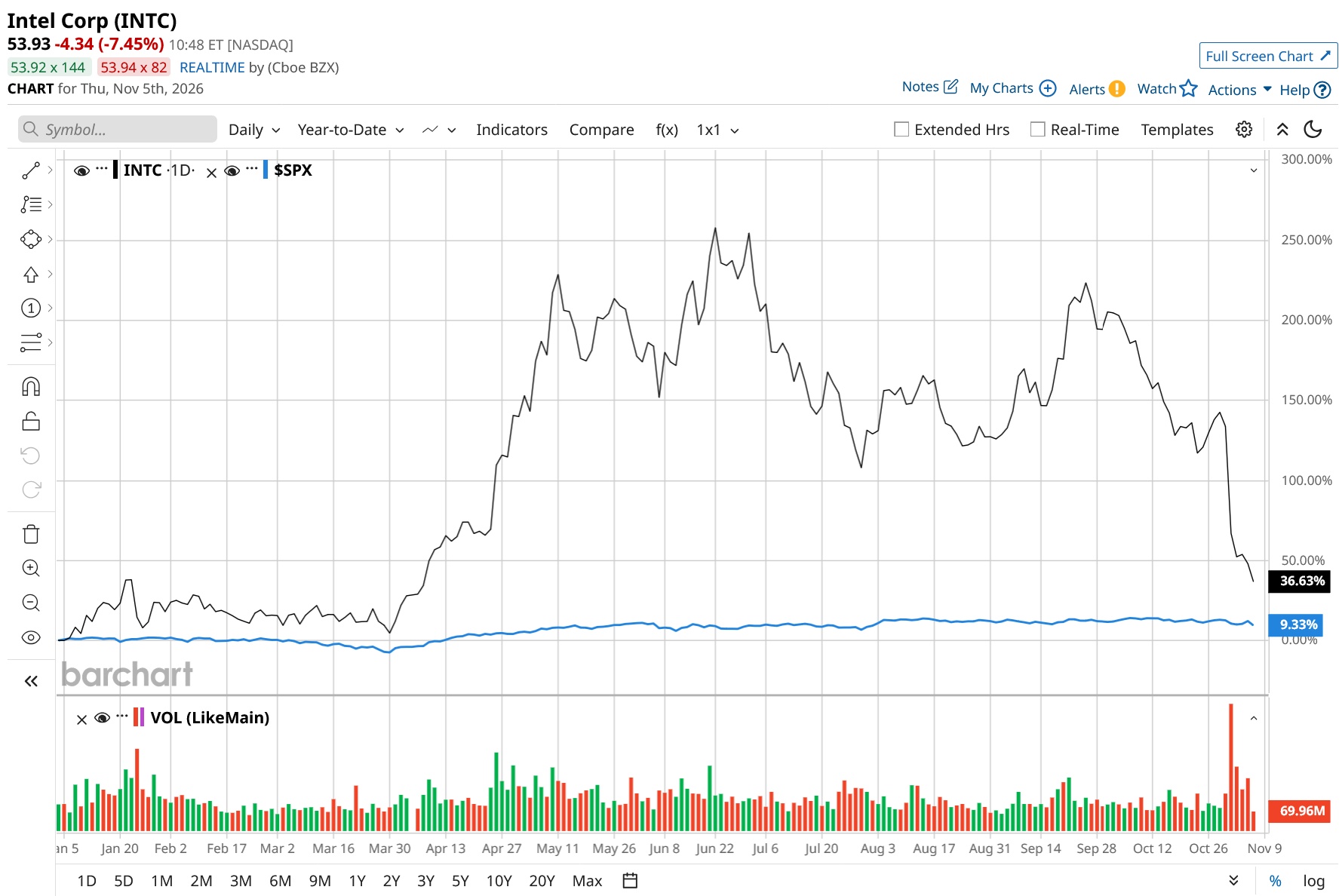
Intel Selloff Goes Beyond One Bad Forecast
Intel reported its third-quarter earnings on Oct. 29, following which the stock plunged 28.6%. The third-quarter results alone did not spark the selloff. In fact, revenue soared 21% year-over-year (YoY) to $16.5 billion, and adjusted earnings per share (EPS) reached $0.52, both surpassing what management and analysts had hoped for. On the Q3 earnings call, CFO David Zinsner proudly noted it was Intel’s eighth straight quarter of beating expectations. Yet even a stellar quarter could not outweigh a dimmer outlook, particularly when investors were hungry for signs that the recovery would accelerate.
The fourth quarter forecast is where confidence cracked. Intel expects revenue of $15 billion to $16 billion and adjusted EPS of $0.25. The midpoint, $15.5 billion, is well below the roughly $17 billion analysts expected. Intel also forecast a 38% adjusted gross margin, down from 44.1% in Q3. Data Center and AI stole the spotlight, bringing in $7.3 billion in revenue, a staggering leap of nearly 80% YoY and 17% sequentially. Demand for Xeon server processors is rising quickly as AI infrastructure grows, with CPUs handling more complex tasks. Management expects industry server CPU unit volumes to increase more than 30% in both 2026 and 2027.
Yet, this surging demand is not fully reflected in Intel’s revenue. Zinsner noted that server CPU demand is outpacing supply, prompting Intel to ramp up production both in-house and with external partners. Tight supplies of advanced packaging substrates add another layer of challenge. Meanwhile, a disruption at the Fab 28 facility in Israel is set to trim Q4 revenue by around $300 million and also affect gross margin. To add to the worries, the PC business is moving in the opposite direction. Client Computing Group revenue slipped 5% YoY to $8.1 billion, as Intel pointed to rising memory costs and shrinking IT budgets. Looking ahead, management predicts PC unit demand will tumble about 12% in 2026, with second-half volumes dropping more than 20%, and another 10% slide expected in 2027. This persistent weakness simply worsens the challenge of a true recovery.
Finally, investment is adding fuel to the fire. Intel is bracing for a massive $20 billion in capital expenditures in 2026, with even higher spending on the horizon for 2027. Zinsner revealed that equipment orders have surged nearly 40% quarter over quarter, and clean-room construction is picking up speed in Arizona and Ohio. He also warned that 2027 will likely be a year of heavy investment, with no positive free cash flow expected as Intel pushes forward with 18A and Intel 3 and gears up for 14A.
Why AMD Has Entered the Picture
In my previous article, I discussed how AMD surged ahead as the bold challenger in the CPU comeback story, snatching market share from Intel and strengthening its foothold in servers.
Against this backdrop, Tan’s remarks about AMD have drawn attention. At an Oct. 24 fireside chat with the Chinese American Semiconductor Professional Association, he said he spoke with AMD CEO Lisa Su about a possible collaboration. No specifics have been disclosed, and no official projects or agreements have been announced yet. According to Mercury Research data reported by Tom's Hardware, AMD captured 30.7% of x86 CPU shipments and 34.5% of server CPU shipments in Q2 2026. Intel still holds the lead, but AMD has become a strong competitor, making its potential cooperation with Intel all the more unexpected.
A foundry deal would be the most eye-catching possibility, but it remains speculation for now. Tan wants external foundry customers, alongside growth in custom processors and advanced packaging. Intel reported $6.7 billion in foundry revenue, yet only $411 million came from external sales, including a non-recurring program. The unit lost $1.9 billion. Tan claims multiple customers are eyeing Intel Foundry but didn’t name any. TechRadar says there is no evidence AMD is among the customers evaluating Intel’s process technology, let alone preparing to manufacture chips there.
The Key Takeaway for INTC Stock Investors
Investors crave more than just a robust server market or a headline-grabbing chat with AMD. Intel faces the challenge of turning pent-up demand into real shipments, stabilizing its PC business, navigating rising investments, and capturing significant foundry revenue. AMD may be a competitor, a collaborator on selected technologies, or eventually something in between. For now, these rumored talks add curiosity to the story but leave Intel’s financial outlook unchanged.
Intel still has to prove it can turn surging demand into lasting growth, healthier cash flow, and a thriving foundry business.
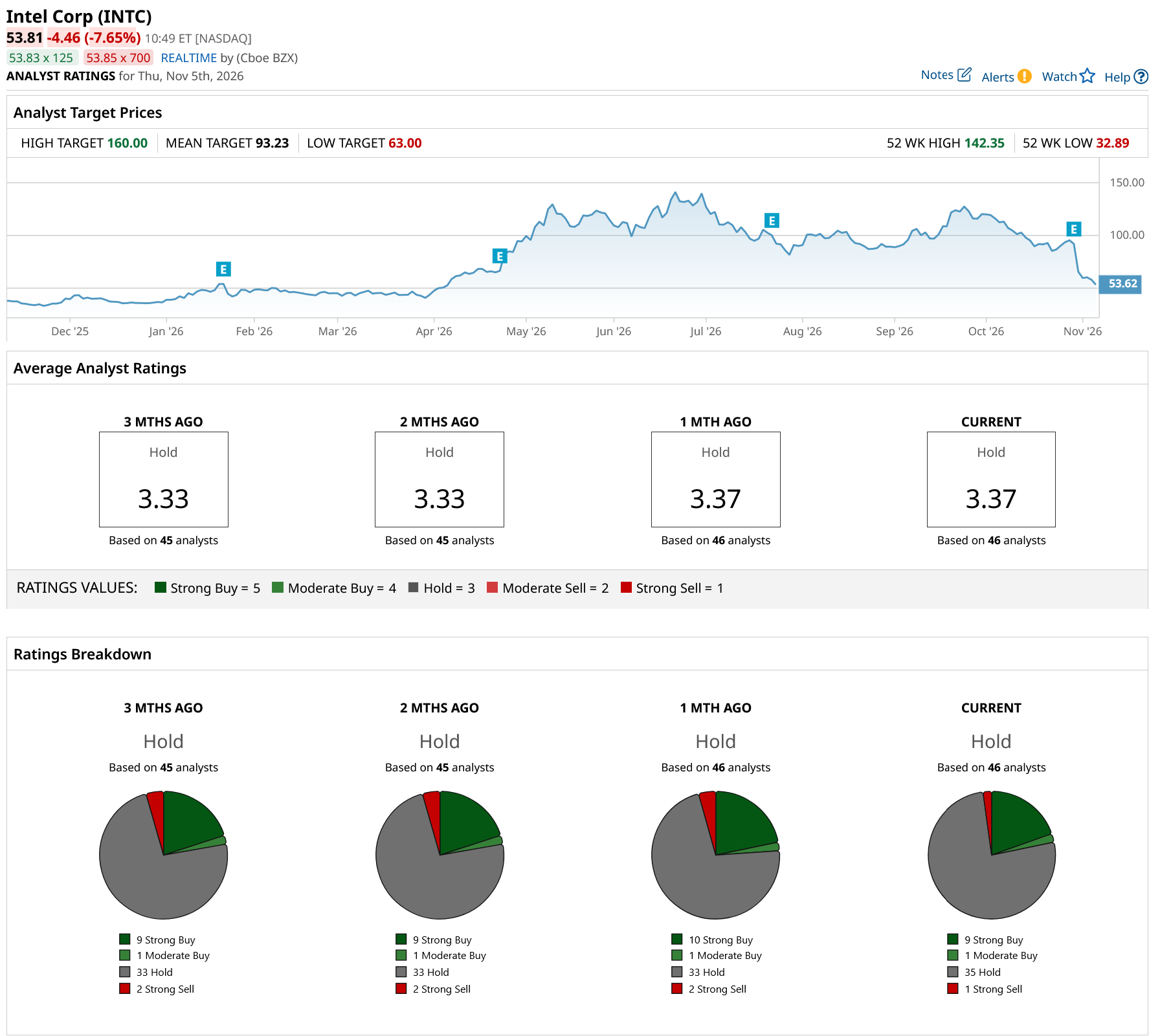
That’s likely why most Wall Street analysts rate INTC stock as a “Hold.” Of the 46 analysts covering the stock, nine have a “Strong Buy” rating, one recommends a “Moderate Buy,” 35 have a “Hold” rating, and one recommends a “Strong Sell.” The average price target of $93.23 suggests 73% potential upside from here, while the high estimate of $160 implies a 196% gain from current levels.
On the date of publication, Sushree Mohanty did not directly have a position in any of the securities mentioned in this article. All information and data in this article is solely for informational purposes. For more information please view the Barchart Disclosure Policy here.