


EN
Earnings Beat Could Be A Key Test For Arch Capital Group Stock
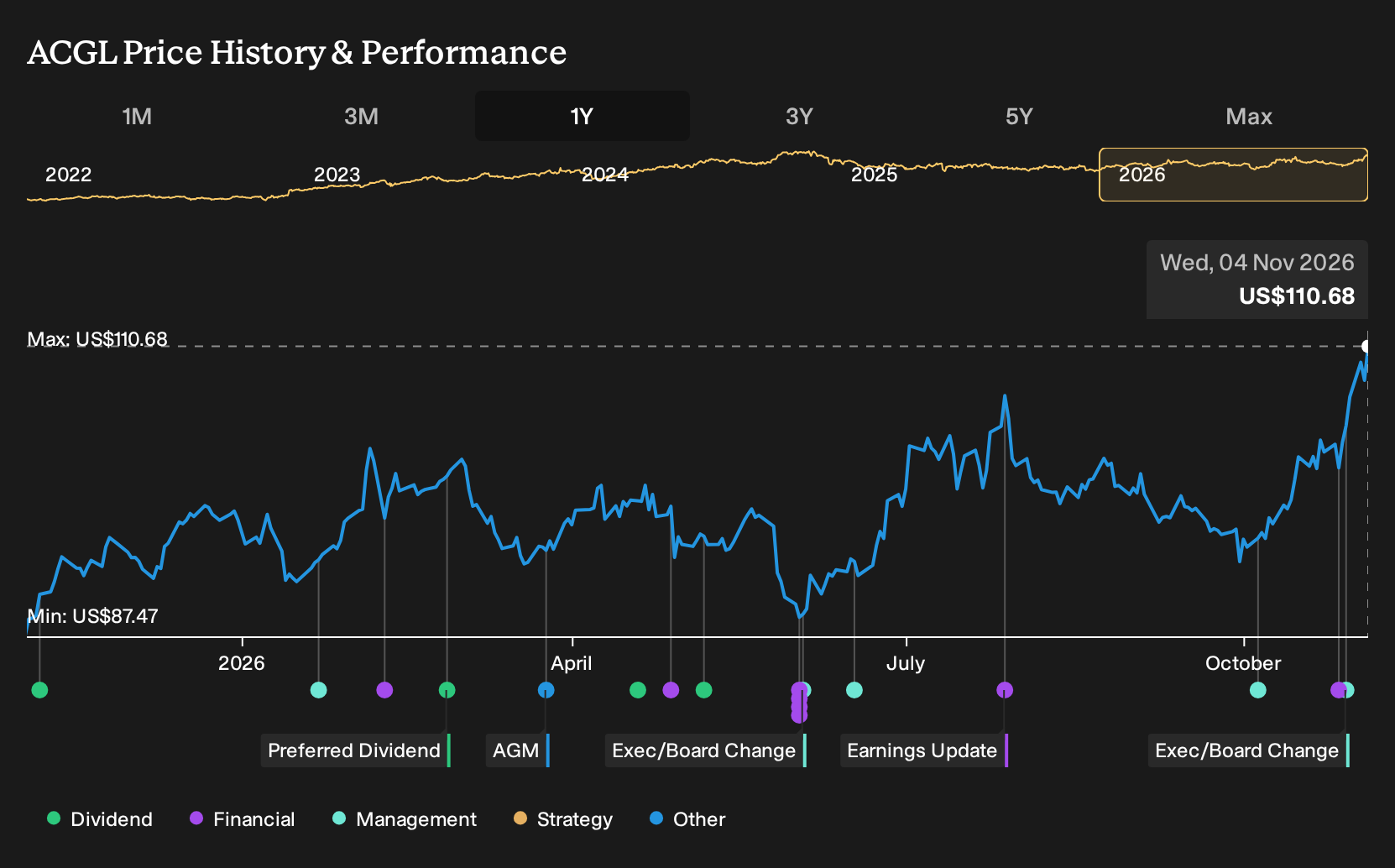
- Arch Capital Group reported third quarter 2026 revenue of US$4.655b and net income of US$1.035b, with earnings per share lower than a year earlier, while operating income per share exceeded prior consensus estimates.
- Pre tax net investment income rose to US$451 million for the quarter, which helped offset softer operating revenue and supported the earnings beat, as the board also disclosed the past resignation of director Moira Kilcoyne with no disagreement on company matters.
- This article will now explore how Arch Capital Group's investment narrative could be influenced by the contrast between the operating earnings beat and softer revenue.
Scan how Arch Capital Group's earnings beat on softer revenue compares with peers by reviewing the 31 resilient stocks with low risk scores that have resilient balance sheets and steadier profit profiles.
Arch Capital Group Investment Narrative Recap
Arch Capital Group appeals to investors who want an insurer focused on underwriting discipline, cycle management and capital efficiency rather than headline revenue growth. The recent quarter showed softer top line and lower net income than a year earlier, yet operating earnings per share and pre tax investment income were solid. For that thesis to hold, you need confidence that underwriting discipline and portfolio mix can offset pressure from softening property and casualty markets and slower mortgage origination.
The most important short term catalyst remains execution on cycle management, especially reallocating away from weaker property catastrophe business and keeping combined ratios tight. The biggest risk is another period of large catastrophe or man made losses on top of already softening pricing, which could pressure earnings and weaken the case that Arch Capital Group can keep margins resilient. The latest results and board update do not appear to change that risk reward balance in a material way.
The third quarter 2026 earnings announcement is the key event to focus on. Revenue for the quarter was US$4.655b versus US$5.109b a year earlier, and net income was US$1.035b versus US$1.350b. Yet operating income of US$2.67 per share exceeded prior external estimates, helped by pre tax net investment income of US$451 million. That combination matters because it highlights how underwriting plus investment returns are doing the heavy lifting while reported revenue trends are softer.
For you as a shareholder, the question is whether Arch Capital Group can keep leaning on its investment portfolio and underwriting discipline if analysts are right that earnings may decline on average over the next few years. The reported rise in pre tax net investment income, supported by a large investable asset base, feeds into that debate. It ties directly into catalysts like continued share repurchases, portfolio reweighting in reinsurance and ongoing use of data and AI, while still leaving you exposed to the core risks of catastrophe events, weaker pricing and pressure on mortgage insurance volumes.
What The Arch Capital Group Forecasts Assume
Arch Capital Group's longer term story hinges on what analysts think happens to revenue and earnings from here, and those expectations are not pointing to straight line growth. In the current set of assumptions, revenue is projected to decline by 7.8% each year over the next three years while profit margins are expected to move from 24.2% today to 21.0% by 2029. On the earnings side, the consensus points to US$3.2b of profit, or US$11.39 per share, by 2029 compared with US$4.7b today. That is a drop of about US$1.5b in earnings, even before considering that some analysts are more upbeat and see as much as US$3.8b by that same year.
Those earnings assumptions also build in a shrinking share count, with analysts expecting the number of shares on issue to fall by around 5.89% per year over the next three years. A lower share base can help earnings per share look healthier even if total profit moves the other way, so it is worth separating the two in your own worksheet. Analysts are effectively arguing that Arch Capital Group can use buybacks and capital management to support per share metrics while the overall profit pool and top line come under pressure. The P/E expectations make that clear, with the stock implied to trade on 12.3x the 2029 consensus earnings compared with 7.1x today and a current US insurance sector average of 11.1x.
Discount rates often get ignored in casual conversation, but they do a lot of work in this set of forecasts. The Simply Wall St report uses a 7.24% rate to translate future cash flows and profits back into a present value, while the fair value bridge that gets to the US$111.66 target price assumes a very similar 7.2%. Put simply, the whole model is built on three moving parts that you can stress test yourself: mid single digit annual revenue declines, earnings falling from US$4.7b to US$3.2b by 2029, and the market being willing to pay a higher multiple for those lower future profits.
Arch Capital Group's narrative projects US$15.1b revenue and US$3.2b earnings by 2029, based on current analyst estimates. This implies a 7.8% yearly revenue decline and an earnings decrease of about US$1.5b from US$4.7b today.
Uncover why Arch Capital Group's fair value is essentially aligned with its current price.
Exploring Other Perspectives
Two fair value estimates from the Simply Wall St Community span roughly US$112 to US$232 per share, which shows how far apart views on Arch Capital Group can be. Those opinions were formed before the latest earnings beat on operating income and the board change, so use them as a starting point and compare with your own read on catastrophe risk, softening insurance markets and mortgage demand. Different investors can see the same numbers very differently, so explore several viewpoints before deciding where you stand.
Explore another Arch Capital Group fair value estimate, including one that suggests it could be worth just $111.66.
Decide For Yourself
Don't just follow the ticker; dig into the data and build a conviction that's truly your own.
- A great starting point for your Arch Capital Group research is our analysis highlighting 3 key rewards and 1 important warning sign that could impact your investment decision.
- See our latest analysis for Arch Capital Group. The report includes a comprehensive fundamental analysis summarized in a single visual, the Snowflake, making it easy to evaluate Arch Capital Group's overall financial health at a glance.
Looking For More Investment Ideas Beyond Arch Capital Group?
If the Arch Capital Group story has sharpened your thinking about risk, return and balance sheet strength, you can use that same lens across a wider watchlist with the Simply Wall St Screener.
- For investors who want quality at a discount, scan a curated 35 high quality undervalued stocks that combine solid fundamentals with prices that may not fully reflect them.
- If sleep-at-night resilience matters most to you, focus on companies with sturdy finances by reviewing a list of solid balance sheet and fundamentals (24 results) and consistent fundamentals.
- To widen your opportunity set beyond well-known tickers, sift through a 19 high quality undiscovered gems that pair strong business profiles with lower market attention.
Have feedback on this article? Concerned about the content? Get in touch with us directly. Alternatively, email editorial-team@simplywallst.com