


EN
AI agents awaken CPU demand to increase profit but cannot support the expensive valuation of Arm (ARM.US) Goldman Sachs once again “sells”
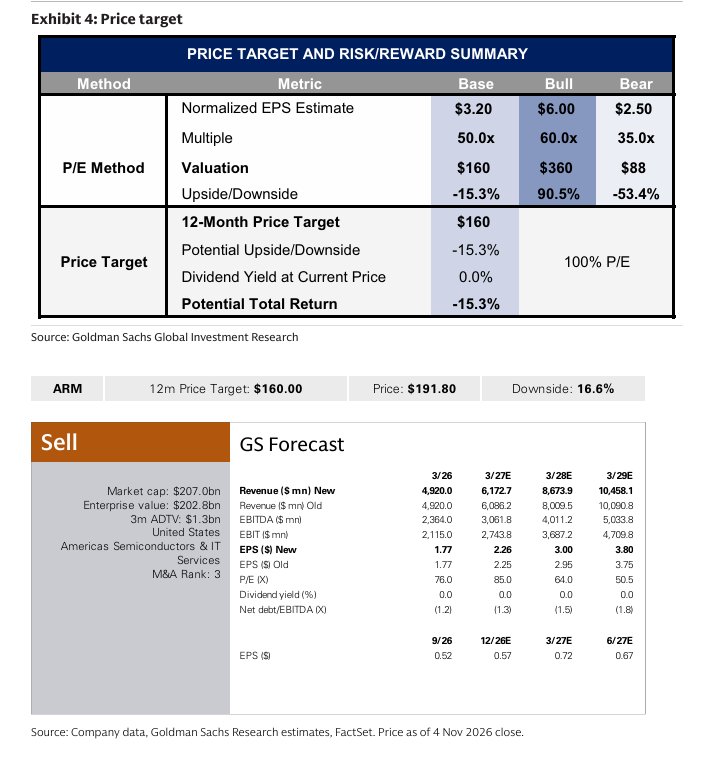
The Zhitong Finance App learned that after ARM (ARM.US), the owner of the ARM instruction set architecture, announced the performance report and future outlook, Goldman Sachs invested in a negative rating research report. The Wall Street financial giant maintained Arm's “sell” rating and a target price of only $160. The Goldman Sachs analyst team acknowledged ARM's strong growth opportunities in the field of AI CPUs with a market size of hundreds of billion dollars, but questioned whether the revenue associated with new AI chips could make up for the pressure on the royalty business and support current overly expensive valuations. Below the target price of 160 US dollars set by Goldman Sachs, it corresponds to a downside of about 16.6% of the latest closing price of 191.80 US dollars.
Arm shares fell 28.9% throughout October, significantly weaker than the Nasdaq 100 Index's decline of about 6.6% and the Philadelphia Semiconductor Index's 15.4% decline. On November 4, Arm closed down 5.28% to 191.80 US dollars before the financial report was announced; after the announcement of the financial report and results conference call, the pre-market trading price for US stocks was 180.60 US dollars as of November 5, Beijing time, and then fell 5.84%. This performance reflects that after experiencing a sharp impact on AI financing costs and AI transaction valuation pressure, investors are increasingly demanding on Arm's growth prospects. It has comprehensively gone from simple revenue growth, further acceleration to long-term sustainability of growth, profit conversion rate, and commercialization of AI CPUs exclusively launched by the company.
In the second quarter of fiscal year 2027 ending September 2026, Arm's revenue reached US$1,443 million, up 27.1% year on year, higher than Wall Street's agreed forecast of US$1,377 billion shown by Visible Alpha adopted by Goldman Sachs; adjusted earnings per share of US$0.52, higher than Wall Street's agreed expectation of about US$0.48. The adjusted operating margin was 44.2%, which also exceeded Wall Street analysts' unanimous expectations of about 41.6%.
However, the team led by James Schneider, a senior analyst at Goldman Sachs, pointed out that exceeding expectations mainly came from authorized revenue, and the royalties that actually reflect the monetization of customer chip shipments fell short of expectations; the improved visibility of AGI CPU demand and supply was not enough to eliminate the pressure on the mobile phone business and doubts about the competitiveness and valuation of its own chips, so it is expected that the stock price may remain volatile in the short term.
Goldman Sachs's target price of 160 US dollars corresponds to a downside of about 16.6% of the closing price of 191.80 US dollars; according to the recently disclosed year-end share capital estimate of 1,070 billion shares, the corresponding market value is about 171.2 billion US dollars. According to the Goldman Sachs analyst team, Arm's revenue stream is expanding, but whether the new business can obtain the valuation premium of the original high-margin IP business and the overall valuation range far higher than the Philadelphia Semiconductor Index still needs to be proven by continuous strong profit data.
Authorization first, royalty lag: AI growth has yet to fully take over the smartphone business baton
Goldman Sachs's research report shows that Arm's strong performance in licensing revenue reflects customer investment in future product routes; royalty performance reveals the huge memory chip cost constraints facing current smartphone terminal demand. Arm's overall licensing and other revenue for the third quarter calendar quarter (the second quarter of fiscal year 2027 ending September 2026) was US$773 million, up 50% year over year, 15.8% higher than the agreed forecast; royalty revenue was US$670 million, up 8% year over year, but unexpectedly about 5.4% lower than the market's agreed expectations.
According to the Goldman Sachs research report, the doubling of data center royalties and the 50% increase in physical AI royalties are still insufficient to offset the drag on mobile phones: the increase in storage prices increases overall machine costs, suppresses demand for mid- and low-end mobile phones, and the increase in single-chip royalties brought about by Armv9 and computing subsystems (CSS) has not fully offset the shipping pressure. The conference call further revealed that the authorized revenue included about US$209 million in technology licensing and design service revenue contributed by SoftBank Group, the largest shareholder of Arm, while the annualized contract value only increased by 12%, indicating that the 50% licensing growth rate in a single quarter was also affected by the pace of contract signing and revenue recognition.
In Goldman Sachs's view, licensing growth is still forward-looking. Three Arm Total Access Agreements (Arm Total Access) were added in the third quarter, with more than 60 active subscriptions, and four new CSS licenses, two for data centers and mobile phones; however, these huge investment in ARM architecture chip design needed to be developed and mass-produced before they could be converted into subsequent royalties.
The Goldman Sachs analyst team pointed out that the major problem behind this is that short-term guidance has yet to show a significant acceleration in royalties: the next quarter is expected to increase by only a single digit year over year. The median value of the company's revenue guidance is US$1,540 million, and the median adjusted earnings per share is slightly higher than the agreed market expectations of US$1,519 billion and US$0.55, respectively, and lower than Goldman Sachs's previous forecasts of US$1,569 million and US$0.60; the adjusted operating expenses are expected to rise to US$825 million. Therefore, according to the Goldman Sachs analyst team, this is a financial report that has positive licensing requirements and slightly exceeds the market as an overall guide, but it has not yet formed an inflection point in royalty growth that could drive a sharp rise in profit expectations.
From collecting technical royalties to delivering CPUs: the revenue pool expands and the valuation formula changes
The new information for AGI CPUs is that customer demand is gradually being supported by purchase orders and supply agreements. Management's confidence that the 2027 and 2028 fiscal years combined will reach a maximum of $2 billion in revenue has increased. The first commercial deliveries are still scheduled for January-March 2027, and customers will expand from Meta to more buyers.
As a result, Goldman Sachs raised its CPU revenue forecast for the 2028 fiscal year from $1 billion to 1.5 billion US dollars, from 2 billion US dollars to 2.2 billion US dollars for the 2029 fiscal year, and maintain 100 million US dollars for the 2027 fiscal year. It can be seen from this that Goldman Sachs has substantially improved its judgment on CPU commercialization, but its combined forecast of 1.6 billion US dollars for the first two fiscal years is still lower than the maximum 2 billion US dollar opportunity discussed by the company. The key fulfillment process is not limited to wafers, but also includes substrate, testing, memory, and final system delivery.
The most important valuation clue in the Goldman Sachs Research Report is that the revised revenue forecast far outweighs the revised profit forecast. Goldman Sachs raised its revenue forecast for the 2027-2029 fiscal year to $6.173 billion, $8.674 billion, and $10.458 billion, respectively, up 1.4%, 8.3%, and 3.6%, respectively; earnings per share only increased to $2.26, 3.00, and $3.80, by 0.5%, 1.7%, and 1.3%. The reason is that higher licensing forecasts, lower royalty forecasts, combined with an increase in CPU sales share, changed the profit structure: the overall gross margin forecast for the 2028 fiscal year was lowered from 90.9% to 87.1%.
Arm's performance call revealed that the gross margin of the first-generation AGI CPU is expected to be around 30% to around 40%, and more than 50% is a target for subsequent products. Therefore, Goldman Sachs emphasized that investors cannot directly apply the gross profit margin close to 98% from the original IP business. Based on this, Goldman Sachs used normalized earnings of $3.20 per share and a 50x price-earnings ratio to arrive at a target price of $160; its $360 bull market and $88 bear valuation were scenario analysis. To change the “sell” judgment, royalties will need to be accelerated again, or CPU size, competitiveness, and operating leverage will be more strongly verified.
CPUs have become the core growth point of AI computing power infrastructure: How can Arm turn intelligent workloads into revenue?
Arm's basic business is to provide customers with intellectual property rights such as instruction set architectures, processor designs, and computational subsystems, collect licensing fees, and obtain royalties when customer chips are shipped; AGI CPUs have added a revenue channel for direct sales of self-designed chips.
ARM architecture CPUs benefit from the underlying mechanism of the agent, because the software execution load outside the model has expanded significantly: GPUs and dedicated accelerators undertake intensive model computation, and the CPU is responsible for tool call, code operation, data access, task scheduling, and operation environment management. The more permanent agents and the more concurrent tasks, the greater the demand for CPU throughput, memory bandwidth, and resource isolation. In power-constrained data centers, higher performance per watt and rack computing density can help increase effective output under existing power supply conditions.
Arm has two parallel monetization paths: customer-developed chips expand IP and royalty revenue, and own AGI CPUs increase revenue obtainable in each system. Traditional authorized customers include Apple, Qualcomm, MediaTek, and Samsung; cloud growth is mainly linked to Amazon Graviton, Google Axion, Microsoft Cobalt, and Nvidia Arm CPU platforms. The company expects Arm's share of servers in leading hyperscale cloud vendors to exceed 60% by the end of 2026. This caliber does not represent the overall share of global servers.
In terms of proprietary chips, Meta is the main cooperative developer and customer. Oracle plans to provide AGI CPU instances in 2027, while TSMC and server partners support manufacturing and system deployment. Arm is not only participating in the growth of cloud giants' self-developed CPUs, but also experimenting with direct supply; the investment value ultimately depends on how much profit the two paths generate together, and whether direct supply can form a sustainable return.
In terms of the latest target prices for other Wall Street institutions, Barclays maintained an “increase in holdings” after Arm's earnings report was announced. The target price dropped from 360 US dollars to 325 US dollars, corresponding to a 69.4% increase, with a market value of about 347.8 billion US dollars; Piper Sandler maintained an “increase” from 320 US dollars to 270 US dollars, corresponding to a 40.8% increase and a market value of about 288.9 billion US dollars. Barclays's judgment and Goldman Sachs agree on the profit mechanism: AGI CPU revenue forecasts will increase, but hardware gross margin and R&D investment have limited the margin of profit improvement. The main difference between the two sides is how much they are willing to pay for long-term growth.
Wells Fargo maintained an “increase in holdings,” and the target price fell from $280 to $255; Needham maintained a “buy” and target price of $255, both of which corresponded to a 33.0% increase, with a market capitalization of about $272.9 billion. Wells Fargo raised its revenue forecast for the next three fiscal years while reducing the target price due to shrinking valuations in the semiconductor sector; Needham placed more emphasis on implementing the supply and demand for AGI CPUs, and waited for the next call to update delivery and the 2028 fiscal year outlook. J.P. Morgan also maintained an “increase in holdings”. The target price dropped from 255 US dollars to 245 US dollars, corresponding to an increase of 27.7% and a market value of about 262.2 billion US dollars. The reduction mainly reflects the decline in the peer valuation ratio.
HSBC analyst Frank Lee maintained “holdings”, and the target price dropped from $230 to $215, corresponding to a 12.1% increase and a market capitalization of about US$23.1 billion. HSBC believes that the clear-cut profit catalyst for the next 12 months is still server royalties: market expansion, increased Arm share, and increased chip core count to jointly increase royalty revenue potential. Combined with Goldman Sachs's cautious valuation of $160, the core of the Wall Street divide is already clear — the AI intelligence frenzy is expanding CPU demand, but the continued restoration of Arm's stock price requires high gross royalty growth to be realized together with chip supply profits; the scale of additional revenue alone is not enough to resolve the valuation differences.