


EN
SpaceX (SPCX.US) Nuggets Communications and AI, Rocket Lab (RKLB.US) moves towards 100 launches! Under stock price shocks, is commercial aerospace preparing for a new round of upward trend?
The Zhitong Finance App learned that the trading logic of the commercial space sector of the stock market seems to have fully expanded from the growth of commercial space orders itself to the comprehensive multi-headed logic of communications, AI, and government aerospace orders. However, the bullish catalysts or negative catalysts faced by specific companies are quite different. Commercial space leaders such as the “AI+ Space Exploration” supergiant SpaceX (SPCX.US) founded and led by Musk and Rocket Lab (RKLB.US), one of SpaceX's rivals, have apparently faced different catalysts recently.
SpaceX recently returned to an issue price of 135 US dollars, but its business expansion is being supported by more specific mobile communication equipment chains, financing, and commercialization arrangements. The core investment change at this stage is that mobile communication and AI computing power services are opening up a new continuous charging market for the company. Qualcomm's participation in Starlink Mobile's nationwide terrestrial 5G construction means that SpaceX is promoting the integration of satellites and terrestrial networks: low-orbit satellites expand geographical coverage, and terrestrial base stations handle traffic from densely populated areas through frequency multiplexing and higher capacity density. The combination of the two is expected to extend the scope of services from supplementary coverage to users' daily mobile communication.
SpaceX plans to start building tens of thousands of sites in 2027, providing an implementation path for the accelerated transformation to the mobile communications sector; exposure to Boost Mobile reflects that the company is also exploring ways to shorten customer acquisition and network access processes. As the scale of users expands, fixed investment in satellites, base stations, and core networks can be shared by more subscription revenue, which is the key for communications services to form economies of scale.
The catalyst for the AI business focuses on how financing promises can accelerate the formation of billable computing power. Financial leasing arrangements of approximately US$40 billion for GPUs and related equipment provide funding for Nvidia's Vera Rubin equipment expected to be delivered in the first half of 2027, making the expansion plan more clearly supported by procurement and delivery. SemiAnalysis believes that the 2027 13 gigawatt capacity target is achievable, but the economic return still depends on whether power supply, server deployment, and customer usage requirements can be synchronized, which is ultimately reflected in equipment utilization, computing power rental revenue, and cash recovery speed.
The 2028 billion US dollar revenue model proposed by Sequoia Capital Partners shows investors' highly optimistic vision of growth space; Morgan Stanley advanced the free cash flow break-even forecast from 2035 to 2031, then further implemented the bullish argument until the capital recovery period. As far as the valuation of SpaceX is concerned, the expansion of revenue sources and earlier expected cash returns form the basis for a more continuous revaluation than a single stock price rebound.
Stock prices retracted but orders accelerated! What factors will the next round of commercial aerospace market focus on?
Rocket Lab's latest dynamic shows the progress of 100 launches. The core value is repeated delivery capability and customer repurchase. Electron has completed its 99th mission and has successfully carried out 10 launches for Japan's iQPS. The latter has also booked 8 more exclusive missions until 2030. Exclusive launches can match the trajectory, inclination and deployment time required by customers, thereby helping remote sensing constellations to develop service capabilities faster; continuous repurchase also provides a demand basis for rocket laboratory production and launch schedules.
Rocket Lab's Neutron series launch product line determines the revenue starting point for the company's larger payload launch business, so delaying the first flight will delay the time to achieve growth. Citizens adjusted its first flight forecast to the latter half of the second quarter of fiscal year 2027, while maintaining a “outperforming market” rating and a target price of $90; based on the November 4 closing price, there is an implied potential increase of about 72%. The judgment is based on continued demand for Electron and the continuation of long-term business opportunities for Neutron. The proposed acquisition of Iridium may also increase revenue from satellite operations and services, and regulatory approval will affect the pace of progress in this expansion path.
AST SpaceMobile's positive breakthrough has brought phones directly connected to satellites closer to everyday use. The connection switch from the terrestrial cellular network to the satellite network with AT&T verifies whether the call or data session can continue after the user leaves the terrestrial coverage; this is directly related to whether the satellite connection can be a stable part of the mobile package. Ericsson and Nokia's participation in network integration also shows that their business path is to embed existing operator systems and use mature customer relationships, brands and channels to expand the scale of use. Chile's 30-year national license and corresponding first phase service schedule for November 2028 further clarified the entry and deployment arrangements for the local market. As SpaceX accelerates the construction of a space-earth integration network, AST SpaceMobile's competitive focus will also extend to constellation coverage, service continuity, and the speed of commercial implementation of operator cooperation.
Redwire Corporation's financial report shows the difference between the pace of revenue recognition and the quality of operations: third-quarter revenue of US$109 million fell short of market expectations, but new contracts reached US$188.7 million, the order revenue ratio was 1.73 times, and on-hand orders rose to US$619.7 million, indicating that the scale of business undertaken in the current period exceeded confirmed revenue. Gross margin increased from 16.3% to 32.3%, with part of the increase due to the decline in inventory accounting effects of mergers and acquisitions in the previous year; after deducting related impacts, adjusted gross margin still increased from 27.1% to 32.3%, which largely indicates that there is actual support for operational improvements. If subsequent order delivery drives revenue expansion, higher gross margins are expected to amplify the contribution of revenue growth to profits.
Voyager Technologies' growth also included new business and mergers and acquisitions: third-quarter revenue increased 124% year-on-year to US$89 million, and new orders reached US$116 million; of the US$742 million in on-hand orders, US$347 million came from Astrobotic acquisitions. The company raised the lower limit of revenue guidance and maintained the upper limit for the whole year, mainly reflecting increased confidence in recent delivery and revenue bottom lines. At the same time, Starlab has signed a commercial reservation of about 700 million US dollars to verify the potential demand for commercial space stations, and the new five-year, $35 million NASA HUNCH management contract provides a service business opportunity with a clear period of time. The two correspond to different implementation stages — service contracts support business revenue, space station reservations support long-term construction and commercialization prospects, and subsequent value release depends on project progress, contract execution, and capacity utilization.
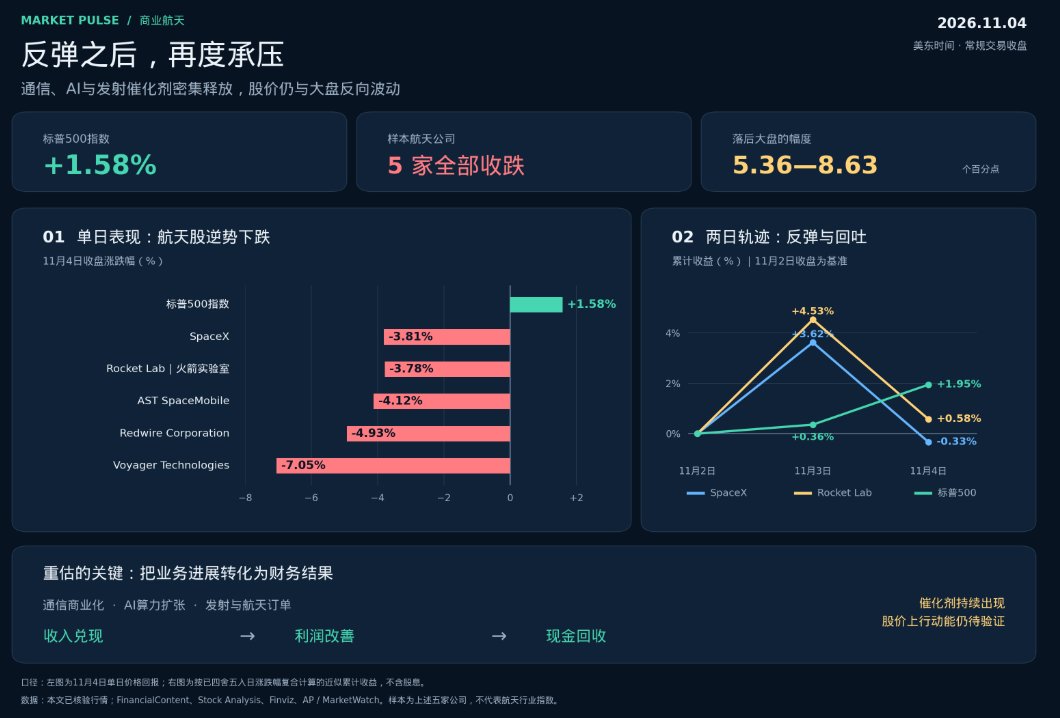
In terms of stock price trends, as of the close of trading on November 4, EST, commercial aerospace stocks showed trading characteristics that rebounded rapidly, rebounded sharply, and clearly deviated from the general market trend. On November 3, SpaceX and Rocket Lab (Rocket Lab) rose 3.62% and 4.53% respectively, clearly outperforming the 0.36% increase in the S&P 500 index, but this round of rebound did not continue: the next day, the two companies fell 3.81% and 3.78%, respectively, and most of the gains from the previous trading day were reversed.
Satellite communications and aerospace infrastructure companies were also under pressure. AST SpaceMobile fell 4.12% on the same day, Redwire Corporation fell 4.93%, and Voyager Technologies fell 7.05%; in contrast, the S&P 500 index rose 1.58%, and adjustments in the commercial space sector significantly exceeded market fluctuations.
Judging from the evolution of transaction logic, the commercialization of communications, the expansion of AI computing power, and the growth of launch orders continue to provide business catalysts, but they have not yet been transformed into stable upward momentum in stock prices; whether the next round of market revaluation can form a continuous upward trend will depend more on whether these developments can be realized as verifiable revenue growth, profit improvements, and cash recovery.
SpaceX expands communication, AI computing power, and AI agent application landscape, Rocket Lab moves towards 100 launches
So far this week, SpaceX's wireless business expansion and AI financing, Rocket Lab (Rocket Lab)'s 99th Electron rocket launch, and AST SpaceMobile's license from Chile have been major news in the space sector; at the same time, the results announced by Redwire Corporation and Voyager Technologies have been mixed.
SpaceX selected Qualcomm to provide technical support for Starlink Mobile's nationwide terrestrial 5G network to further advance its mobile communications layout. Network deployment will begin in 2027, with plans to build tens of thousands of sites.
Qualcomm CEO Anmon said, “This is a major achievement in our infrastructure business and the beginning of a strategic partnership with great potential.” Qualcomm anticipates that related businesses will begin contributing revenue towards the end of FY2027 and further increase in FY2028.
According to reports, SpaceX is also exploring the possibility of acquiring EchoStar's Boost Mobile or using its network. However, transferring network access rights obtained through leasing may require the operator's consent.
While expanding its wireless business, SpaceX is also raising funds for larger AI infrastructure construction. Goldman Sachs and Apollo are seeking buyers for part of their $40 billion chip financing arrangement involving leasing Nvidia Vera Rubin equipment expected to be delivered in the first half of 2027.
According to SemiAnalysis, SpaceX's goal of achieving 13 gigawatts of computing power capacity in 2027 appears to be attainable. The agency has identified more than 9 gigawatts of capacity and 3.6 gigawatts of capacity under construction at different sites, while pointing to power supply constraints.
Sequoia Capital partner Shawn Maguire's agency invested in SpaceX. In his investment model, he predicts SpaceX's revenue will reach $731.1 billion in 2028. CEO Elon Musk responded: “I think we can do better.” Additionally, Morgan Stanley brought forward its projected free cash flow break-even period from 2035 to 2031.
However, Musk's growth ambitions face political and transactional risks. Senator Ted Cruz warned that a subpoena might be issued to Musk; Gary Blake warned that in an all-share purchase transaction, a drop in the buyer's share price could erode the acquisition premium received by the target company's shareholders.
Furthermore, Musk's heavy bet on the Republican Party's loss in the midterm elections is turning political uncertainty into valuation pressure on SpaceX and Tesla. The Democratic Party won control of both houses of Congress and took the seat of governor of Texas, where the two companies are headquartered, allowing investors to re-evaluate the policy environment facing Musk's business landscape. On November 4, SpaceX closed down 3.81% and Tesla closed down 3.34%; an important catalyst for this round of sell-off was market concerns about tightening government contract supervision, data center approval, and potential merger reviews. XTB research director Kathryn Brooks said that Congress could slow down the potential merger process of the two companies through increased scrutiny, and that political risk premiums have begun to suppress their share prices. Judging from the pricing mechanism, investors are demanding higher return on investment due to the uncertainty of project advancement and business integration, thereby reducing the valuation they are willing to pay.
This also forms an important background where stock prices are still under pressure due to the favorable expansion of SpaceX Communications and AI: Qualcomm's participation in the construction of the Starlink mobile terrestrial 5G network, which is scheduled to begin deployment in 2027, and the $40 billion financing arrangement for Nvidia's Vera Rubin devices have respectively expanded the commercial space for communications services and the ability to expand AI computing power; however, how much value these investments ultimately create depends on when the new infrastructure can be put into operation and generate continuous revenue.
Gina Hinojosa, the elected governor of Texas, has advocated suspending new data center projects and removing related tax benefits until community protection measures are strengthened. If the approval and deployment cycle is lengthened, the time for capital investment to be converted into fee computing power and operating cash flow may be delayed, and the expansion capacity brought about by financing arrangements will be difficult to immediately transform into shareholder returns.
Compared with last week, quantitative retail investor sentiment data compiled by the Stocktwits investment platform showed that retail investors' sentiment about SpaceX improved from “bearish” to “neutral,” and the amount of related discussions was at a “high” level. The company's stock price has dropped 16% since this year.
Investors' focus on Rocket Lab's valuation and fundamental outlook can be described as the launch news coexisting with questions about mergers and acquisitions.
Rocket Lab (Rocket Lab) launched the IQPS Wadatsumi-II radar imaging satellite into orbit on Monday, only one time away from the 100th launch of the Electron rocket. This mission, called “Poseidon Survey,” is its 20th mission in 2026 and the 10th time it has successfully launched for iQPS; 8 other exclusive launch missions have already been booked and are scheduled to be carried out until 2030.
The advance in the launch business supports Citizens' bullish stance. The agency reaffirmed its “outperforming the market” rating and a target price of $90, viewed the Neutron extension as a setback in progress, and anticipated its first launch in the latter part of the second quarter of FY2027.
However, the company's broader expansion is still under scrutiny. Globalstar (Globalstar) raised questions about potential supplier conflicts of interest involved in the acquisition of Iridium Communications (Iridium); Rocket Labs and Iridium Communications said other issues relating to SpaceX and Ligado existed prior to this merger. Space Systems Business Director Brad Klevinger also discussed commercial space and national security with Senator Kevin Kramer at the University of North Dakota summit on Wednesday.
It was also revealed that CFO Adam Spice sold 140,157 shares for an amount of $7.4 million after exercising the options; director Nina Armanio sold 10,926 shares. Both of Monday's sales were carried out in accordance with previously drawn up trading plans.
Compared with last week, the sentiment of retail investors in Rocket Lab (Rocket Lab) as shown by the Stocktwits investment platform changed from “neutral” to “bearish,” and the amount of discussion was at a “normal” level. The company's stock price has dropped 25% since this year.
As direct satellite connections promote commercial use, commercial aerospace star companies ushered in orders and performance differentiation
AST SpaceMobile and AT&T announced on Monday that they have successfully switched the “industry's first” terrestrial cellular network to satellite cellular network. Tests conducted in Washington state last month maintained connectivity during the network switch and received technical support from Ericsson and Nokia.
Robert Walters, AT&T's network business executive, said, “The successful transition is a major milestone, but it's not the end.” The two companies are advancing the beta service.
AST SpaceMobile has also obtained a 30-year national franchise license in Chile, expanding its market access. The first phase of the service schedule is 24 months, calculated from the date of announcement on Tuesday, corresponding to November 2028.
As AST SpaceMobile advanced its business, competition also increased the sense of urgency. Peter Addon, founder of Boost Mobile, said, “AST SpaceMobile needs to adjust direction, and we must act quickly.” He urged the company to work with experienced mobile brand operators.
According to shareholding data disclosed at the beginning of this week, as of September 30, Pioneer Pilot Group held 15.33 million shares, accounting for 5.11%; Lotte Investment Management's shareholding increased 23.9% to 17,156 shares at the end of the quarter.
Compared to last week, the retail sentiment shown by Stocktwits is still “bearish”, and the amount of discussion is at a “low” level. The company's stock price has dropped 51% since this year.
Redwire Corporation's performance showed strong growth in on-hand orders, but revenue data fell short of expectations. Redwire Corporation's third-quarter revenue increased 5.4% year over year to US$109 million, below the market's consensus forecast of US$126.56 million; loss per share was US$0.09, in line with expectations.
The results also showed that the company's on-hand orders reached a record high of US$619.7 million, and gross margin rose from 16.3% in the same period last year to a record 32.3%. The total amount of contracts awarded was US$188.7 million, and the ratio of new orders to revenue reached 1.73 times.
CEO Peter Canito said, “Although the pace of revenue recognition is still fluctuating, gross margin once again hit a record this quarter, rising to 32.3% from 16.3% in the same period last year. As we deliver mission-critical products and solutions in multiple areas, the quality of revenue is improving.”
Redwire Corporation maintains a revenue forecast of 450 million to 500 million US dollars for the 2026 fiscal year, and the market consensus forecast is 475.2.8 million US dollars. The company recorded a net loss of $23.2 million, and the adjusted profit before interest, tax, depreciation and amortization (EBITDA) was a loss of $5.3 million.
Compared to last week, retail investor sentiment shown by Stocktwits jumped from “bullish” to “extremely bullish,” and discussions were at a “high” level. The company's stock price has risen 2% since this year.
Voyager Technologies' revenue exceeded expectations and received new business from NASA. Voyager Technologies' third-quarter revenue increased 124% year over year to US$89 million, exceeding the agreed market expectations of US$81.38 million. The adjusted loss per share was $0.87, slightly higher than the market expected loss of $0.86.
The company raised its revenue forecast for the 2026 fiscal year from 275 million to 305 million US dollars to 287 million to 305 million US dollars, and the market consensus forecast is 291.51 million US dollars. Supporting this outlook, the company's on-hand orders reached a record $742 million, of which $347 million came from Astrobotic; new orders also reached a record high of $116 million.
CEO Dylan Taylor said, “Record on-hand orders provide significant visibility into revenue for years to come, and the increase in full-year guidance reflects this growth.”
The total number of commercial bookings that Starlab has signed reached US$700 million; however, Voyager Technologies recorded a net loss of US$55.7 million attributable to the company.
In addition to the results, Voyager Technologies was awarded a five-year, $35 million NASA HUNCH project management contract on Wednesday, and appointed retired US Space Force Admiral B. Chance Saltzman as the chairman of the advisory board on Monday.
Compared to last week, Voyager Technologies retail sentiment is still “bullish” and discussion volume is at a “high” level. The company's stock price has dropped 12% since this year.