


EN
Globalstar (GSAT) Draws FCC Focus While Fair Value Still Looks Just Out Of Reach
Regulatory concerns around Rocket Lab Iridium deal put Globalstar in the spotlight
Globalstar (GSAT) entered the regulatory conversation after echoing concerns raised by SpaceX and Ligado over Rocket Lab’s proposed Iridium acquisition, urging tougher FCC scrutiny while stopping short of directly opposing the transaction.
Recent regulatory headlines land on top of a powerful run in Globalstar’s market performance, with the stock’s share price at $84.58 and a year to date share price return of 32.18%, alongside a 1 year total shareholder return of 75.30% that builds on a very large 3 year total shareholder return of more than 3x.
Scan beyond Globalstar and explore other satellite and telecom opportunities that match this type of regulatory and return profile with our hand picked 19 high quality undiscovered gems.
Globalstar now trades only about 6% below the average analyst target, even after a multi year run that has already rewarded believers. Is that slim discount a sign the market is too cautious on regulatory risk, or is it already giving the business full credit for the story so far?
Most Popular Narrative: 6% Undervalued
Globalstar’s most followed valuation storyline pegs fair value at $90, which sits modestly above the recent $84.58 close and frames today’s price as a small discount rather than a deep bargain.
Advancements in software-defined radio (XCOM RAN) and Network-as-a-Service models create new opportunities to capture enterprise and horizontal markets (beyond initial customers), capitalizing on the convergence of satellite and terrestrial networks to drive incremental service and licensing revenues with improved gross margins.
See why 41 investors see Globalstar as 6% undervalued.
The popular thesis is based on a 7.108% discount rate and assumes Globalstar grows into a $409.5 million revenue profile with $64.3 million in earnings by around 2029. These figures are then used to justify the $90 fair value estimate. That framework suggests investors are being asked to underwrite a very high future P/E multiple and a long runway of execution on spectrum, IoT modules and large customer agreements.
Supporters of this view focus on the 16.1% annual revenue growth forecast and an expected shift from a current net loss of $62.49 million to a positive margin near 15.7%. This would represent a meaningful change in Globalstar’s earnings mix. Critics of the same narrative point to the current unprofitable status, a negative return on equity and heavy capital needs, arguing that the hurdle to reach those targets is high, especially with 100% of liabilities funded through higher risk sources such as external borrowing.
Regulation and funding risk remain central to whether this valuation story holds together. Long sales cycles in government and enterprise markets, potential delays in spectrum approvals and the need to support satellite replenishment and ground infrastructure can all pressure cash generation and increase the likelihood of additional financing or dilution. At the same time, recent insider selling and limited board refresh over the past three years mean some investors may want to look closely at governance and incentives when weighing that 6% gap between market price and the narrative fair value.
Result: Fair Value of $90 (UNDERVALUED)
Still, the Globalstar narrative can crack if long sales cycles delay expected cash flows, or if heavy satellite and ground spend forces fresh, shareholder-diluting capital raises.
Find out about the key risks to this Globalstar narrative.
Another View: Globalstar Looks Expensive On Sales
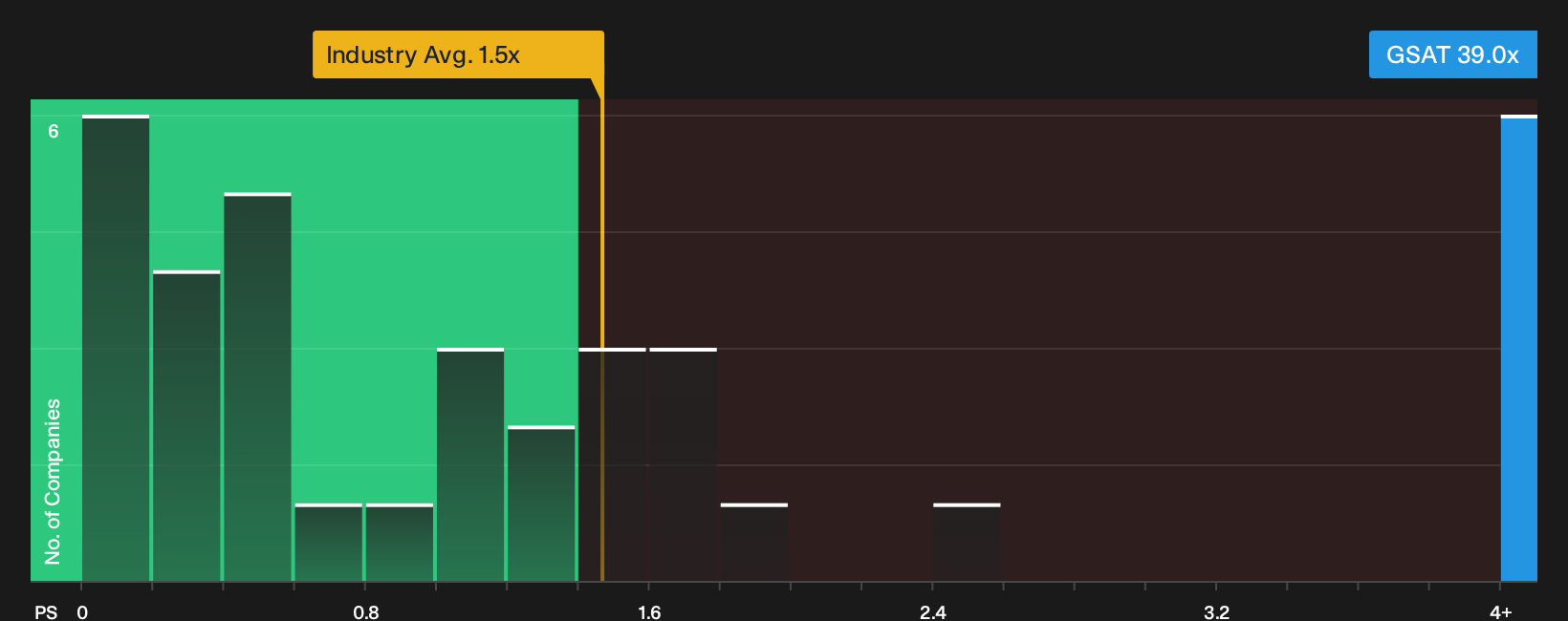
The story shifts when you step away from fair value narratives and focus on what investors are currently paying for Globalstar. On a P/S ratio of 39x, the stock trades far above the US Telecom industry at 1.4x and its peer average at 1.9x, while the fair ratio sits at 2.2x. That gap concentrates a lot of expectation into the price, so how much execution risk are you really comfortable underwriting at this level?
For a closer look at how this valuation gap plays out in practice and what the numbers imply for future re rating risk, See what the numbers say about this price — find out in our valuation breakdown.
Next Steps
Strong opinions run through this Globalstar story. Now is the moment to test the numbers, probe the assumptions and form your own angle using the 1 key reward and 1 important warning sign.
Looking for more investment ideas beyond Globalstar?
If you only stop at Globalstar, you risk missing other opportunities that better match your goals, risk comfort and time horizon.
- Target potential upside in overlooked corners of the market by scanning our 19 high quality undiscovered gems before other investors pay attention.
- Build a foundation around balance sheets that look resilient rather than fragile by running your filters through the list of solid balance sheet and fundamentals (24 results).
- Strengthen your income watchlist by hunting for payout-focused opportunities with the 5 dividend fortresses while yields and quality still align.
Have feedback on this article? Concerned about the content? Get in touch with us directly. Alternatively, email editorial-team@simplywallst.com