


EN
Walmart (WMT) Stock Looks About Right After A 178% Run
Walmart has delivered strong share price gains in recent years, and the latest run raises a simple question for you as an investor: Is the current price you see on the screen still grounded in what the retailer is earning today and is expected to earn over time?
- Over the past 5 years, Walmart has returned 177.9%, which puts a lot of weight on whether those gains are matched by sustainable earnings power.
- The company is committing about US$6b to automation and robotics in its distribution network, an outlay that can support future efficiency and profit margins but also concentrates more capital on its supply chain strategy.
- The analysts covering Walmart have run their own numbers. See what analysts think Walmart's shares could be worth.
The issue now is whether Walmart's current valuation is adequately supported by its earnings when set against the Fair Ratio benchmark.
If you want to test the same earnings question you are asking of Walmart across a wider field of retailers and other sectors, start by scanning 35 high quality undervalued stocks.
Is Walmart Fairly Priced on Earnings?
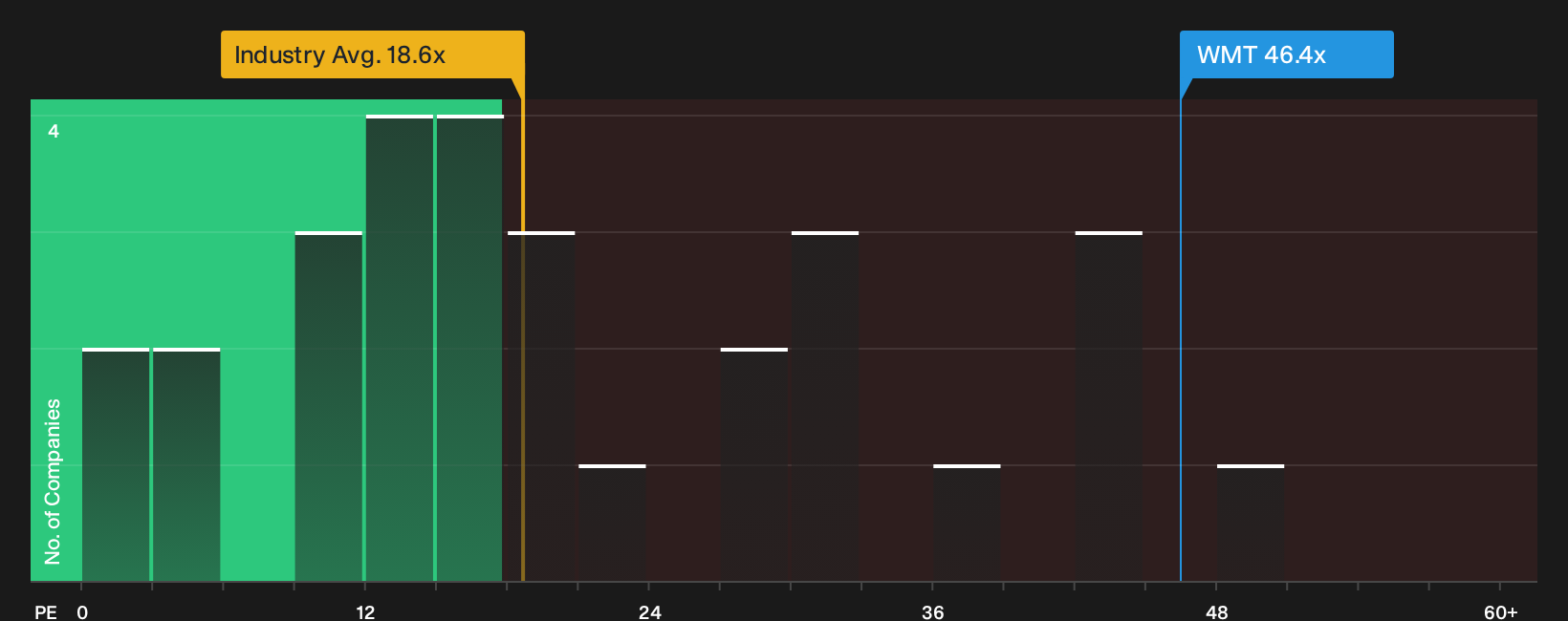
The P/E ratio is a useful way to assess Walmart because earnings are the clearest link between what investors pay today and what the retailer earns per share. Walmart trades on a P/E of 46.4x, which is much higher than the Consumer Retailing industry average of 18.6x and also above the broader peer group on 25.6x. That gap indicates the market is willing to pay a much richer price for each dollar of Walmart’s profit than it does for typical retailers.
On this framework, the Fair Ratio, which adjusts for Walmart’s own growth profile, margins, size and risk, points to a level slightly below the current multiple. As a result, the stock screens only slightly expensive rather than extreme. Despite the US$6b automation build out raising expectations for long term efficiency, the present P/E already reflects a premium to both sector and peer benchmarks. Any investment case therefore needs to focus on whether Walmart can justify that richer valuation over time. Explore the numbers behind Walmart's P/E valuation.
The Walmart Narrative: What Would Justify Today's Price?
Walmart's valuation puzzle raises a natural next step, which is to spell out what future path could actually make today's price look either conservative or stretched. Narratives on Simply Wall St's Community page do that linking work by tying each Walmart storyline to a clear view on how its growth, profitability and risk profile might evolve, and by anchoring each number in a concrete expectation for where earnings power could move next. This gives you something you can revisit as new information emerges.
Community views on Walmart are split between those who see additional upside in newer profit streams and others who think the current price already reflects most of that story.
Bull case: 16% undervalued
"Walmart continues to diversify its business, the SBU “Other” has emerged as a dynamic growth engine, capturing new opportunities beyond traditional retail…"
Discover why this Narrative puts Walmart at 16% undervalued.
Bear case: roughly fairly valued
"The main factor that has to go right is the continued growth and profitability of higher margin alternative profit pools such as advertising, marketplace services, and membership…"
Explore why this Narrative puts Walmart at roughly fairly valued.
Walmart's price is only one side of the story
Walmart's current multiple tells you what investors are willing to pay today. The next layer is how professional analysts think its earnings profile could look a few years from now. Explore where analysts expect Walmart to be in a few years.
Have feedback on this article? Concerned about the content? Get in touch with us directly. Alternatively, email editorial-team@simplywallst.com