


EN
What Transocean Doubters Missed
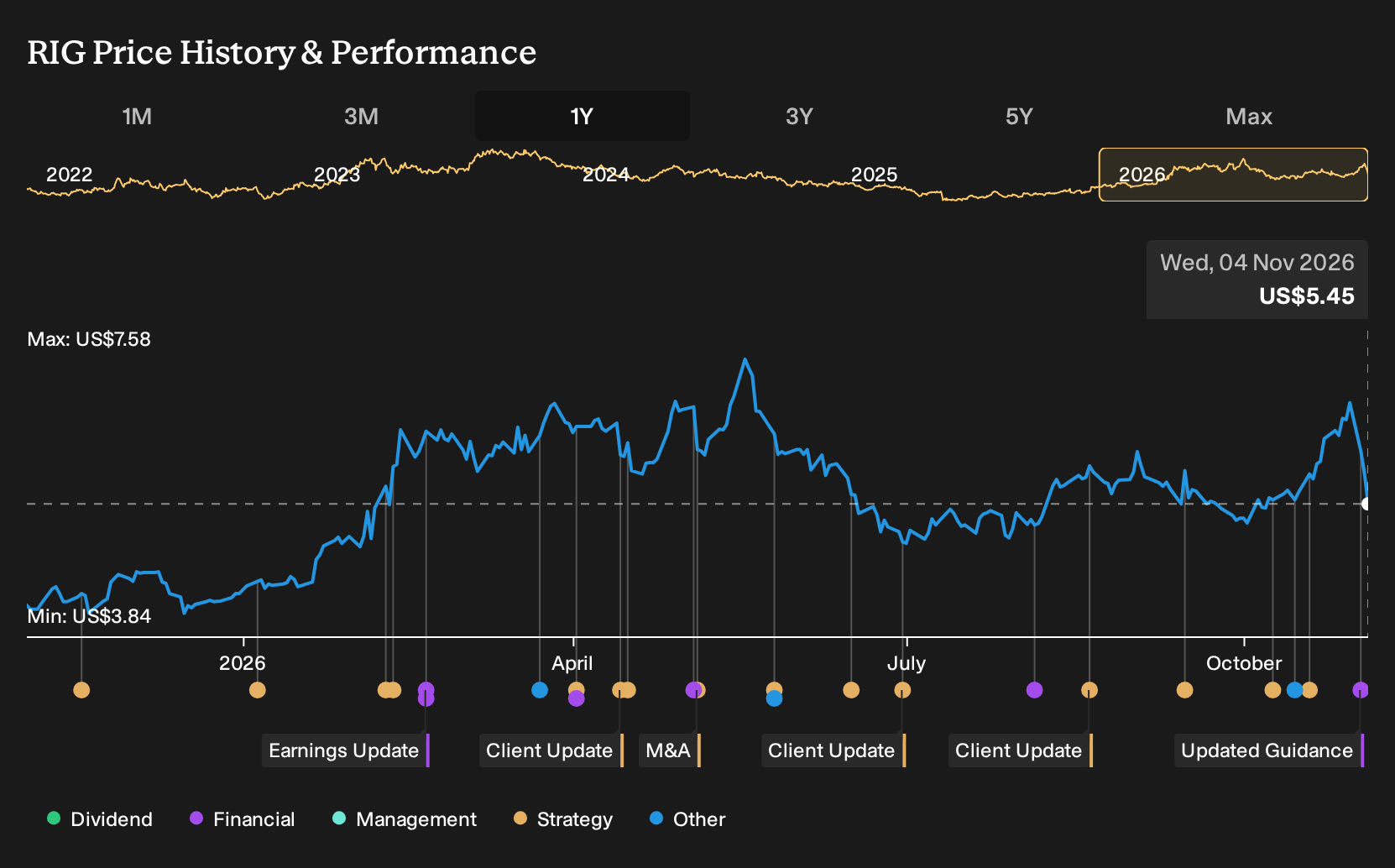
If Transocean sat on your watchlist instead of in your portfolio, the outcome might feel different right now. Holding Transocean over the past year would have returned 39.7%, including dividends. That move invites a tougher question. Back on 4 November 2025, when analysts were split between tight ultra deepwater rig markets and rising regulatory costs, what business assumption about long term rig demand could have helped you recognise that this backlog heavy driller might surprise on the upside?
On Simply Wall St, a Narrative is an investor's thesis written down: the reasoning, plus the numbers it rests on. Run those numbers and you get an estimated Fair Value.
Transocean has already moved. See which of 34 high quality undervalued stocks still trade below our estimates.
The Two Transocean Stories Investors Had To Weigh
The shares cost US$3.9 at the start of the period, and the argument around Transocean was about whether ultra-deepwater demand would justify a higher price.
The bullish Narrative pinned Fair Value at US$5.5 and leaned on a 2.0% annual revenue growth assumption plus a profit margin rising to 6.2%, supported by tight rig supply and premium day rates.
The bearish view set Fair Value at US$2.5, focused on a 3.4% annual revenue decline assumption, and highlighted high debt and rising regulatory costs as key risks to future profitability.
What The Evidence Around Transocean Actually Tested
Transocean kept signing multi year ultra deepwater and harsh environment contracts, taking backlog above US$7.7b and lifting visibility on future rig use, which supported the optimistic demand story. Reported Q3 2026 results showed revenue slipping to US$937m while net income moved from a US$1,923m loss to a US$26m profit, so the profitability claim stayed only partly proven. The evidence cut both ways.
The whole debate turned on whether tight rig markets would show up in backlog and margins. For a different offshore driller, you would track signed contract value, utilisation guidance, and the reported net margin each quarter against whatever long term rig demand story you are being asked to believe.
What Transocean's Recent Run Already Assumes
Transocean now trades at US$5.45 after a 39.7% gain over the past year, and the selected Narrative’s Fair Value sits below that market price.
The Narrative focuses less on whether offshore demand exists and more on how efficiently Transocean can turn a large backlog into durable cash generation. Anyone buying today is effectively assuming strong utilization and smooth Valaris integration. This raises the question of how cost inflation and execution risk affect that bet.
"The main thing that has to go right is that Transocean converts a tightening deepwater rig market and a larger, longer-dated backlog into sustainably higher cash generation despite higher capex, inflation in freight and fuel, and an enlarged balance sheet after the Valaris acquisition."
One Narrative disagrees with today's price. → See where this Narrative says Transocean should trade
One Step Beyond Transocean
Transocean focuses attention on offshore rigs and deepwater demand. You could also ask what powers the fuels those rigs chase.
Oil and gas buyers want reliable supply but also face emissions pressure. That mix of needs pushes producers toward projects with lower operating costs and cleaner profiles.
Another large energy group leans into exactly that combination. It backs lower cost hydrocarbon fields, cuts methane leaks and keeps investing in power tied to renewables.
The curiosity is whether a business that once looked like a pure producer quietly shifts into a broader energy utility, with cash flows coming from more than wells alone.
One Narrative has already put a figure on it. → Uncover the company trading 18% below one Narrative's Fair Value
Have feedback on this article? Concerned about the content? Get in touch with us directly. Alternatively, email editorial-team@simplywallst.com