


EN
Wall Street warns: Under a divided government pattern, the 2027 debt ceiling game will test the “safe-haven myth” of US debt
The Zhitong Finance App learned that the dust settled in the US midterm elections, the Democratic Party unexpectedly gained control of Congress, and the market ushered in a classic combination of splitting the government. Historically, investors have often welcomed this kind of political impasse — because it meant that policies were hampered and spending was constrained. On Wednesday, as news of the Democratic Party's big win spread, the US bond yield curve declined across the board, continuing this tradition. The data shows that since the mid-90s of the last century, the average yield on 10-year US Treasury bonds has been low for 1 month and 12 months after the midterm elections under a divided government pattern.
This time, however, Wall Street's concerns are focused on another issue: the debt ceiling.
Deutsche Bank strategist George Saravelos pointed out, “The single biggest source of domestic policy uncertainty in the US is the debt ceiling that will become binding around the second quarter of next year.”
Currently, the US federal government has only about 800 billion US dollars of space left from its statutory borrowing limit of 41.1 trillion US dollars. Strategists expect the government to hit the cap in the first half of 2027. At that time, the Ministry of Finance can free up some borrowing space through unconventional accounting methods to avoid default, but in the end, the National Assembly will still have to raise or suspend the debt limit in order to completely eliminate the risk of technical default.
The Democratic Party's full control of Congress means that its confrontation with the Trump administration over government borrowing is likely to be protracted. Fitch Ratings warned last month that the Democratic Party's control of Congress could increase the risk of a political marginal game surrounding the debt ceiling. The agency also said that the outgoing Republican-led Congress can raise or suspend the debt ceiling until the end of its term at the end of the year; otherwise, this issue will become a major test facing the new Congress.
BMO Capital Markets strategist Vail Hartman said: “If Congress fails to resolve the debt ceiling issue before the end of the year, financial markets may face a protracted debt ceiling impasse in 2027.” He expects that the Democratic Party will use the debt ceiling as a “powerful bargaining chip to obtain concessions from the Trump administration”. The result may be that treasury bill prices will be distorted around the expected “X day” (the day the government runs out of funds), and the volatility of the cash and repurchase market will increase.
Looking back at history, whenever the debt ceiling confrontation approaches, investors usually sell treasury notes that expire around X days and buy securities maturing before or after X, thus leaving an obvious “distorted point” in the yield curve.
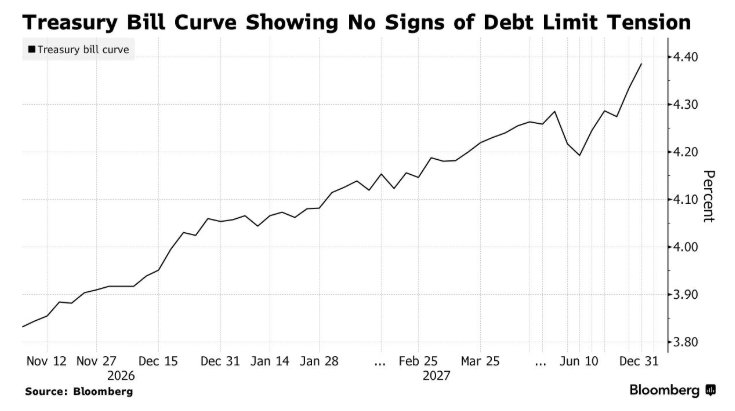
Currently, the treasury bill curve has not shown any obvious signs of concern, as there are still several months until the upper limit has been reached. However, the CIBC strategist team (led by Michael Cloherty) reminded investors on Wednesday that they should “include more risk premiums” for the money market until 2027.
The deeper problem lies in fiscal fundamentals. George Brown, a senior economist at Schroders (Schroders), pointed out that the current US fiscal deficit accounts for about 6% of GDP, public debt already exceeds 32 trillion US dollars (not yet included in internal government arrears such as social security and health insurance), and both the Trump administration and the upcoming Democratic Congress have promised additional spending — “This hypothesis (which divides the government benefits US debt) is worth re-examining.”
He further warned: “If political compromises increasingly mean larger deficits rather than fiscal consolidation, investors may demand higher maturity premiums to hold long-term US debt.” This may cause the US bond yield curve to become steeper.
It is worth noting that the debt ceiling impasse in the past caused the market to worry that the Ministry of Finance might not be able to pay interest on some maturing treasury notes on time, triggering fears of a “technical default.” Such government dysfunction also prompted rating agencies to act — in August 2023, Fitch downgraded America's sovereign rating by one level to AA+ on the grounds that a political struggle with debt ceilings pushed the US to the brink of default.
Markets are generally pessimistic about whether the National Assembly can resolve the risks before the end of the year. CIBC's Cloherty expects the Republican Party to try to raise the borrowing limit during the “lame duck” session, but he believes this effort will end in failure. This means that the new Congress will face what CIBC calls a “fierce debt ceiling battle for the fourth quarter of 2027 and beyond.”