


EN
Ubiquiti (UI) Launches UniFi Cloud Storage As Recurring Revenue Hopes Meet A Full Valuation
Ubiquiti (UI) has rolled out UniFi Cloud Storage, a subscription backup service priced at US$5 per month per terabyte. The service ties cloud-based data retention directly to its UniFi Drive and Protect hardware ecosystem.
Recent trading shows how expectations around Ubiquiti are being reset. The share price has climbed 2.86% in the past day even though the 7 day and 30 day share price returns are down 6.92% and 7.93% respectively. The 1 year total shareholder return has declined 27.46% against a very large 3 year total shareholder return of about 4.4x. This hints at earlier enthusiasm now cooling as investors weigh fresh subscription products like UniFi Cloud Storage against changing views on risk and the durability of past gains.
Capitalize on Ubiquiti's cloud momentum by scanning a curated set of infrastructure focused opportunities through our 53 AI infrastructure stocks.Bulls highlight Ubiquiti’s recurring cloud offering and solid multi year return, while bears point to the recent 1 year decline. Which narrative does the current valuation appear to support next?
Price-to-Earnings of 34.4x: Is it justified for Ubiquiti?
Ubiquiti trades on a P/E of 34.4x, which sets a high bar at the current $561 share price compared to both peers and the wider communications sector.
The P/E ratio compares what investors are paying for each dollar of current earnings. For a hardware and networking specialist like Ubiquiti, it reflects how much the market is willing to pay today for profits that are linked to its UniFi platforms, wireless gear and newer subscription lines such as UniFi Cloud Storage.
Against the US Communications industry average P/E of 30.5x, the stock carries a clear premium. Relative to Ubiquiti’s estimated fair P/E of 31.1x, the current 34.4x multiple also sits above a level the market could move toward if enthusiasm around earnings momentum cools or simply normalizes.
Compared with a narrower peer set on 46.7x, Ubiquiti looks cheaper within its immediate group. This suggests some investors may be paying a lower tag for each dollar of earnings than they are for similar businesses. At the same time, the stock still prices in richer expectations than the broader industry and the regression based fair ratio, which points to a valuation that leans full rather than discounted.
Explore the SWS fair ratio for Ubiquiti.
Result: Price-to-Earnings of 34.4x (OVERVALUED)
Still, Ubiquiti’s high P/E and reliance on a single integrated UniFi ecosystem leave the story exposed if subscription uptake or hardware demand turn out to be weaker than expected.
Find out about the key risks to this Ubiquiti narrative.
Another View on Ubiquiti’s Value
A second lens gives a similar message. Our DCF model points to a future cash flow value of about $488.08 per share, compared with Ubiquiti trading recently around $545 to $561. That suggests the stock screens as overvalued on this approach as well. Where does that leave room for upside in your thesis?
Look into how the SWS DCF model arrives at its fair value.
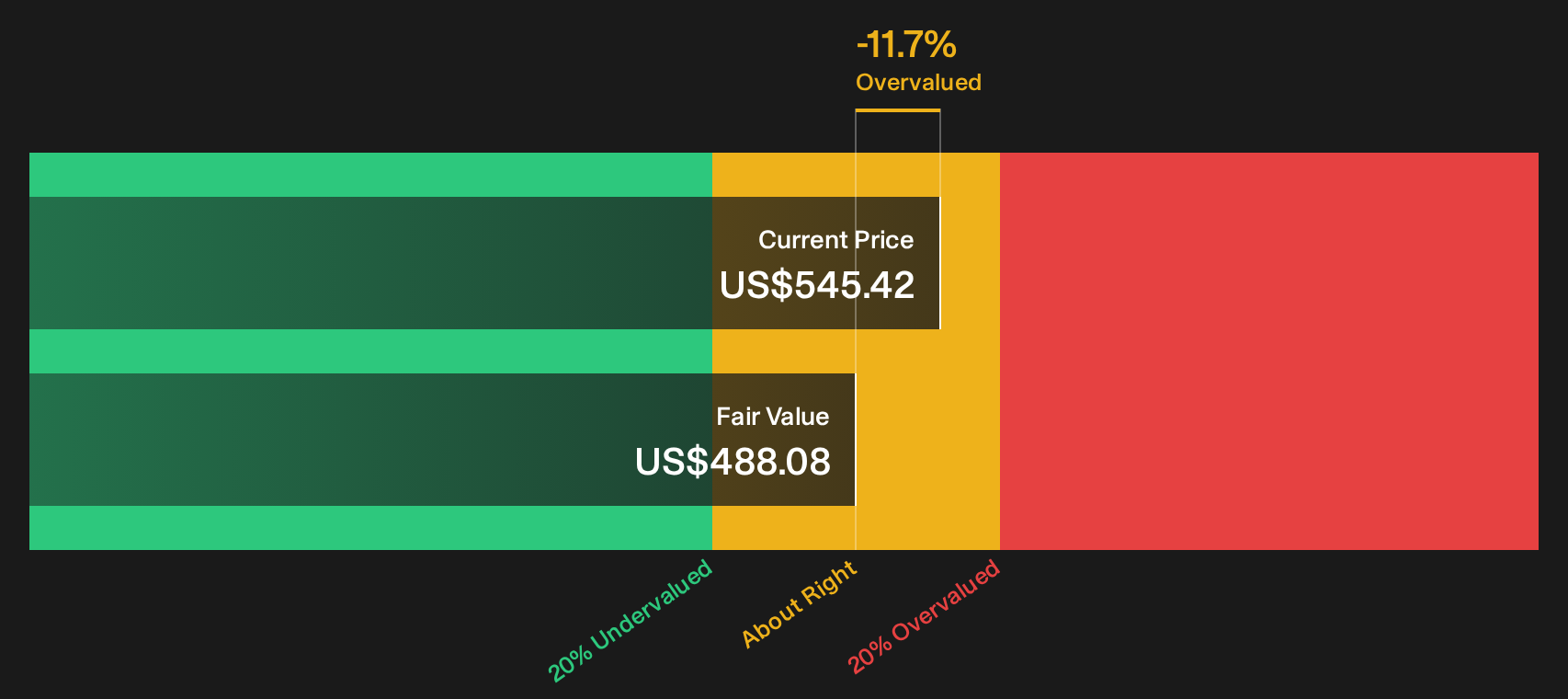
Simply Wall St performs a discounted cash flow (DCF) on every stock in the world every day (check out Ubiquiti for example). We show the entire calculation in full. You can track the result in your watchlist or portfolio and be alerted when this changes, or use our stock screener to discover 34 high quality undervalued stocks. If you save a screener we even alert you when new companies match - so you never miss a potential opportunity.
Next Steps
That mix of caution and optimism around Ubiquiti can feel conflicted. Review the data yourself and weigh the potential rewards through the 2 key rewards.
Looking for more investment ideas beyond Ubiquiti?
Ubiquiti may be on your radar, but you do not want to miss other opportunities that fit different goals, risk levels, and income needs.
- Target fresh potential by scanning a tightly filtered set of promising smaller companies through the 10 elite penny stocks with strong financials.
- Prioritise value and financial strength by zeroing in on a list of solid balance sheet and fundamentals (23 results) that can handle tougher conditions.
- Boost your income focus by reviewing a curated group of 4 dividend fortresses built around meaningful yields.
Have feedback on this article? Concerned about the content? Get in touch with us directly. Alternatively, email editorial-team@simplywallst.com