


EN
What a $115 Billion Deal to Buy Lumentum Really Means for Marvell Stock Investors
Semiconductor company Marvell Technology (MRVL) is all set to acquire Lumentum (LITE), a leading supplier of optical and photonic technologies, for $115 billion in an all-stock deal. Under the terms of the agreement, Lumentum shareholders will receive 4.5 shares of Marvell for each share of LITE stock they own. Marvell shareholders will own 67% of the combined company, while the rest will be held by Lumentum shareholders.
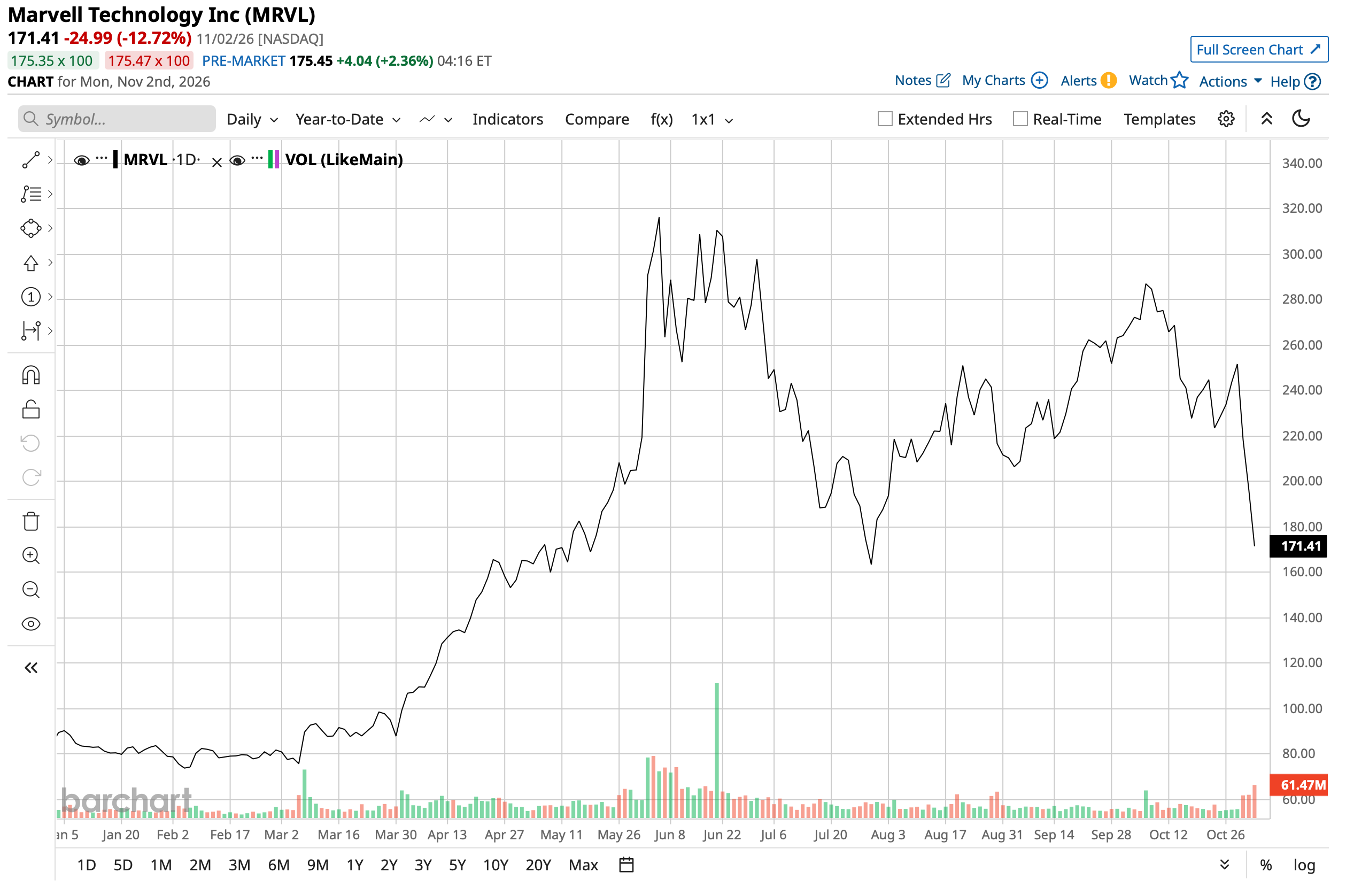
Marvell investors made their displeasure about the development clear, with shares ending almost 13% lower on Nov. 2 and down again today. They appear to believe the price tag of the deal is too high while the heavy dilution is also undesirable. Notably, the $115 billion consideration is an 86% premium to Lumentum's current market capitalization of $61.6 billion.
However, Marvell management believes that the deal has the potential to result in cost savings of more than $1 billion. “The companies that move first and help define this transition will set the standard for decades to come," said CEO Matt Murphy, describing the artificial intelligence (AI) infrastructure market's focus on optical connectivity as a “once in a generation” opportunity. “By bringing together two leaders with highly complementary technologies, exceptional talent and specialized manufacturing capabilities, we intend to help shape the next era of AI connectivity and create exceptional stockholder value."
About Marvell Technology
Founded in 1995, Marvell is an AI infrastructure company centered on data-center connectivity, custom silicon, optical interconnects, switching, and storage. Its custom silicon business in particular includes custom AI accelerators, XPUs, networking chips, storage and memory controllers, and data-center interconnect products. Marvell has an impressive customer base that includes Amazon (AMZN), Microsoft (MSFT), and Alphabet (GOOGL), among others.
Marvell currently commands a market cap of $150.8 billion, with MRVL stock up an impressive 86% on a year-to-date (YTD) basis. Notably, the stock also offers a modest dividend yield of 0.14%.
So, keeping the immediate market reaction aside, how will Marvell's impending acquisition of Lumentum impact its operations? Let's take a closer look.
Lumentum Is Legit for Marvell in the Long Haul
One rationale being bandied about the deal is that Marvell will gain access to Lumentum's expertise in optical transceivers, which allows for faster data transfer with less power. However, Marvell is buying more than faster optical transceivers. The bigger ambition of the deal is to control more of the technology connecting AI processors — from custom silicon and networking chips to lasers, optical modules, and optical circuit switches.
Notably, Marvell wants to design the electrical and optical signal chain together rather than optimize individual components separately. Bringing its silicon photonics, switching, and custom processors together with Lumentum’s lasers and optical manufacturing could reduce engineering friction, simplify customer qualification, and shorten development cycles, resulting in the development of a vertically integrated semiconductor player that is harder to replace once its technologies are incorporated into a customer’s design.
Meanwhile, Lumentum also brings indium phosphide capabilities and specialized laser production that complement Marvell’s semiconductor design strengths. Additionally, optical circuit switching provides a separate growth opportunity beyond transceivers.
On Nov. 2, amid its first-quarter fiscal 2027 results, Lumentum said that optical circuit switch (OCS) demand visibility could support a business generating several billion dollars annually. Management also disclosed a second major win involving optics placed near or alongside processors, supported by purchase commitments exceeding $5 billion. Those commitments give the Marvell acquisition thesis more substance than a broad forecast for rising AI traffic alone.
Finally, with Lumentum, Marvell will be able to offer potential customers a more complete alternative to its larger peer and biggest competitor, Broadcom (AVGO). However, integration also creates a potential channel conflict. Customers that currently buy components from independent suppliers may hesitate if their supplier becomes a broader competitor. Marvell must preserve those relationships while pursuing more integrated sales.
Marvell Reports a Super Q2
Before examining Marvell's Q2 figures, we should look at the company’s updated commentary on fiscal 2027 and fiscal 2028 revenue. Marvell raised its revenue outlook for both years, now projecting fiscal 2027 revenue of $12 billion and fiscal 2028 revenue of $18 billion, up from previous guidance of $11.5 billion and $16.5 billion, respectively. Within the fiscal 2028 outlook, Marvell anticipates data-center revenue growth of 60%, underscoring continued strength in the largest segment of the AI infrastructure buildout.
That momentum was visible in the latest quarterly results as well. Marvell reported record net revenue of $2.74 billion in Q2 fiscal 2027, representing a 37% increase from the prior year. Although that absolute figure set a new high, the growth rate lagged Broadcom, which recorded a 48% rise in its corresponding Q2 results. Meanwhile, Marvell's data-center revenue advanced 46% year-over-year (YOY) to $2.17 billion in Q2.
Gross margins contracted modestly to 58.9% from 59.4% in the year-ago period as stock-based compensation rose to $15.9 million from $13.4 million. Nevertheless, EPS increased 40% YOY to $0.94, just above the consensus estimate of $0.93.
For Q3, Marvell guided EPS between $1.05 and $1.15. Gross margins for Q3 are expected to fall in the range of 57.5% to 58.5%.
Net cash from operating activities improved to $605.5 million from $461.6 million in the prior year. Overall, Marvell closed Q2 with $3.93 billion in cash and no short-term debt. Long-term debt of approximately $5 billion, however, continues to appear as higher interest expense on the income statement. Interest expense rose to $61.6 million from $51.9 million in the same period last year.
Meanwhile, the searing rally in MRVL stock this year has led to punchy valuations. Its forward price-to-earnings (P/E) ratio of 56.1 times, price-to-sales (P/S) ratio of 18.3 times, and price-to-cash flow (P/CF) multiple of 47.1 times are all above the sector medians of 21.1 times, 3.2 times, and 18.7 times, respectively.
What Do Analysts Think of MRVL Stock?
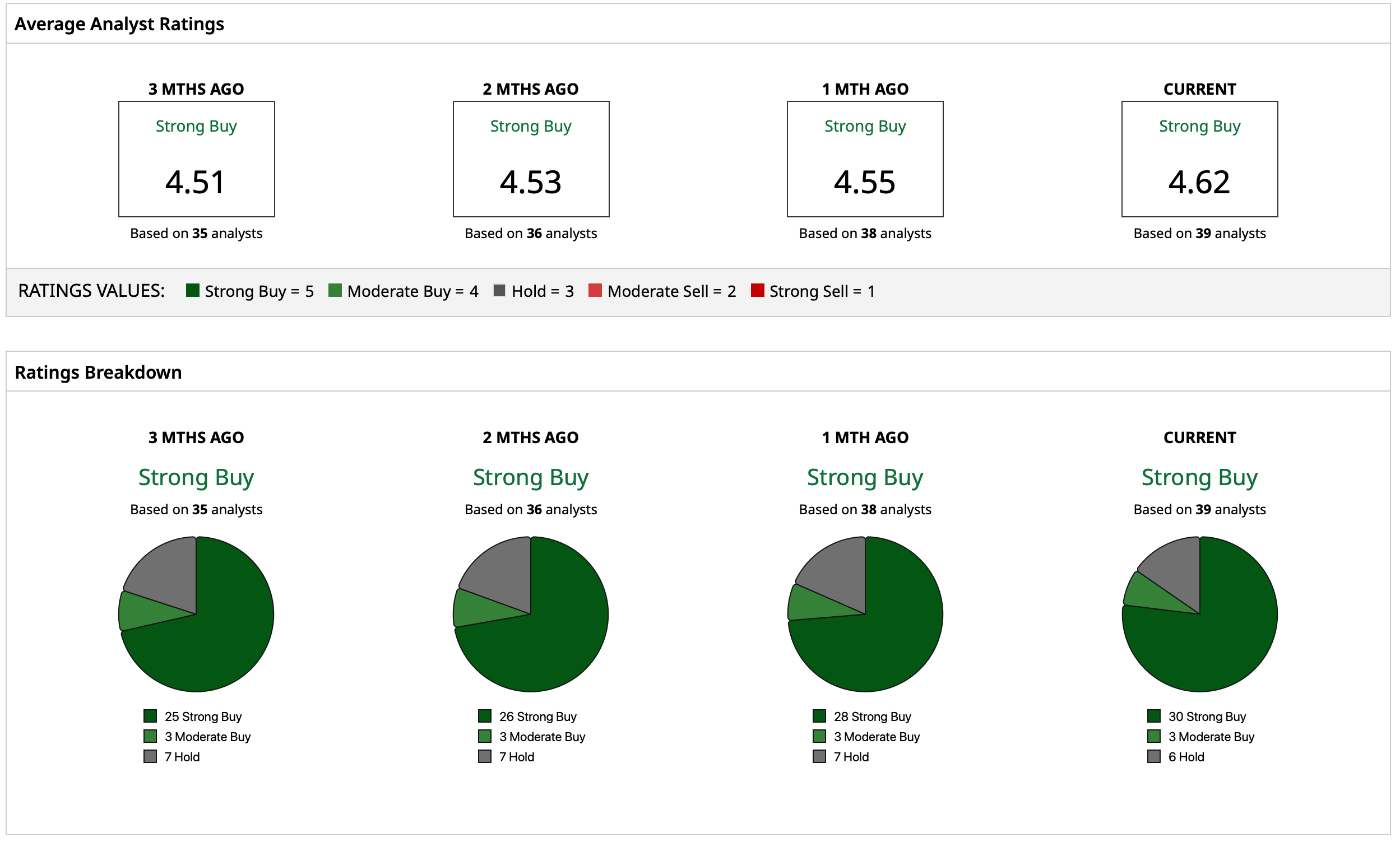
Taking all of this into account, analysts have a consensus “Strong Buy” rating for MRVL stock overall. Out of 39 analysts covering the stock, 28 have a “Strong Buy” rating, three have a “Moderate Buy” rating, and eight have a “Hold” rating. The mean target price of $317.05 denotes potential upside of 102% from current levels.
On the date of publication, Pathikrit Bose did not directly have a position in any of the securities mentioned in this article. All information and data in this article is solely for informational purposes. For more information please view the Barchart Disclosure Policy here.