


EN
Salesforce Stock Has Only Done This Twice Before. Here's What History Suggests Happens Next.
Key Points
Salesforce has seen three declines of at least 50% from a record closing high, including the 2026 episode.
Shares gained about 63% and 44% in the year after the first two threshold crossings.
AI could strengthen Salesforce’s customer relationships, while also threatening parts of the software business.
What's your first thought when you see "half off" at the bakery? Are you eager to snap up a quick deal, or do you assume the bread's gone stale? A similar question emerges in the stock market.
Take Salesforce (NYSE: CRM), for example. The company's stock has endured a rough patch over the last two years. At its June 2026 low, the stock had dropped more than 59% from its all-time high.
Missed Nvidia in 2009? This Rare Signal Is Flashing Again. In 2009, a "Double Down" signal flashed for a little-known chipmaker called Nvidia. For the first time in years, that same "Total Conviction" signal is flashing for a company 1/100th the size of Nvidia. Continue »
But to decide whether Salesforce is a ready-made bargain or a week-old baguette, we need to examine the details.

Image source: Getty Images.
Salesforce's 50% stock declines are rare
Salesforce has been a public company since 2004. In its more than 22 years as a public company, its stock has dropped 50% or more from its all-time high on only three occasions:
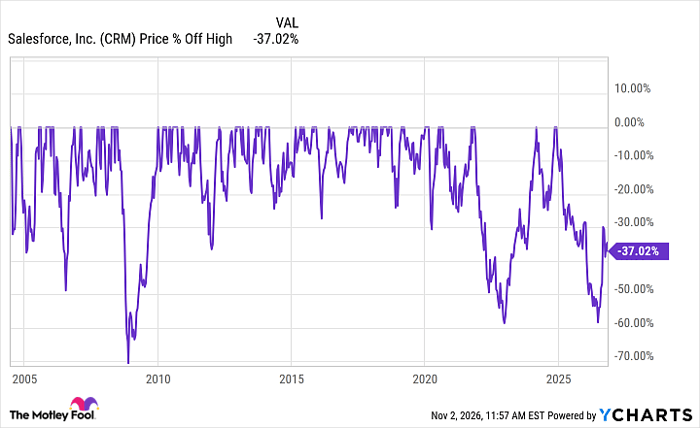
- Oct. 7, 2008: Salesforce stock fell sharply, along with the broader market, as the financial crisis shook Wall Street. Salesforce stock ultimately declined by 70% before bottoming in November 2008.
- Sept. 1, 2022: Salesforce stock melted slowly throughout late 2021 and nearly all of 2022 during the latest bear market. After crossing the 50% threshold in September 2022, the stock bottomed in December 2022, down 59% from its all-time high, before recovering and setting new all-time highs in 2024.
- Feb. 23, 2026: Salesforce stock fell below the 50% mark in February 2026 as market participants fretted over whether software-as-a-service (SaaS) business models would withstand rapid innovations in the artificial intelligence (AI) sector.
These drops aren't garden-variety pullbacks; they are rare structural resets. And in the latest case, a recovery may already be underway.
Past recoveries rewarded patience, not perfect timing
So, let's see what happened in the past. In each case, we'll assume an investor bought the day after the 50% level was crossed. In the 2008 case, shares gained 63% in the year after the breach. In 2022, Salesforce stock rose 44% in the following 12 months. However, there's one very important caveat: Things got worse before they got better. In 2008, shares dropped another 39% before the bottom was truly in. In 2022, shares fell another 16%.
In other words, while a 50% drop is massive for Salesforce stock, investors shouldn't think of it as a line in the sand. The stock can -- and has -- fallen even further before. Past rebounds show resilience, but today's recovery requires a clear-eyed look at the current business.
Can Salesforce turn AI into lasting growth?
To see where Salesforce stock is headed, let's look at what it already does. In a nutshell, the company sells customer relationship software. AI poses both an opportunity and a threat.
First, the opportunity. Salesforce is already integrating AI into its products, essentially upgrading an existing car by putting a state-of-the-art engine under the hood. The benefit is clear: Businesses retain their existing software investment, employees keep their familiar interfaces, and AI simply accelerates existing workflows. And that is, in fact, what seems to be happening. As Salesforce CEO Marc Benioff said, "AI is delivering value across every layer of our platform." Moreover, this optimism from management is reinforced by impressive results. In its most recent quarter (ended July 31), Salesforce reported 11% revenue growth.
Granted, AI could cut into Salesforce's status as a growth stock. Indeed, if AI advances far enough, an AI-generated competitor could emerge, or companies could build their own replacement software in-house. However, building an internal replacement or switching vendors carries massive friction. Salesforce holds decades of proprietary customer data and deeply ingrained integrations across enterprise tech stacks -- switching costs that most IT departments are loath to incur simply to chase a newer AI wrapper.
What Salesforce's history means for investors today
In summary, scary-looking price declines happen. In Salesforce's case, two prior declines ultimately rewarded investors who had the patience to ride out the volatility and focus on the company's solid fundamentals. Salesforce continues to deliver solid revenue growth, steady margins, and cash flow. While the market shouldn't dismiss fears of AI disruption entirely, patient long-term investors still have plenty of reasons to keep Salesforce on their radars.
Jake Lerch has no position in any of the stocks mentioned. The Motley Fool has positions in and recommends Salesforce. The Motley Fool has a disclosure policy.