


EN
How Investors Are Reacting To Workday (WDAY) Benefits And Payroll Partnerships
- Workday scheduled the release of its fiscal 2027 third quarter results for November 24, 2026, and arranged a same day webcast and conference call to review financial performance and business outlook with investors.
- Securian Financial and Chime joining the Workday ecosystem in wellness and direct deposit integrations signal deeper embedding of Workday into employee benefits and financial wellness workflows for mutual customers.
- The focus now turns to how Workday's deeper wellness and direct deposit integrations could influence the existing investment narrative around its platform.
Workday Investment Narrative Recap
To own Workday, you need to believe the business can keep turning strong AI adoption and wider product coverage in HR and finance into durable subscription demand without losing its margin discipline. The near term spotlight stays on the fiscal Q3 2027 results on 24 November 2026, where management commentary on AI related annual recurring revenue and Flex Credits usage sits front and center.
The biggest current risk is that AI expectations run ahead of recognized subscription revenue, especially if customers are slow to shift to the hybrid consumption model. The latest wellness and payroll partnerships look directionally helpful but do not meaningfully change that near term tension between the AI narrative, reported growth in the low teens, and a rich P/E multiple.
Among the recent updates, the expanded Chime partnership ties most clearly into the catalyst story. It puts Workday inside the direct deposit choice flow for millions of employees and connects paychecks to Chime financial tools, reinforcing Workday’s push into financial wellness and everyday payroll decisions rather than just back office processing.
For you as a shareholder, this matters because it tests Workday’s ability to turn new workflow integrations into higher attach rates for AI driven tools over time. Any evidence around Q3 that these embedded experiences support broader adoption of Flex Credits or higher activity across AI agents and Data Cloud could help address concerns that AI related growth remains concentrated in smaller, slower ramping deals.
Workday's current analyst narrative projects US$13.8b in revenue and US$2.1b in earnings by 2029, based on an assumed 10.7% yearly increase in sales and a move from US$1.3b in earnings today to that 2029 consensus level. This implies roughly a US$0.8b step up in profit over the period.
Discover why Workday's fair value indicates a 5% potential upside to its current price, which could materialize sooner than many investors anticipate.
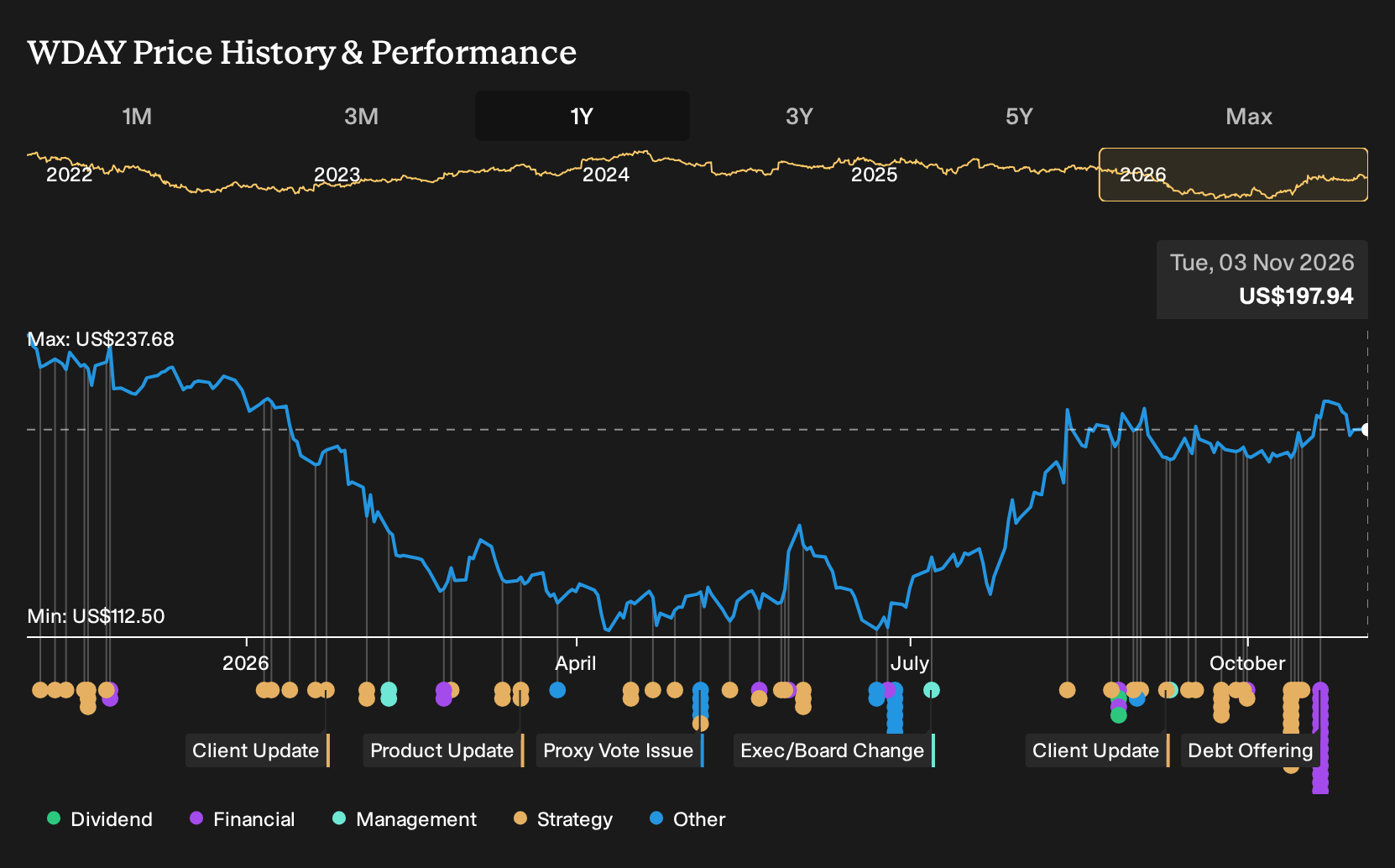
Exploring Other Perspectives
Some of the most optimistic analysts frame Workday’s AI centric partnerships as proof that paid AI services can scale far beyond consensus expectations. Before this news, the bullish narrative already pencilled in revenue of about US$14.5b and earnings of US$3.6b by 2029. Your takeaway is that opinions differ widely, and both narratives may shift once these wellness and payroll integrations filter into guidance.
Explore 7 other Workday fair value estimates, including one that suggests potential upside of up to 178% from the current price.
Reach Your Own Conclusion
Don't just follow the ticker. Dig into the data and build a conviction that's truly your own.
- A great starting point for your Workday research is our analysis highlighting 3 key rewards that could impact your investment decision.
- See our latest analysis for Workday. The report includes a comprehensive fundamental analysis summarized in a single visual, the Snowflake, making it easy to evaluate Workday's overall financial health at a glance.
Looking for more investment ideas beyond Workday?
If you want to put Workday in context and pressure test your thesis, compare it with other companies that share similar qualities using the Simply Wall St Screener. Pick a few different angles, see which businesses clear your personal hurdles, and use that cross check to sharpen your overall portfolio.
- If you prize balance sheet strength and steady fundamentals, start with our list of solid balance sheet and fundamentals (23 results) to see which companies match that profile.
- If you are hunting for quality at a reasonable entry point, scan our curated 35 high quality undervalued stocks to spot ideas that may warrant a closer look.
- If resilience matters more than excitement in your portfolio, filter for defensiveness first with our 30 resilient stocks with low risk scores
Have feedback on this article? Concerned about the content? Get in touch with us directly. Alternatively, email editorial-team@simplywallst.com