


EN
How to Play the Selloff in Arm Stock
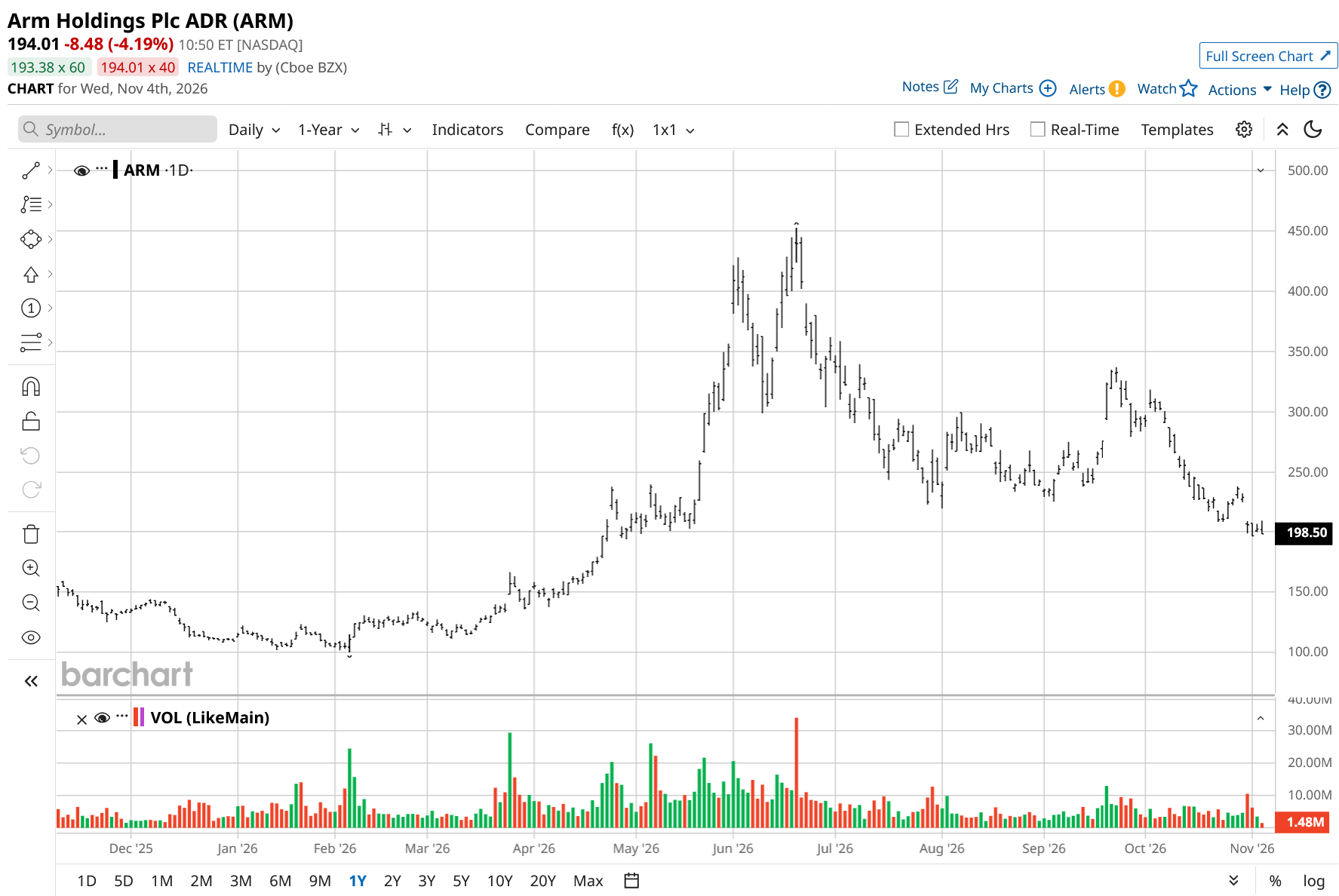
The recent tech selloff has been especially tough on semiconductor stocks, with Arm Holdings (ARM) suffering the most. Shares fell more than 11% during the Friday trading session on Oct. 30, before recovering somewhat to end down by around 10%. The selling sentiment continued on Monday, though ARM had been bouncing back to around $203.71 during Tuesday's session before dropping again as trading kicked off Wednesday morning.
Importantly, the decline wasn't caused by poor earnings results from Arm itself. Rather, concerns over returns from investments in AI infrastructure have been putting a lot of pressure on the overall semiconductor group. Advanced Micro Devices (AMD), Nvidia (NVDA), and Broadcom (AVGO) have all seen significant declines. Nevertheless, with Arm set to report earnings on Nov. 4, there are additional reasons to rethink the company's valuation and prospects for growth.
About Arm Stock
Based in Cambridge, England, Arm Holdings develops and licenses semiconductor IP, including energy-efficient CPU architectures that are used in a wide array of applications ranging from smartphones and data centers to automotive systems and AI devices. Instead of selling chips itself, Arm makes its money mostly from licensing and royalties; however, the recent move into producing its own silicon has changed that somewhat. At Monday's close, the company had a market cap of around $210 billion.
Although the company has seen a noticeable correction, ARM stock has performed well this year. Shares have been up by around 86% year-to-date (YTD), easily outperforming the 12% gain in the Nasdaq-100 Index. Nevertheless, the stock has lost about 34% over the past month and currently sits at around 55% below its 52-week high of $452.70.
The most serious concern right now is valuation. ARM trades at a forward price-to-earnings (P/E) ratio of 178.76x and a P/S ratio of 44.71x. In contrast, a peer group valuation dataset for semiconductors puts the median price-to-sales (P/S) ratio at around 14.6x.
Therefore, even despite this steep selloff, Arm still looks expensive. Investors are paying a very high price for the company's exposure to AI infrastructure and for its ability to generate more revenue per generation of chips.
Beats on Earnings as AI Demand Accelerates
The recent earnings results of Arm provide quite a different story compared to the recent price performance. During the July 29 conference call, the company reported Q1 2027 earnings that beat expectations on both top and bottom lines. Revenue came in at $1.29 billion, rising 22% year-over-year (YoY) and beating Wall Street's expectation of approximately $1.26 billion. EPS was $0.45, above the consensus of $0.40 and up 29% from the year before.
What attracted my attention was the performance of Arm's royalty business, which saw its revenue rise by 22% to $715 million, while licensing revenue increased 23% to $574 million. Importantly, data center royalties have grown more than two times YoY, implying that Arm is now benefiting more and more from the transition to power-efficient AI infrastructure.
Moreover, Arm's newly introduced AGI CPU provides another opportunity. According to management, the demand for the product from customers now exceeds $2 billion over fiscal years 2027 and 2028, compared to the previously mentioned initial $1 billion opportunity. However, it shouldn't be confused with actual revenue recognition, since the company is still struggling with increasing manufacturing capacity.
There are also some worries. While reporting robust revenue growth, the company's GAAP operating income decreased by approximately 20% YoY to $91 million. That was due to higher operating expenses and investments in R&D. With Arm moving beyond its traditional licensing business model, execution and profitability have now become more and more important.
Looking forward, the company guided Q2 revenue to be around $1.38 billion, ±$50 million, and EPS to be $0.47, ±$0.04. Wall Street expects the company to bring in approximately $1.38 billion in revenue and earn $0.48 in EPS, meaning that analysts expect another quarter of double-digit revenue growth.
It has been confirmed that Arm will publish its Q2 2027 results on Wednesday, Nov. 4, after the market close. Given the recent volatility, the upcoming earnings report may be quite critical for determining whether shares stabilize or suffer another correction.
What Do Analysts Expect From ARM Stock?
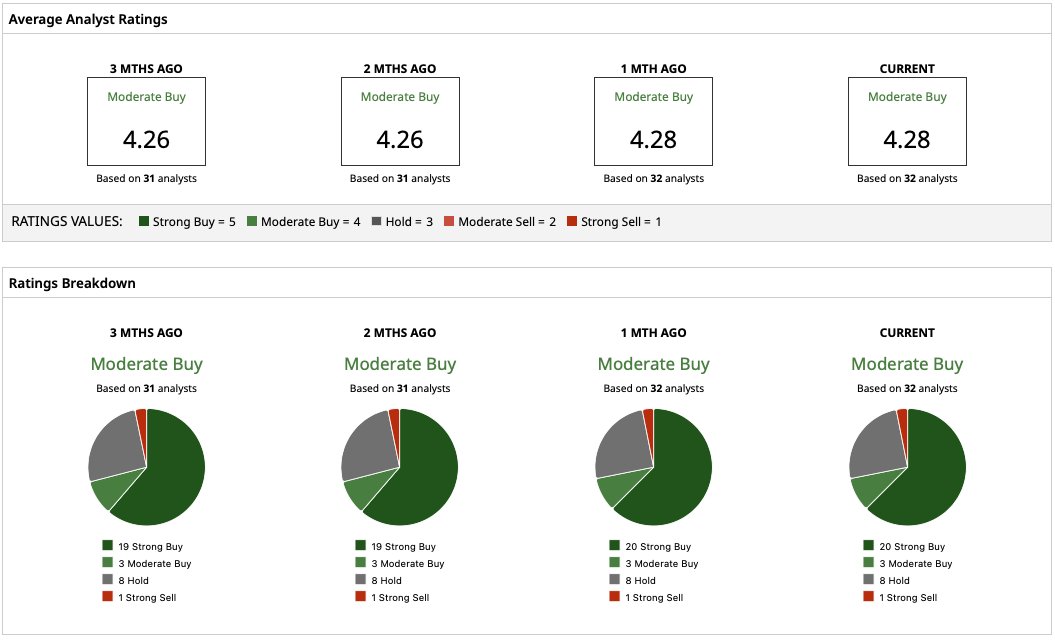
Despite the sharp drop, Wall Street has remained fairly optimistic about Arm's outlook. Analysts assign ARM stock a “Moderate Buy” rating consensus with a mean price target of $289.14. Based on the recent price of $199, its mean target implies a potential upside of approximately 47%. At the same time, the highest price target of $480 implies a potential upside of approximately 136%, while the lowest target of $130 offers a potential downside of roughly 34%. This rather large range reflects the uncertainty concerning Arm's earnings potential and its valuation.
On the date of publication, Yiannis Zourmpanos did not directly have a position in any of the securities mentioned in this article. All information and data in this article is solely for informational purposes. For more information please view the Barchart Disclosure Policy here.