


EN
Should You Forget VOO and Buy This Magnificent ETF Instead?
Key Points
The tech-heavy Nasdaq-100 has lost about 9% within the past month.
Other than Apple, most of the "Magnificent Seven" are flat or negative in the past year.
Buying the Vanguard S&P 500 ETF might be a better choice for long-term investors.
Tech stocks are suddenly looking like a questionable-at-best bet for investors. The tech-heavy Nasdaq-100 has declined by about 9% since its Oct. 6 high. Many investors are worried about the high costs of building data centers and infrastructure for the artificial intelligence (AI) industry. Recent reports from skeptical analysts have suggested that the payoff from AI might not be arriving anytime soon.
For most of the past several years, buying the "Magnificent Seven" tech stocks -- Alphabet, Amazon, Apple, Meta Platforms, Microsoft, Nvidia, and Tesla -- has been a great way to grow your money. The Roundhill Magnificent Seven ETF (NYSEMKT: MAGS) offers equal-weight exposure to all seven of these companies in one exchange-traded fund (ETF).
Missed AI’s "Act 1"? Act 2 Could Be 15x Bigger. Most investors think they missed the AI boat because they didn't buy Nvidia in 2005. But according to our analysts, we’re only at the end of "Act 1"—the R&D phase. "Act 2" is the global rollout. Continue »
But in the past year, share prices of the seven companies represented in MAGS have mostly been negative or flat. Only Apple shares have delivered a strong gain.
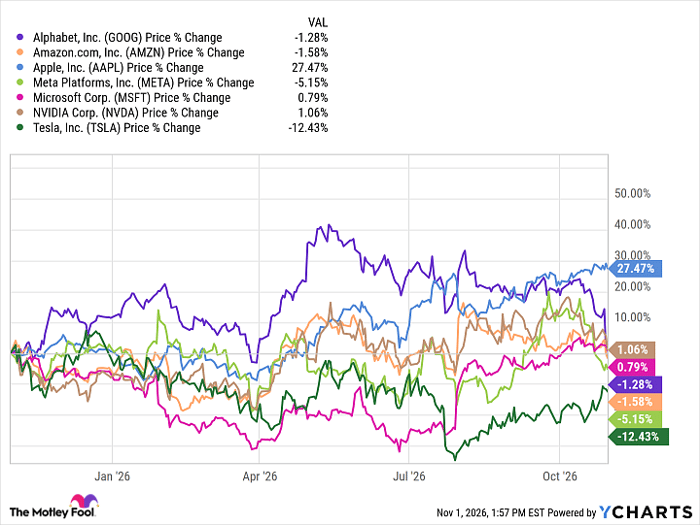
Several Magnificent Seven stocks are AI hyperscalers that are making hundreds of billions of dollars in capital expenditures to build what they hope will be the next generation of transformative, productive, must-have digital tools and services. But as the recent Nasdaq-100 sell-off has shown us, investors have their doubts.
Based on what we know today, could you be better off investing in the Vanguard S&P 500 ETF (NYSEMKT: VOO) instead of the Magnificent Seven? Let's look at the evidence.

Image source: Getty Images.
Why buy MAGS despite the AI stock sell-off...or not
If you believe that investor fears about tech stocks are overblown, the Nasdaq-100 is going through a short temporary downturn, and the Magnificent Seven will quickly bounce back, you might be right. These seven tech stocks are among the largest, most profitable companies in history. Their leaders are investing aggressively in AI because they believe it will change the world, just as smartphones and the internet did.
In the past three-and-a-half years since the fund's inception in April 2023, the Roundhill Magnificent Seven ETF has delivered average annual returns (as of Sept. 30) of 36.9%. But the fund's performance in the past year is less impressive; MAGS has returned only about 12.2%. Much of that past-year return came from Apple, while other stocks lagged.
Will the Magnificent Seven still be a good investment in the future?
Right now, I don't feel confident putting too much money into just these seven companies. Not all Magnificent Seven companies might be good investments if the AI boom turns into a prolonged bear market. For example, Apple is not really an "AI stock" in the same way as Alphabet -- which recently lost about $500 billion of market value in one day due to fears that AI chatbots are undermining Alphabet's core business of search engine ads.
Is AI a bubble? Will AI technology ultimately fail to pay off for investors? Are companies like Alphabet and Meta spending way too much on AI data centers and expensive AI models that will never make money? If you believe that the answer is "yes" to any of those questions, you might want to avoid the Mag Seven and buy the Vanguard S&P 500 ETF (VOO).
Why buy VOO -- AI bubble or not
In the past four years since ChatGPT launched, there's been a huge amount of excitement among investors for the companies building AI. This has included AI hyperscalers like most of the Magnificent Seven, as well as semiconductor stocks and construction companies that build data centers. But recent Vanguard research suggests that for the future of AI, the best place to invest now might be non-tech stocks and sectors.
Vanguard believes that some of the biggest long-term winners of AI might not be tech companies that build AI. Instead, the future AI winners might be companies that use AI in their businesses. This could include value stocks like healthcare stocks and financial services.
If you buy an S&P 500 ETF like VOO, you will own all 500 of the largest publicly traded companies in America -- not just seven tech stocks. Broadly diversifying among 500 large-cap stocks could help you own a wider range of sectors. VOO owns major tech names and its portfolio is about 39.7% tech stocks. But it also includes large-value stocks, major banks, and pharmaceutical companies.
VOO could let you own a mix of companies that might benefit most from the productivity gains of AI, even though they're not building the AI tools themselves. But VOO also holds tech stocks so that you could benefit from some of that upside in case tech stocks bounce back and soar to new highs.
In the past five years, the Vanguard S&P 500 ETF has delivered average annual returns of about 12%. That strong performance includes the 2022 bear market. Even if we go through another bad tech-stock bear market like the one we experienced in 2022, buying VOO is likely a smart choice for long-term investors.
Ben Gran has no position in any of the stocks mentioned. The Motley Fool has positions in and recommends Alphabet, Amazon, Apple, Meta Platforms, Microsoft, Nvidia, Tesla, and Vanguard S&P 500 ETF. The Motley Fool has a disclosure policy.