


EN
What Parker-Hannifin Buyers Were Betting On
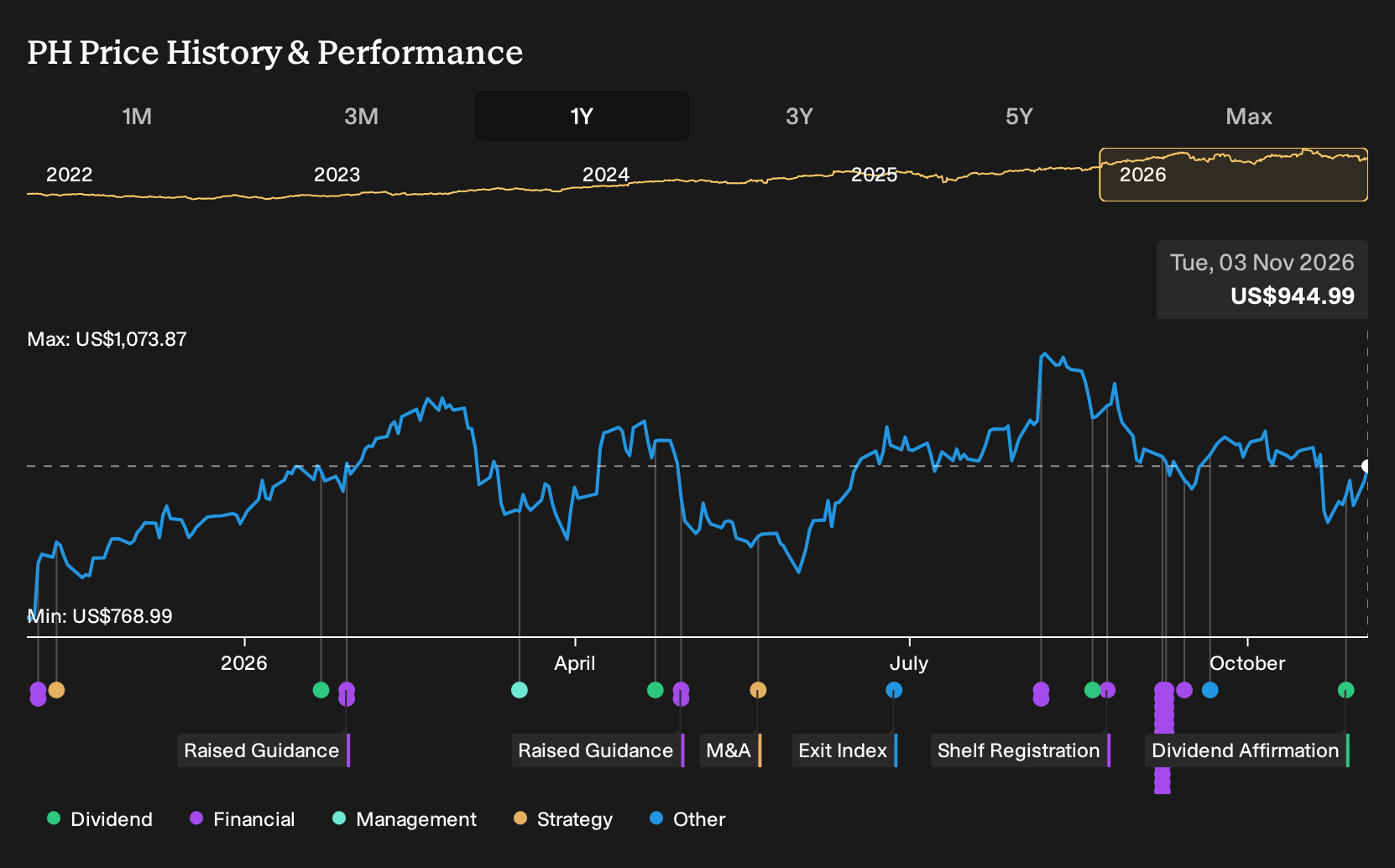
If Parker-Hannifin was on your watchlist rather than in your portfolio, the return may sting. Investors who held Parker-Hannifin over the past year are up 23.9%, including dividends. That outcome raises an obvious question. What might have helped you view Parker-Hannifin as an automation and decarbonization enabler for global infrastructure, rather than just a mature industrial, before that move showed up in your account?
Parker-Hannifin is not the only name tied to this theme. Zero in on 94 robotics and automation stocks and compare how each one is priced.
The Two Parker-Hannifin Stories Investors Had To Judge
The shares cost US$772 at the start of the period, which left you weighing two sharply different stories about what Parker-Hannifin could become.
On the bullish side, one camp argued the stock was worth a Fair Value of US$857, a price that reflected what they thought the assumptions added up to, built on the idea that higher structural margins from portfolio transformation and cost work would support stronger long-term earnings power.
The bearish camp anchored on a Fair Value of US$500, based on concerns that the global shift toward electrification and software-heavy automation might steadily weaken demand for Parker-Hannifin's hydraulic and pneumatic components and leave its traditional markets under pressure.
What The Results Changed For The Parker-Hannifin Debate
Parker-Hannifin delivered Q4 2026 revenue of US$5.76b and net income of US$1.09b, up from US$5.24b and US$923m a year earlier, with net margin rising from 17.6% to 19.0%. That pattern, along with record full-year earnings and higher operating margins, supported the view that argued for stronger earnings power, although slowing organic growth kept the cautious case in consideration.
The useful lesson is simple. When a thesis hinges on “structurally higher margins,” you test it by tracking multi-year net margin and operating margin trends, not just headline revenue or analyst enthusiasm.
What Parker-Hannifin's Current Price Already Assumes
Today Parker-Hannifin trades at US$945, after a 23.9% gain over the past year. The selected Narrative places its Fair Value below that level, reflecting a view that the current quotation already builds in a premium for execution and earnings quality.
The Narrative centers on slower organic expansion in legacy industrial exposure, offset by higher margin aerospace and filtration platforms. Anyone buying Parker-Hannifin here is effectively assuming those portfolio shifts, integrations and lean programs land on time and at scale. How does the risk of slower synergy capture or backlog conversion affect that bet?
"Although Parker-Hannifin has pushed its portfolio toward longer cycle aerospace, engineered materials and filtration platforms that now represent about 65% of pro forma sales, a meaningful portion of revenue still relies on slower growing traditional industrial demand. This could keep organic revenue growth closer to the recent 3.2% pace and limit upside to earnings and free cash flow."
That disagreement has a full argument behind it. → Uncover the lower Fair Value this Narrative argues for
How Could You Get There Earlier?
What if your next investment idea came before the headlines? Go straight to the companies whose prices and our estimates still disagree. Three places to start, with the names waiting behind the link.
- Company 1 - 23% below our estimate - supplies power and connectivity hardware for hyperscale data center construction and long-duration projects.
- Company 2 - 38% below our estimate - expands production of high-output engines used to address accelerating data center energy needs.
- Company 3 - 45% below our estimate - processes digital transactions so large merchants can manage increasing emerging market payment activity.
That is three of the list. See all 34 potentially undervalued companies →
Have feedback on this article? Concerned about the content? Get in touch with us directly. Alternatively, email editorial-team@simplywallst.com