


EN
3 Korean Bank Stocks Built For Higher Rates
Inflation in South Korea has settled into an awkward zone, not hot enough to force new rate hikes yet sticky enough to keep borrowing costs elevated, and that is reshaping where risk and reward sit across Korean domestic banks and financial stocks. When cash stays expensive, some balance sheets feel the squeeze while others quietly collect richer interest margins. This article picks out three companies from the Bank of Korea higher rates story that screen positively on fundamentals and policy exposure, and explains how the current backdrop may call for patience in some areas and caution in others.
The three stocks covered next are only a sample. The full higher rate screen surfaced 9 more Korean financial companies with equally compelling stories that are not unpacked here.
If you want to identify which Korean lenders, insurers and brokers line up best with your own risk and income goals, move straight into the Korean Domestic Banks and Financials Benefiting from Prolonged Higher Rates screener.
KB Financial Group (KOSE:A105560)
KB Financial Group sits near the center of the higher rate story in South Korea, with a wide mix of banking, securities and insurance activities that tie its earnings power tightly to where the Bank of Korea keeps policy settings.
KB Financial Group is a large Seoul based financial conglomerate offering retail and corporate banking, cards, securities and insurance across several countries, with a market value of about ₩53.2t.
"Although KB Financial Group is increasing the share of fee and capital-market-linked income in its revenue mix, the same shift leaves earnings more exposed to variable securities and wealth management activity, which could lead to more volatile noninterest revenue and a less predictable contribution to overall earnings."
The balance between relatively steady interest income and more changeable fee flows could significantly influence overall returns.
That mix of steady and variable income is exactly what the full narrative for KB Financial Group unpacks, highlighting where shifting rate sensitivities may be masking KB Financial Group’s next leg of returns.

Hana Financial Group (KOSE:A086790)
Hana Financial Group is one of the clearest plays on the higher for longer rate story in Korea, because its core banking and fee engines are built around domestic lending spreads and capital light services that can respond quickly when the Bank of Korea keeps money expensive.
Hana Financial Group is a broad based financial group spanning banking, securities, cards, asset management and insurance across Asia and major global hubs, with a market value of about ₩30.7t.
"Hana Financial Group is tying higher ROE and disciplined growth in risk weighted assets to a formulaic capital return framework, so any uplift in profitability can translate more mechanically into larger dividends and buybacks that influence earnings per share and return on equity."
What happens if one quiet pressure on its funding costs shifts faster than loan pricing can adjust will decide how powerful that framework feels to shareholders.
If that funding squeeze is the real hinge, the full narrative for Hana Financial Group shows where Hana Financial Group’s capital return engine could still be quietly accelerating.
Shinhan Financial Group (KOSE:A055550)
Shinhan Financial Group is one of the purest expressions of this higher for longer rates theme, because its nationwide loan and deposit engine sits at the center of how the Bank of Korea’s policy choices flow through to bank earnings and investor payouts.
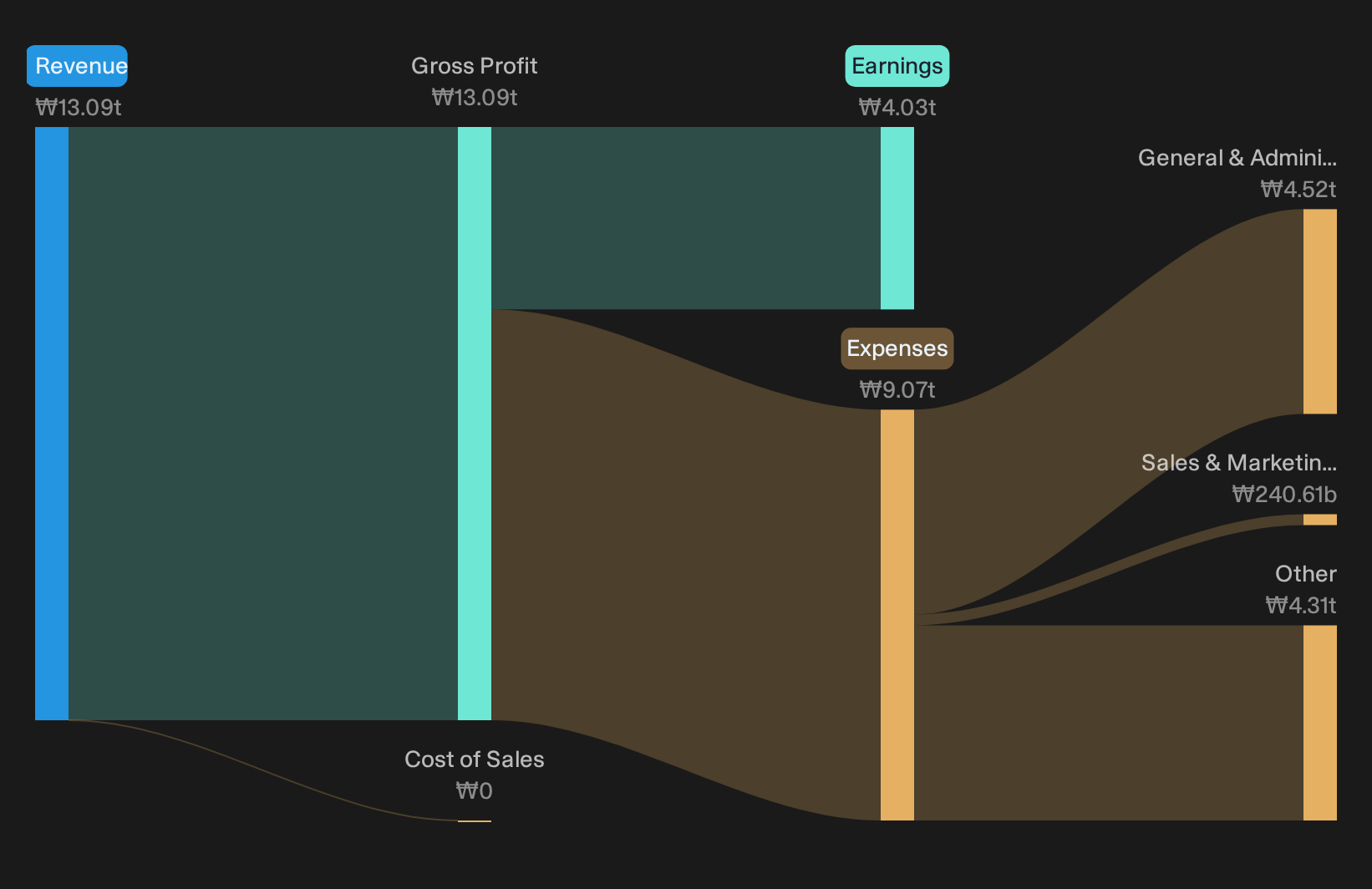
Shinhan Financial Group runs a broad Seoul based financial group built around banking, which generated about ₩9.8b in revenue, alongside securities at roughly ₩1.9b, credit cards near ₩1.7b, insurance close to ₩0.9b, and other activities, giving it a market value of about ₩40.2t.
"The formula based shareholder return approach, including guidance for a 50 to 60% three year shareholder return ratio and more than 10% annual DPS growth over the next three years, can lift earnings per share as buybacks reduce the share count."
What happens if one unseen pressure on funding costs or credit losses pushes against that payout formula will be crucial for margins and investor returns.
If you want to see how that pressure could still accelerate shareholder returns, move through the full narrative for Shinhan Financial Group to see where Shinhan Financial Group’s payout formula might be quietly decoupling.

Seeking Alternatives Before The Crowd?
Fresh ideas move first. By the time momentum is obvious, the best entry points can be gone and valuations flying. Scan these under the radar lists while it matters and consider your options early.
- Spot potential breakouts earlier by reviewing hand picked 196 high quality undervalued stocks that pair solid cash flows with balance sheets built to stay resilient when sentiment drops.
- Track where real earnings momentum meets AI hype by scanning curated 40 profitable AI stocks that aren't just burning cash that already generate cash instead of relying on constant funding.
- Strengthen your income core by assessing pre filtered 220 dividend fortresses designed to highlight higher yielding payers that still keep an eye on financial stability.
Have feedback on this article? Concerned about the content? Get in touch with us directly. Alternatively, email editorial-team@simplywallst.com