


EN
Starlink Technology (06727)'s first financial report on the launch: revenue acceleration, new product launch, and steady expansion of the global landscape
The Zhitong Finance App learned that in September 2026, Starlink Technology (06727) entered the Hong Kong stock market and officially set up an “A+H” dual capital platform. Recently, the company disclosed its report for the third quarter of 2026, and handed over the first performance questionnaire after the Hong Kong stock listing, which sent multiple positive signals: revenue for the first three quarters increased 19.57% year on year; Q3 revenue growth rose to 31.62% year on year; single quarter gross margin rose to 64.71%, and net loss to mother for the first three quarters narrowed 27.33% year on year.
In addition to continuous improvement in operating fundamentals, the company's blockbuster GPU native cognitive database has successively launched multi-industry benchmark projects and appeared at the International Database Conference and Southeast Asia Industry Summit; at the overseas business level, relying on local qualification certification, industry partner collaboration and in-depth industry exchanges, the global boundary continues to expand.
For an enterprise that has been deeply involved in underlying basic software for a long time and has insisted on high R&D investment, the acceleration in revenue and the narrowing of losses are intuitive proof of the current improvement in operating efficiency; the commercialization of new products and breakthroughs in overseas markets are the core clues for investigating its long-term commercialization potential.
Increased revenue growth, loss reduction driven by gross profit restoration and lean management
In the first three quarters of 2026, Starlink Technology achieved revenue of 269 million yuan (unit: RMB, same below), a year-on-year increase of 19.57%; in the third quarter, single-quarter revenue of 96 million yuan, a year-on-year increase of 31.62%, significantly higher than the overall growth rate of the previous three quarters.
While the revenue curve is improving, the recovery in gross margin is another highlight of this financial report. According to the company's main business caliber, gross margin for the first three quarters was 53.33%, and gross margin climbed to 64.71% in Q3. Both indicators increased compared to the same period last year.
For basic software circuit companies, the expansion of revenue scale and simultaneous improvement in gross margin means that while the business is growing in size, the ability to generate profits is simultaneously increasing, building a solid foundation for covering high R&D and operating expenses and continuously optimizing operating fundamentals.
The cost side showed a lean management trend: sales expenses in the first three quarters were 105 million yuan, down 6.48% year on year; management expenses were 73 million yuan, down 13.39% year on year. In the context of maintaining positive revenue growth, two core expenses have been reduced, demonstrating the company's continued refinement of operating efficiency.
At the same time, the company has always maintained a high level of investment in R&D. R&D investment in the first three quarters was 171 million yuan, accounting for 63.73% of revenue. This caliber includes cost-based and capitalized R&D expenses, and continues to feed back the underlying architecture iterations, product matrix upgrades, and new business line exploration.
Due to the resonance of the three factors of revenue growth, gross profit recovery, and cost optimization, net loss to mother narrowed to 155 million yuan in the first three quarters, a year-on-year decrease of 27.33%. The company is still in a growth loss cycle at this stage, but the combination characteristics of “high R&D investment in parallel and continuous narrowing of losses” confirm its phased results in balancing technological innovation and operational quality improvement.
GPU native cognitive database launched a benchmark project, and the commercialization path is clear
If the improvement in gross margin reflects the restoration of current business quality, then the progress of GPU native cognitive databases is related to the company's second growth curve for the AI agent era.
Traditional databases mainly serve manual queries and business systems, but after AI agents gradually enter enterprise production processes, agents need to continuously call data, retrieve knowledge, use tools, and rely on complete business context and long-term memory. As a result, the role of a database is shifting from a “data storage and query tool” to a “cognitive infrastructure that supports agents to understand business, continuously analyze, and execute tasks.”
Starlink's GPU native cognitive database was designed for this change. It uses GPUs as the core to restructure the database architecture, integrating high-performance data processing, knowledge recall, and long-term memory. In response to the bottlenecks faced by CPU databases in AI inference scenarios with insufficient parallel computing power, low data processing efficiency, and high data handling delays between CPU and GPU, GPU native cognitive databases incorporate capabilities such as data analysis, knowledge retrieval, and multi-modal processing into a unified GPU acceleration system to open up a link between data processing and model inference.
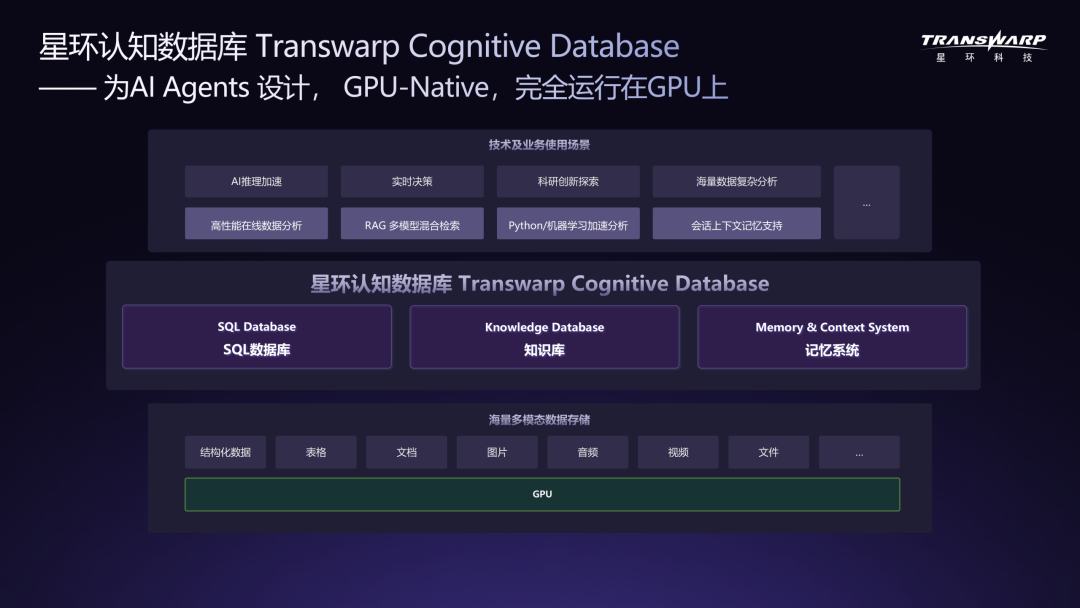
(Starlink Technology GPU Native Cognitive Database Architecture Diagram, Source: Starlink Technology Official Account)
More importantly, this product has begun to move from technical verification to scenario implementation. Currently, the product is being implemented in projects of leading customers in various industries. In the future, it is expected to be mainly used in low latency, high concurrency, and large data volume scenarios such as financial risk control, quantitative investment and research, intelligent financial analysis, and enterprise knowledge question-and-answer. It shows a wide range of enabling values and flexible scenario adaptation capabilities, providing a strong new engine for the company's future large-scale expansion and high-quality growth.
Accelerating the global layout: academic debut, ecological roots, partnership collaboration on multiple lines
When enterprise-level AI goes overseas, it is ultimately necessary to answer two questions: can the technology adapt to the business needs of different markets, and can the product rely on local resources to achieve continuous delivery? Focusing on these two key links, Starlink Technology is gradually improving its overseas business layout through international professional exchanges, local ecological construction, and regional partnerships.
The company continued to perform at the top international database conference VLDB 2026 and the financial exhibition area of the 23rd China-ASEAN Expo, showcasing database architecture and practical exploration for data and AI integration scenarios, so that professionals in the international database field can more intuitively understand their product capabilities, and also communicate with global technology and industry participants around the data processing needs of the AI Agent era to provide references for subsequent product iterations and market expansion.
In Southeast Asia, Starlink Technology continues to strengthen exchanges with local institutions and industry partners, with Malaysia as an important fulcrum. During the first WAIC CONNECT Malaysia 2026, the company showcased technical ideas for integrating SQL analysis, data processing and AI inference on the same platform, exchanged views with the Malaysian Ministry of Higher Education, digital economy authorities and industry figures, and visited institutions such as MRANTI, MIMOS, and AI Malaysia Berhad to learn more about local AI development and application needs.
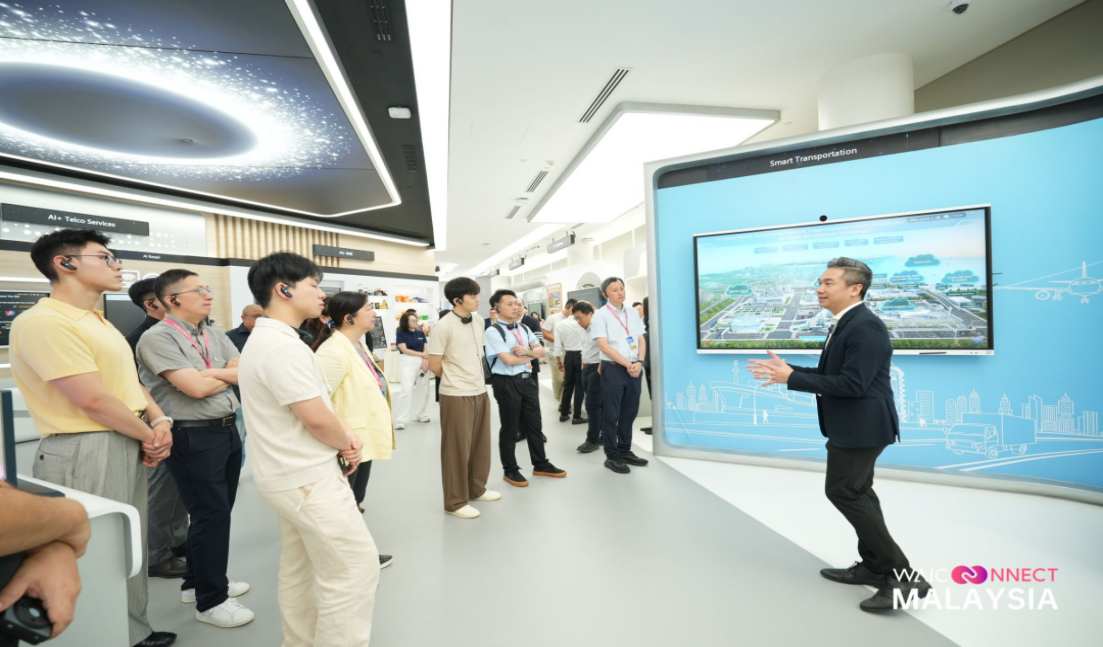
(Starlink Technology communicated with Malaysian institutions and industry figures to understand the real AI needs of the region. (Source: Official Account)
The company was awarded the Malaysia Digital Status (MD Status) certification by the Malaysian Digital Economy Authority, creating favorable conditions for integrating into the local digital economy ecosystem and expanding business cooperation. At present, Starlink Technology has set up branches in Singapore, Canada and Malaysia, and the overseas service network is gradually improving.
For customers such as banking, telecommunications, education, and the public sector, enterprise-grade AI needs to balance data security, system integration, and continuous service from technical verification to daily operations. The cooperation between Starlink Technology and Worldmatics in the Middle East market revolves around this demand.
The two sides signed a strategic cooperation agreement in Istanbul to combine Starlink Technology's data and AI platform capabilities with Worldmatics's local integration, implementation and delivery experience to jointly promote enterprise-level AI applications. According to the company's disclosure, this “platform+local delivery” cooperation model has achieved results in the Middle East education industry, providing a practical foundation for understanding regional customer needs and accumulating localized delivery experience.
Establishing long-term barriers: product and customer accumulation to support continuous breakthroughs in commercialization
Behind the launch of new products and overseas expansion are the product stacks and high-value customer chassis that Xinghuan Technology has accumulated over the years.
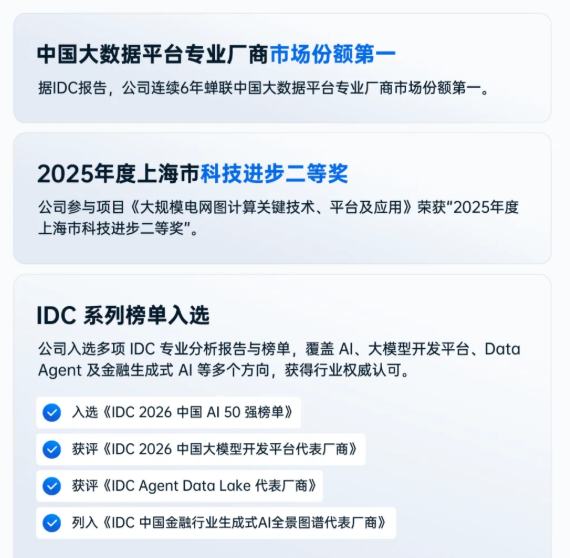
As an AI infrastructure software vendor, the company's product matrix covers big data and cloud infrastructure platforms, distributed databases, data development and governance tools, large models and machine learning operation platforms, GPU-native cognitive databases, and enterprise-level AI agents to open up the end-to-end process from data to knowledge and model to application. According to IDC data, the company has ranked first in the market share of Chinese big data platform manufacturers for six years.
During the reporting period, the company continued to be selected for a number of IDC's authoritative research reports and lists, covering cutting-edge tracks such as AI, large model development platforms, data agents, and financial generative AI. At the same time, it also participated deeply in the preparation of artificial intelligence industry standards, and continued to strengthen its technical voice.
From marginal improvements in financial fundamentals, to the continued implementation of benchmark projects, to the successful implementation of overseas cooperation models, the first questionnaire after the listing of Starlink Technology's Hong Kong stock market showed positive progress in improving the quality of operations and commercialization of technology in multiple dimensions.
Looking ahead, as the GPU native cognitive database scenario continues to expand and overseas regional cooperation continues to deepen, the company's ability to transform long-term technology accumulation into standardized and replicable delivery capabilities and stable cash flow will be the core yardstick for the capital market to examine its long-term growth and success.