


EN
ECB Governing Council Member Nagel: Inflation prospects are getting worse or interest rates will have to be raised in December
The Zhitong Finance App learned that ECB Management Committee member and Bundesbank President Joachim Nagel said that due to worsening inflation prospects, the ECB may have to raise borrowing costs next month.
Speaking in Berlin, Nagel said that even the consumer price benchmark forecast announced by the European Central Bank in September was already based on further interest rate hikes, and since then, the inflation situation has worsened further, and repeated surges in energy costs have increased the risk that prices of other goods and services will be affected in a chain.
ECB officials may be able to assess this risk more clearly when they meet again in December, because at that time they will have an updated set of economic forecasts covering the period up to 2029. Nagle said, “We will make decisions based on these predictions. However, judging from the current situation, interest rate hikes seem inevitable unless the inflation outlook improves significantly.”
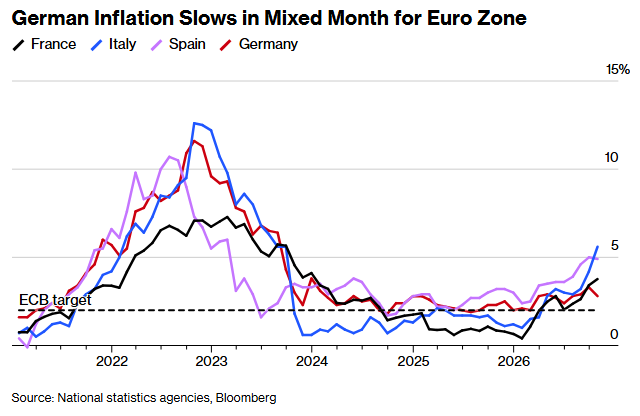
At a time of mixed inflation performance in the Eurozone, the growth rate of inflation in Germany is slowing
Eurostat's report on Wednesday is expected to show that the Eurozone inflation rate rose to 4% last month, double the ECB's 2% target. However, the core inflation index, excluding highly volatile projects such as energy, is expected to remain unchanged at 2.5%.
The ECB kept interest rates unchanged last week. The ECB has raised interest rates twice since the outbreak of the war in the Middle East. However, several officials said that the central bank may need to take further action. Nagle also expressed this opinion in an interview last Friday. He said at the time that the ECB will take decisive action if necessary to push the inflation rate back to the target level.
Nagle said that one of the reasons why the ECB suspended interest rate hikes last week is that there is little sign that inflation has had a second round effect so far. However, he said that the rise in energy prices “may be increasingly transmitted to wage demands,” and “this in turn will push prices up further.”
Later on Tuesday, Nagle's Dutch colleague Olaf Slapen said that although the impact of the situation in Iran has lasted longer than previously anticipated, so far, the relevant effects have only shown “initial signs of indirect effects.” However, he said that although long-term inflation expectations are “performing quite well,” short-term inflation expectations are rising. Slapen said, “As energy prices continue to be high, indirect effects and the upward risk of further second-round effects are very obvious. This is exactly what the central bank doesn't want to see.”
Bulgarian Central Bank Governor Dimitar Radev said on Tuesday that suspending interest rate hikes last week does not mean that the interest rate hike cycle is over. His Slovak colleague Peter Kajmir also said last Thursday that last week's interest rate decision “is not the end.” Economists expect the ECB to raise interest rates for the last time next month. However, investors believe that the austerity policy may continue until 2027.