


EN
Amazon's Earnings Just Hit a Record. So Why Is the Stock Down 11% From Its Peak?
Key Points
Amazon's cloud revenue growth is accelerating, but its cash burn is getting worse.
E-commerce revenue growth looked worse than it actually was because of a Prime Day schedule shift.
Shares look cheap if you expect current trends to continue.
The technology bull market is beginning to stagger just a bit. Amazon (NASDAQ: AMZN) stock fell again after it reported earnings last week, and while it has rebounded modestly, as of midday Monday, it is still down 11% from its peak.
Earnings came in at record levels, yet investors remain nervous about the technology giant in e-commerce and cloud computing. Understanding why could help inform your decision about whether or not you should buy Amazon shares right now.
Missed Nvidia in 2009? This Rare Signal Is Flashing Again. In 2009, a "Double Down" signal flashed for a little-known chipmaker called Nvidia. For the first time in years, that same "Total Conviction" signal is flashing for a company 1/100th the size of Nvidia. Continue »
Robust cloud demand but a dent in cash flow
In the third quarter, Amazon's cloud division, Amazon Web Services (AWS), was the star of the show yet again. Revenue was up 39% to $46 billion, one of its fastest growth rates in years, with phenomenal earnings of $17.8 billion, resulting in a margin of 39%. Management is guiding for year-over-year revenue growth of 40% in 2027 and 2028, which would essentially double AWS' sales in just two years.
The problem is that high revenue growth at AWS will require massive up-front capital expenditures. The company's free cash flow has been negative over the last 12 months due to its $220 billion capital spending plan for 2026. It's likely to increase its capex in 2027 and 2028.
Amazon has around $100 billion in cash on its balance sheet that it could put toward funding these data center investments, but it may need to raise additional funds to fully finance its artificial intelligence (AI) build-out. The amount of long-term debt on its books stood at $173 billion as of the end of last quarter. The combination of more debt on the balance sheet and negative free cash flow will make investors more skittish about the stock.

Image source: Getty Images.
The e-commerce business is intact
The other engine of Amazon's business is commerce. Its North American commerce revenue growth decelerated to 6% year over year in Q3, which may have concerned the Street as well. In the second quarter, North American sales grew 16% year over year.
Most of the deceleration was due to a simple and obvious reason, though: Amazon moved Prime Day from Q3 last year to Q2 this year, which shifted 400 basis points (4 percentage points) of growth from Q3 to Q2 in 2026. Normalizing this switch, North American growth last quarter would have been 10%, which is quite good for a mature business generating close to $500 billion in annual revenue.
Margins look great for e-commerce, too. Over the last 12 months, North American profit margins were at a record 8.2% and are likely to keep climbing in the near future.
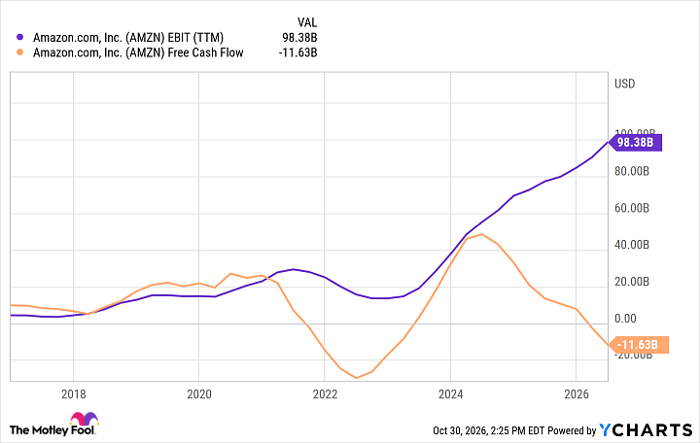
AMZN EBIT (TTM) data by YCharts.
Is Amazon stock a buy?
Combined with AWS growth and margin expansion in North American retail, Amazon's consolidated EBIT (earnings before interest and taxes) reached $98 billion over the last 12 months. Free cash flow has diverged from EBIT and turned negative, but this trend should reverse once Amazon stops investing so much in AI capital expenditures relative to its current revenue base.
Right now, Amazon's market cap is about $2.7 trillion. The stock trades at around 26 times its trailing EBIT figure, which does not seem dirt cheap in a vacuum. However, Amazon is poised to deliver strong earnings growth over the next five years. AWS is projected to have strong double-digit revenue growth, and its superior margin profile should help lift Amazon's overall profit margins.
The margins in its retail segment will continue to expand as Amazon gains ever more operating leverage from its fixed infrastructure investments in delivery and warehouses. Overall sales grew 12% last quarter, and operating margin was a record 13.9%. Assuming this overall trend continues over the next five years -- which is increasingly likely as AWS becomes a larger percentage of the business -- Amazon could grow its revenues from $775 billion to $1.37 trillion.
If its operating margin expands to 17.5%, that would result in overall EBIT of $240 billion, or roughly 10 times the current market cap, making Amazon stock a buy today.
Brett Schafer has no position in any of the stocks mentioned. The Motley Fool has positions in and recommends Amazon. The Motley Fool has a disclosure policy.