


EN
Apple (AAPL.US) clashed long and short after the earnings report: AI intelligence is the “biggest risk”, but iPhone and cash flow still support the “increase in weight” rating
The Zhitong Finance App learned that Apple (AAPL.US) handed over a report card of “strong revenue and weak guidance” in the latest fiscal quarter: both revenue and earnings per share exceeded Wall Street expectations. iPhone revenue increased 17% year over year, but gross margin guidance and service business growth prospects for the next fiscal quarter were significantly lower than market expectations, causing investors to shift their focus from hardware resilience to medium- to long-term challenges brought about by memory costs, Siri AI investment, and personalized AI intelligence. Apple shares fell about 4% in the pre-market on Tuesday after the earnings report was released.
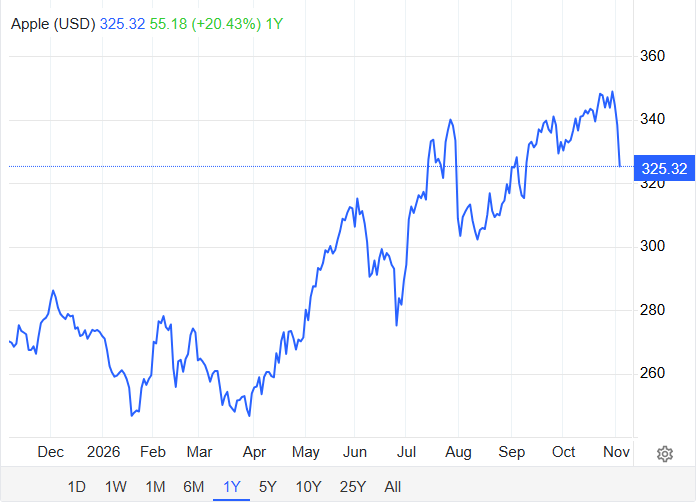
Specifically, Apple's fourth-fiscal quarter revenue was US$114.48 billion, higher than Wall Street's estimate of US$113.39 billion; earnings per share were US$2.10, which was also higher than analysts' expectations of US$1.98. Among them, iPhone revenue increased 17% year over year, and service revenue reached a record high of US$31.57 billion, but the year-on-year growth rate slowed to 9.8%, down from 12.1% in the previous quarter; revenue from the wearables, home, and accessories business also fell short of market expectations.
Looking ahead, Apple's revenue growth guide for the next fiscal quarter is 7% to 10%, and the service revenue growth guide is 8% to 9%, lower than analysts' expectations of 12%; the gross margin guideline is 45% to 46%, which is not only lower than 47.9% in the previous quarter, but also about 47% lower than the market forecast. Apple attributed the pressure on gross margins mainly to the “unprecedented” rise in memory chip prices and the costs of investing in Siri's artificial intelligence (AI) assistants.
AI intelligence: the “biggest risk” that Apple doesn't have a positive answer?
Gene Munster, a well-known technology investor and managing partner of Deepwater Asset Management, tweeted that during the earnings call, he expressed disappointment with Apple CEO John Ternus (John Ternus)'s answer about personalized AI agents.
Munster said in an article on X that he wants Tenus to explain how Apple will position itself in the context of AI intelligence reshaping how consumer technology interacts, rather than just discussing improvements to Siri. “It's clear they don't want to talk about personalized intelligence,” Munster wrote, adding that it was “the biggest risk to the Apple ecosystem.”

Munster estimates that currently about 20 million people use personalized AI agents, including Meta Platforms (META.US)'s Muse and SpaceX (SPCX.US)'s Grok Bot, and predicts that this scale of use may eventually reach several billion people per day. Faced with analysts' questions about how AI agents may affect Apple's service business, Tenus emphasized that Apple's AI-driven Siri still has the ability to expand while maintaining user privacy and security; in the second question, he described the iPhone as a personal hub and emphasized that Siri can safely access user information.
However, according to Munster, Apple's response to the “smart AI” competitive landscape is still insufficient.
This concern also echoes risk alerts from some investment banks. In the report, Morgan Stanley juxtaposed the slowdown in service business growth with “intelligent risk,” and believes that in addition to the App Store, third-party licensing, and foreign exchange headwinds, discussions on the possible impact of AI on Apple's key service business are heating up. Bernstein also listed “Apple lags too far behind in generative AI, and the ecosystem is being disrupted by AI's native competitors” as one of the downside risks.
Bank Rating: Remains bullish, but target prices and profit forecasts have been fine-tuned
Morgan Stanley cut Apple's price target from $355 to $350. The bank's analyst Erik Woodring team pointed out that Apple's revenue guidance for the next fiscal quarter was better than expected, but the decline in service business and gross margin offset the benefits, and earnings per share expectations for the first fiscal quarter remained basically unchanged. Morgan Stanley also cut Apple's earnings per share for fiscal year 2027 and natural year 2027 by 5 cents and 16 cents, respectively, to $9.85 and $10.00.
According to a detailed breakdown by Morgan Stanley, Apple's revenue growth guide for the next fiscal quarter is 7% to 10%, about 260 basis points higher than the bank and market expectations. Despite the company facing supply constraints, a high base and few new flagship models released last year; iPhone and Mac are the main drivers of growth, and pricing is expected to contribute more than 100% of the year-on-year revenue growth. Channel inventory fell short of target at the end of September, as did iPhone, Mac, and iPad, which strengthened the bank's confidence in product-side demand.
However, the service business growth guide was only 8% to 9%, which is 2 to 2.5 percentage points lower than market expectations, which means a further slowdown from 9.8% in the September quarter. Management attributed the pressure to third-party licensing (i.e. Google TAC), foreign exchange drag of around 50 basis points, weak mobile gaming, and changes in the App Store business model. Morgan Stanley predicts that the service business may slow further to 7% year-on-year growth in the March quarter and grow 9.3% for the full year of FY2027, falling below 10% for the first time since FY2023.
In terms of gross margin, Morgan Stanley said that the median value of Apple's 45% to 46% guideline for the next fiscal quarter was 100 basis points lower than its expectations and 140 basis points lower than market expectations; the bank previously anticipated a tariff refund of about 1 billion US dollars, but it seems that it has not actually been implemented. After excluding this factor, the guidelines “almost meet expectations.”
Even so, the guidelines still mean a month-on-month reduction of about 140 basis points compared to the 46.9% month-on-month reduction in the September quarter after excluding tariff refunds. The impact was mainly affected by rising memory costs, which outweighed the offsetting effects of iPhone, Mac, and iPad price increases, carry-over inventory revenue, and lower costs of non-memory components. Management expects memory inflation to continue until after the next quarter, while low-cost inventory earnings will gradually subside, and product gross margins may “deteriorate first and then improve.” The incremental cloud inference costs brought about by the launch of Siri AI will include service business costs, but they are small compared to memory costs.
Despite lowering the target price, Morgan Stanley maintained an “gain” rating, arguing that the debates between the bulls and bears have not fundamentally changed due to financial reports: bulls will emphasize the next fiscal quarter's upward revenue, lower capital expenditure and strong free cash flow, and the continued strength of the iPhone as a core product; bearers will focus on the slowdown in service business, intelligent AI risks, headwinds in memory costs, and a lack of substantial earnings per share improvement after earnings reports. The bank tends to take a constructive stance, but believes that the new target price has limited room to rise; Apple's stability and cash flow predictability may be more rewarded when the market questions the overall AI deal.
Bernstein also maintains Apple's “outperforming the market” rating, with a target price of $370. The bank's analyst Mark C. Newman's team pointed out that Apple's fourth fiscal quarter revenue was US$114.5 billion, up 12% year on year, higher than the bank's and market consensus expectations of 1.6% and 0.9%, respectively; earnings per share of $2.10 were higher than their expectations and consensus of 6% and 5%, respectively. iPhone revenue increased 17%, slightly higher than the middle double digit guideline; service revenue increased 10%. Despite facing an incremental foreign exchange headwind of about 2.5 percentage points, the growth rate after excluding foreign exchange was about 12.5%, which is basically the same as about 12% in the previous quarter. The gross profit margin of 47.9% is at the high end of the 47% to 48% guidance range, which is 36 basis points higher than the bank and market consensus, respectively; the operating profit margin is 31.1%, which is higher than the expected 68 basis points and 44 basis points of agreement, respectively.
But Bernstein is even more disappointed with the gross margin guidance for the next fiscal quarter: Apple's guidance of 45% to 46% is lower than its previous forecast of 46.2%, and lower than the market's forecast of 46.7%. According to the bank, this guideline has been incorporated into a more favorable iPhone product structure, but it is offset by an accelerated rise in memory costs; if high-end portfolio earnings are excluded and the basic iPhone 18 is available, the gross margin for the next fiscal quarter may be about 30 basis points lower than the guidelines.
Management clearly listed memory costs as the primary headwind for gross margin, and said that memory prices will continue to rise after the next fiscal quarter, and that revenue from low-cost inventory will decrease. Bernstein expects gross margin pressure to continue in the short term, with operating expenses estimated at US$20.4 billion to US$20.8 billion, and a tax rate of about 17%.
However, in the long run, the bank still believes that Apple's bullish logic is perfect: Apple is the entrance to the consumer-side intelligence revolution. It is at the intersection of hardware, software, and AI, and has a high-quality installed base of more than 2.5 billion active devices.
The “turbulent period” of gross profit margin and further acceleration of services are the key
Additionally, Evercore ISI analyst Amit Daryanani's team wrote in the report that Apple will have to face a “volatile gross margin environment” until memory prices stabilize or fall and there is evidence that Siri AI can be commercialized.
Goldman Sachs analyst Michael Ng's team said that confidence in the iPhone switching cycle has increased, but they also emphasized that the growth of the service business is slowing down, which is partly hampered by the App Store.
In terms of shareholder returns, Porter & Company analyst Ross Hendricks pointed out that Apple's quarterly repurchase scale of 24 billion US dollars is not outstanding compared to its market value of about 5 trillion US dollars; based on an annualized value of 96 billion US dollars, the shareholder return is about 2%.