


EN
Did Lennar's Fall Catch You Out? What Investors Missed
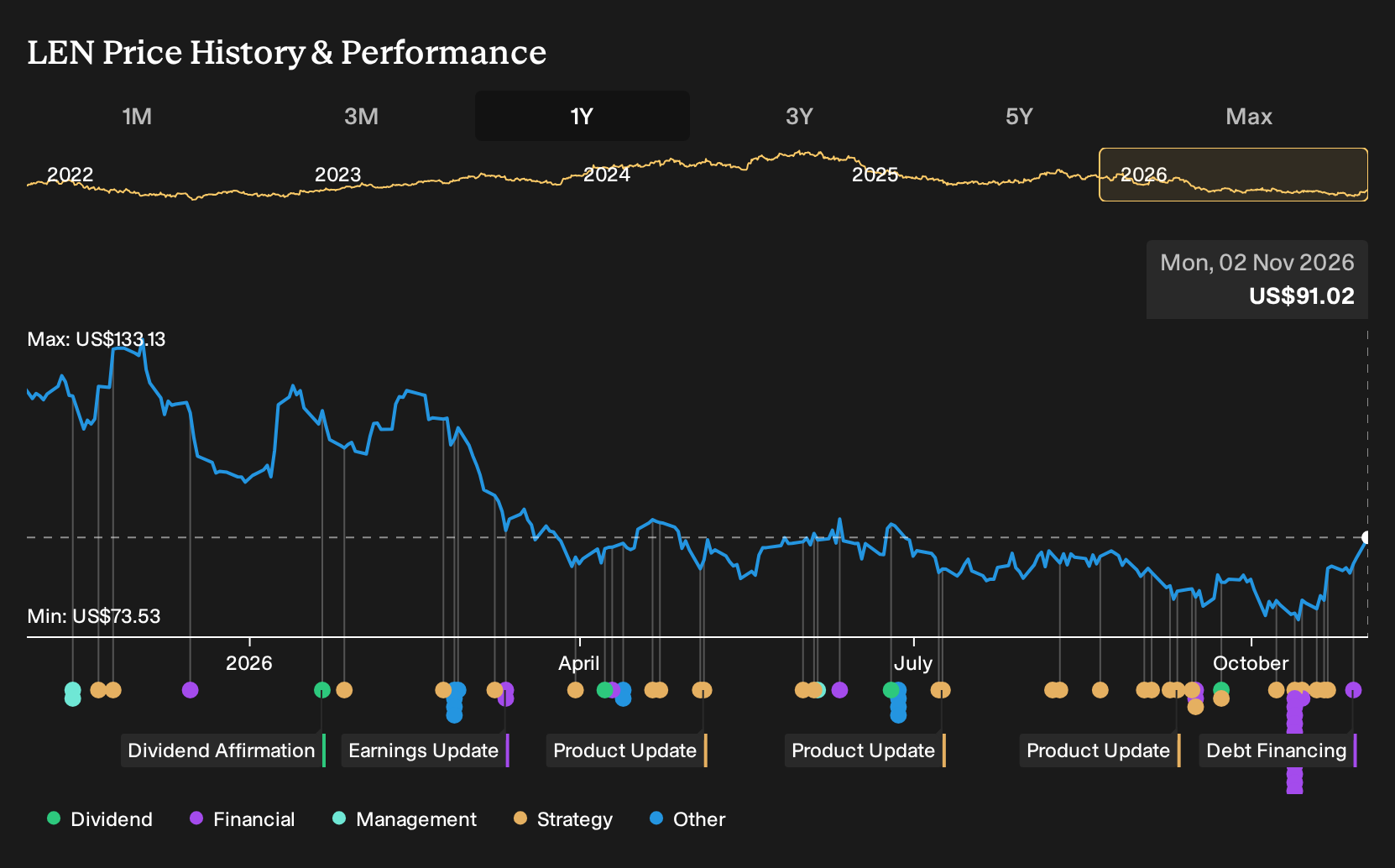
Lennar’s last twelve months have been rough for anyone who owned the stock through rising mortgage costs and legal questions around the Millrose spin off. Investors who held Lennar over the past year are down 22.8%, including dividends. If you had bought on 2 November 2025, convinced by the bullish case around the asset light model, the Rausch Coleman Homes deal and expected margin resilience, which of those specific assumptions failed to allow for what actually happened?
Lennar has already moved. See which of 34 high quality undervalued stocks still trade below our estimates.
The Two Lennar Stories Investors Were Weighing
The shares cost US$124 at the start of the period, and Lennar investors were effectively choosing between an efficiency story and a demand squeeze story.
On the optimistic side, the bullish view put Fair Value at US$159. This was a price implied by expectations tied to the asset light model and the Millrose spin off improving cash flow efficiency, while the Rausch Coleman Homes acquisition supported consistent volumes.
The cautious camp saw Fair Value at US$95, based on the idea that high US mortgage rates and roughly 13% sales incentives would keep housing demand and margins under pressure.
What Lennar’s Results Said About The Two Cases
Lennar’s Q3 2026 report challenged the bullish efficiency story. Revenue slipped from US$8.81b to US$8.05b, net income fell from US$585.7m to US$282.0m, and net margin declined from 6.6% to 3.5%, even as management talked up the asset light model and land banking. That pattern supported the cautious case.
The lesson for you is simple. When a thesis leans on efficiency, track net margin and incentive levels in the filings, and do not rely solely on commentary about asset light strategies or acquisitions.
What Lennar’s Lower Price Is Asking You To Believe
Today Lennar trades at US$91.02, after a 22.8% loss over the past year. The selected Narrative’s Fair Value sits above that level, framed around how the asset light approach could reshape earnings quality rather than just scale.
For that higher figure to be reached, a buyer today would need confidence that land banking costs stay contained enough for efficiency gains and faster build cycles to show up in sustained margins and cash generation.
"The current valuation implies that the market is pricing Lennar as if land banking costs, housing affordability pressures, and resale competition will continue to weigh on margins more heavily than the asset light model and efficiency gains will support them."
That disagreement has a full argument behind it. → Uncover the higher Fair Value this Narrative argues for
Find Your Own Contrarian Opportunity
Passing on this one could have spared you a loss. Where might you find the opposite surprise? Start looking for companies whose prices leave room for a better outcome than investors expect. These three trade below our estimated value.
- Company 1 - 49% below our estimate - converts a record backlog of modular tech construction projects into recurring contract revenue streams.
- Company 2 - 38% below our estimate - operates long life gold deposits that turn sizeable in-ground resources into steady production volumes.
- Company 3 - 30% below our estimate - ties expanding AI computing demand to subscription and usage based services on shared cloud infrastructure.
Three companies from the same screener. Open the full list of 24 financially solid companies →
Have feedback on this article? Concerned about the content? Get in touch with us directly. Alternatively, email editorial-team@simplywallst.com