


EN
Trump May Have Handed GE Vernova an Unexpected Opportunity. Here’s What It Means for GEV Stock.
Washington's renewed focus on energy independence might hand GE Vernova (GEV) a rare opportunity to capture investor enthusiasm. President Donald Trump's push to cut reliance on foreign-made power infrastructure may set the stage for American equipment makers to shine. Trump's latest move on wind turbine imports could hand GEV a surprising edge over its rivals. On October 22, the president signed a proclamation designed to curb imports of wind turbines and their parts, possibly paving the way for new trade barriers against foreign competitors.
For GE Vernova, which manufactures wind turbines alongside its much larger gas power and electrification businesses, this action may open the door to a stronger foothold in the American market.
Let’s find out what this could mean for GEV stock, which has already soared 26.2% year to date, outpacing the Industrial Select Sector SPDR Fund’s (XLI) 6% gain.
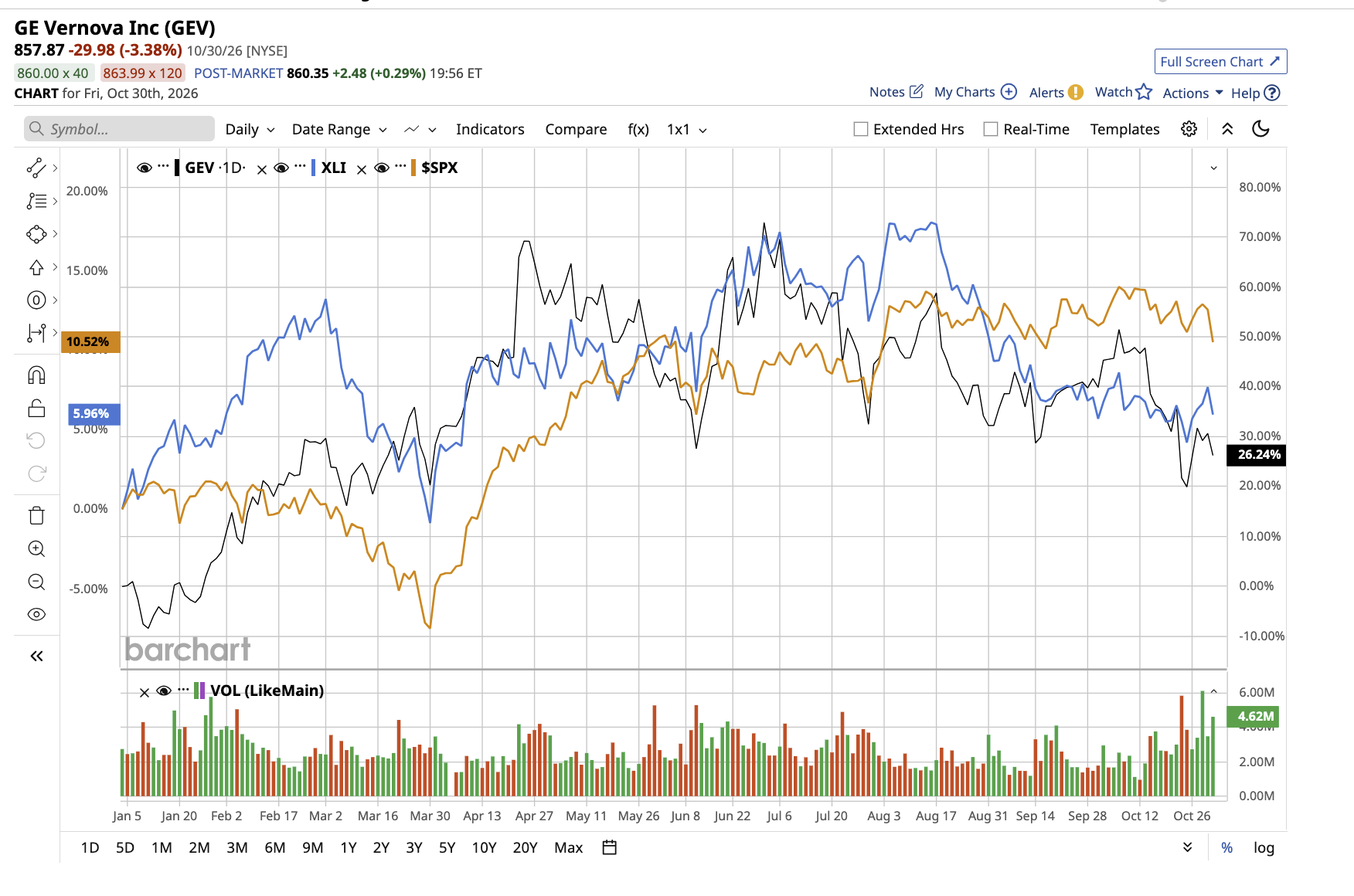
Trump's Wind Import Crackdown Could Benefit GE Vernova
Trump's October 22 proclamation could give GE Vernova a competitive advantage in the US wind market. Invoking Section 232 of the Trade Expansion Act, the president directed officials to negotiate with foreign trading partners about national security concerns over imported wind turbines and their components. The administration cited cybersecurity vulnerabilities, potential radar interference, and America's dependence on foreign-made equipment.
GE Vernova stands to gain if negotiations lead to import restrictions or increased costs for foreign manufacturers. With solid onshore and offshore wind operations, the company is ready to compete for projects that could otherwise go to international competitors. Still, the proclamation stops short of imposing immediate tariffs. With a 180-day window for negotiations, the true effects remain unclear.
Wind Business Is Showing Signs of Improvement, But Challenges Remain
The timing of Trump's announcement is interesting because GE Vernova's Wind segment has been a weaker part of its portfolio. While its gas power and electrification business have thrived on booming electricity demand, the wind business continues to wrestle with softer onshore demand, project execution challenges, and mounting profitability concerns.
However, there are some encouraging signs. In its most recent third quarter of 2026, Wind revenue increased 3% year over year, orders climbed 16%, and the segment generated $72 million in EBITDA, returning to profitability. Stronger onshore services activity, offshore equipment deliveries, and lower offshore project costs supported the improvement. Management expects organic Wind revenue to slip by a mid-single-digit percentage in 2026, with a projected full-year EBITDA loss of $400 million to $500 million. Persistent challenges such as muted U.S. onshore demand, permitting delays, and offshore execution hurdles continue to cast a shadow over the business. In response, management is prioritizing delivery of the current offshore backlog, boosting onshore services profitability, and actively exploring strategic paths forward for the segment.
This is where Trump's proclamation becomes a double-edged sword. While less foreign competition might give GE Vernova a shot at more domestic deals, restrictions alone cannot generate demand for wind projects. The administration's broader skepticism toward wind energy could discourage investment, and import restrictions may drive up costs for manufacturers that rely on global supply chains. Ultimately, GE Vernova must improve its own profitability before any competitive advantage turns into real earnings.
Consequently, Trump's policy might set the stage for a longer-term competitive boost, but investors should not mistake it for an immediate financial turnaround.
Gas Power and Electrification Give GEV Two Bigger Growth Engines
GE Vernova's investment case actually relies on its Power and Electrification businesses, which are doing most of the heavy lifting. They benefit from rising electricity demand as hyperscalers expand AI data centers and utilities invest in grid infrastructure.
In the third quarter, the Power segment surged ahead with a 25% year-over-year revenue jump and a healthy EBITDA margin of 21.4%. GE Vernova delivered 32 gas turbines, up 60% from last year, and captured 11 GW in new equipment orders and slot reservations. The total gas equipment backlog and reservations climbed to 122 GW, with management ambitiously targeting at least 130 GW by year-end. Meanwhile, new equipment pricing is rising, with average prices per kilowatt for 2026 orders projected to soar about 50% above 2025 levels.
Electrification also continues to surge ahead. Revenue soared 51% to $3.9 billion, with organic growth contributing 16%. EBITDA jumped 57% to $739 million, pushing the margin to a robust 19.1%. North American equipment orders doubled from last year, and the equipment backlog grew about 60% to $42 billion, signifying strong demand for transformers, substations, switchgear, and transmission equipment. Total orders in the quarter soared to $29.3 billion, a remarkable 96% organic increase, and the total backlog surged to $197 billion.
Backed by strong performance across both these two businesses, management raised the full-year 2026 outlook. GE Vernova now expects revenue between $46.5 billion and $47.5 billion, adjusted EBITDA margins of 13.5% to 14.5%, and free cash flow of $16 billion to $17 billion. The company also doubled its share repurchase authorization to $20 billion, signaling strong confidence in its future.
Why GEV Stock Looks Like a Good Long-Term Hold
All in all, Trump's proclamation could give GE Vernova an additional competitive advantage, though its impact on Wind profitability is still uncertain. Furthermore, the true potential lies in how the administration brings this policy to life and how quickly utilities and power companies respond. The stronger investment case lies in GE Vernova’s growing gas power and electrification businesses, which benefit from rising electricity demand and grid investments. With a substantial backlog and strengthening financial performance, GEV looks like an attractive long-term hold. However, investors need to stay mindful of execution risks.
Wall Street is also becoming more bullish on GE Vernova. HSBC upgraded the stock to Buy from Hold and raised its price target to $1,100 from $1,040. The firm believes strong gas demand will support the company's 2027 performance. Higher pricing for gas turbines and grid equipment could further improve profit margins. HSBC also sees the Wind business moving beyond its worst period, suggesting the segment's financial pressures could gradually ease.
Overall, on Wall Street, GEV stock holds a “Strong Buy” rating. Of the 30 analysts covering GEV, 22 have a “Strong Buy” recommendation, two have a “Moderate Buy” rating, five suggest a “Hold,” and one says it is a “Strong Sell.” Based on its analysts’ average price target of $1,202.07, analysts expect it to climb by 40.1% from current levels. Plus, its high price estimate of $1,450 implies a potential upside of 69% over the next 12 months.
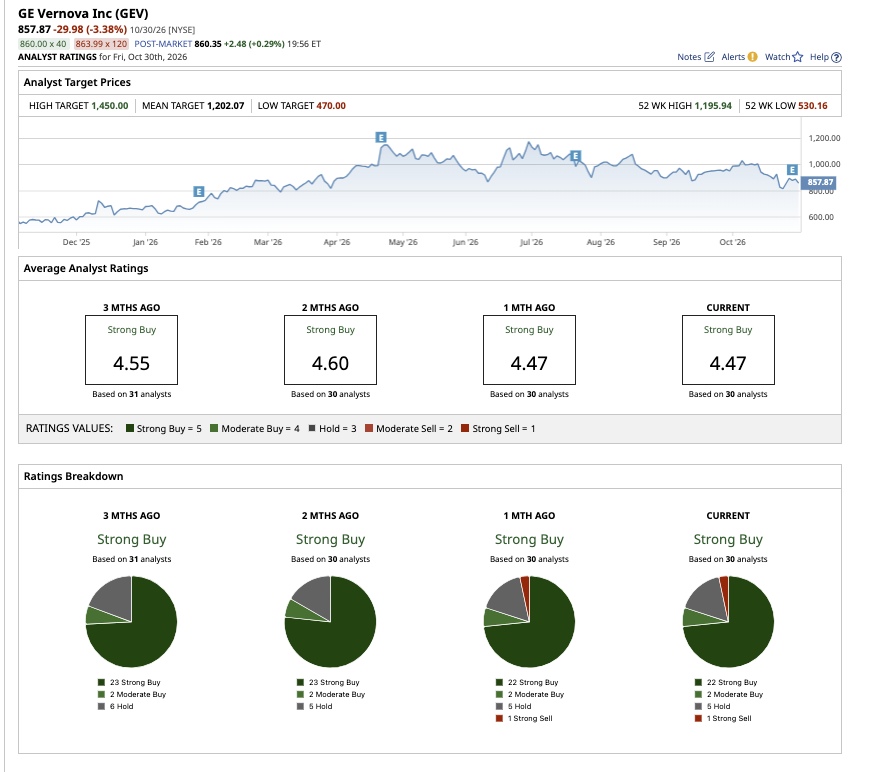
On the date of publication, Sushree Mohanty did not directly have a position in any of the securities mentioned in this article. All information and data in this article is solely for informational purposes. For more information please view the Barchart Disclosure Policy here.