


EN
The ECB may raise interest rates again in December, but inflation may fall below 2% by the end of next year? AI big model outlines the trajectory of cooling inflation
The Zhitong Finance App learned that the Bloomberg Economics research report shows that a series of statements recently issued by ECB officials suggest that their opinions basically indicate that the Eurozone inflation rate is expected to fall “significantly below” 2% after a year.
The economist André Sokol came to this conclusion. He uses cutting-edge artificial intelligence big models to analyze news headlines based on speeches and interviews with policymakers, and combines the analysis results with a nonlinear predictive tool.
The results suggest that the impact of the war in Iran will be temporary, and inflation will also fall below the level shown by the ECB's latest forecast.
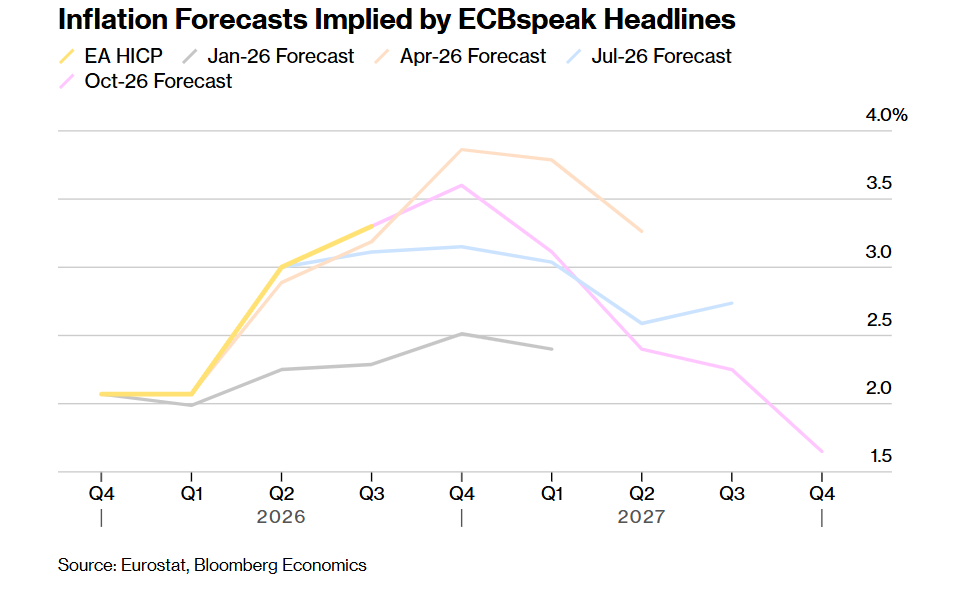
The above chart is an inflation forecast implied by news headlines relating to remarks made by ECB officials. Source: Eurostat, Bloomberg Economic Research.
The ECB's monetary policy makers almost unanimously judged last week that the risks facing the inflation outlook are biased towards the upside. According to current forecasts, the average inflation rate is 3% this year and 2.5% in 2027. Although the ECB keeps interest rates unchanged, officials are ready to raise interest rates for the third time in the year in December.
Sokol wrote, “In the vast amount of information released by the ECB, there are signs of how policymakers view the evolution of inflation risks. Our new AI model helps uncover these signals.”
According to his analysis, policymakers' comments still point to inflation approaching 4% in the fourth quarter.
For 2027, these remarks suggest that the inflation rate will fall back to 2.4% in the middle of the year and then fall further to 1.7%. This is basically in line with Bloomberg Economics' forecast report: the agency expects the inflation rate to fall below 2% in the second half of 2027.
Approaching 4%, may drop to 1.7% by the end of next year: How long will the energy shock last?
The ECB is likely to raise interest rates again in December, while the Eurozone inflation rate is still likely to fall to 1.7% by the end of 2027. There is no contradiction between these two judgments: what the central bank now needs to prevent energy price increases from penetrating wage negotiations and corporate pricing; the Bloomberg Economics study found after analyzing official speeches using an AI big model is another medium term path — if energy prices do not continue to rise, and even if oil and gas prices remain high, the effect of energy on year-on-year inflation will weaken as the comparative base rises.
The ECB's own official forecast summary for September also predicts that this effect will subside. The main difference is whether inflation will return to around 2% or significantly below 2% thereafter.
The latest data shows why central banks are still afraid to let their guard down. The inflation rate in the Eurozone rose to 3.8% in September from 3.2% in August. Among them, the year-on-year increase in energy prices increased from 14.3% to 18.9%, and service prices also increased from 3.0% to 3.2%. The economy is still expanding, but the pace has slowed: real GDP grew 0.4% month-on-month in the third quarter, down from 0.6% in the previous quarter; the manufacturing purchasing managers' index fell from 52.9 to 52.7 in October, still above the 50 boom and dry line. As of November 3, the initial value of Eurozone inflation for October has not been announced; according to a Reuters survey, economists agree that the reading released on November 4 will reach 4.0%.
How many more increases after the December rate hike? Wages and bond yields give two clues
The ECB kept the deposit mechanism interest rate at 2.50% on October 29. ECB President Lagarde later said that the situation at the time was sufficient to support interest rate hikes, and data for the next few weeks will test this judgment.
On October 30, the market priced the December rate hike at about two-thirds; if 25 basis points are added, deposit interest rates will rise to 2.75%, which is also the third rate hike in the year. The management committee's views on follow-up efforts are already different: Bank of Slovakia Governor Kajmir warned on November 2 that the market may still underestimate the amount of austerity needed to contain inflation; Bank of Italy Governor Panetta also advocated preventing wages and prices from boosting each other, but emphasized that rising bond yields are already increasing financing costs, and that this part of the austerity effect should be taken into account when formulating policies.
For the euro interest rate market, what is more worth pricing is the path after December. According to the ECB's wage tracking indicators, the average growth rate of negotiated wages for the first three quarters of 2027 is expected to be 2.6%. If wage growth remains moderate, financing tightens, and weakens companies' ability to raise prices, even if interest rates are raised in December, investors have reason to lower their expectations for the number of subsequent interest rate hikes; if service prices and wages continue to accelerate, Kajmir's warning will have more weight.