


EN
“Layoffs” have become the key word for earnings season! From PayPal to Volvo, Wall Street is beginning to differentiate between AI efficiency improvement and passive contraction
The Zhitong Finance App observed that in this US stock earnings season, one of the hot topics investors continue to focus on is why technology companies are making large-scale layoffs at this moment. PayPal (PYPL.US), a leader in online wallets and digital payments in the US, has cut more than 2,000 employees, reduced management positions by more than a quarter, and raised its full-year adjusted earnings per share forecast to approximately $5.60. The picture commonly seen by investors seems to be — under the frenzy of AI agents focusing on efficient agent-based AI workflows, companies have begun to use cutting-edge AI technology to reduce management levels and use AI for customer service, etc., which has been accompanied by an improvement in profit margins.
Swedish car giant Volvo Car AB (Volvo Car AB) announced a further 2,500 layoffs at a time when quarterly operating losses far exceeded expectations and cash consumption doubled year on year. The stock price unexpectedly fell sharply by about 24%. The two companies cut jobs in similar numbers, but profit prospects and market valuation prospects are moving in different directions — the former has allowed investors to see the results of cost savings, while the latter has yet to prove that the savings are enough to offset the impact of weak sales. In other words, PayPal raised profit guidelines while introducing AI customer service and streamlining management; Volvo further used AI to reduce costs and increase efficiency when demand was weak and losses exceeded expectations, and began a new round of layoffs.
The investment implications brought about by this trend of stock price differentiation are also the key for investors to judge the financial content of “AI cost reduction.” Taking customer service as an example, an indicator with investment significance is how much the total cost of solving a customer problem is reduced on the premise that service quality does not deteriorate; complex token costs such as model calls, manual reviews, and error rework indicators need to be factored in. The number of layoffs alone does not answer this question. In particular, it is necessary to distinguish between completed cuts and plans that have not yet been implemented: for example, Microsoft, one of the leaders in enterprise software and cloud computing in the US, provides voluntary termination compensation plans to about 60,000 employees. 60,000 are the number of people who are eligible to accept the plan, not the actual number of people who have left their jobs.
Tech companies laid off workers during earnings season due to AI and cost pressure, and investors reacted mixed
As CEOs respond to the full rise of artificial intelligence and the need to use cutting-edge AI technology to reduce business operating costs while drastically improving operational efficiency, investors have successively received news that companies have announced the reduction of thousands of jobs during this earnings season.
Bloomberg Intelligence's latest earnings season analysis report shows that the number of job cuts, layoffs, and layoffs mentioned in a series of recent earnings season news reports has risen again, reaching the highest level since May in October. In Europe, even governments have joined the ranks of streamlining manpower, putting more jobs at risk of not being insured.
Recent developments include: Walt Disney is preparing to cut thousands of jobs. German auto parts supplier Schaeffler said on Tuesday that it will cut 3,460 jobs in Europe. The news caused its stock price to drop slightly.
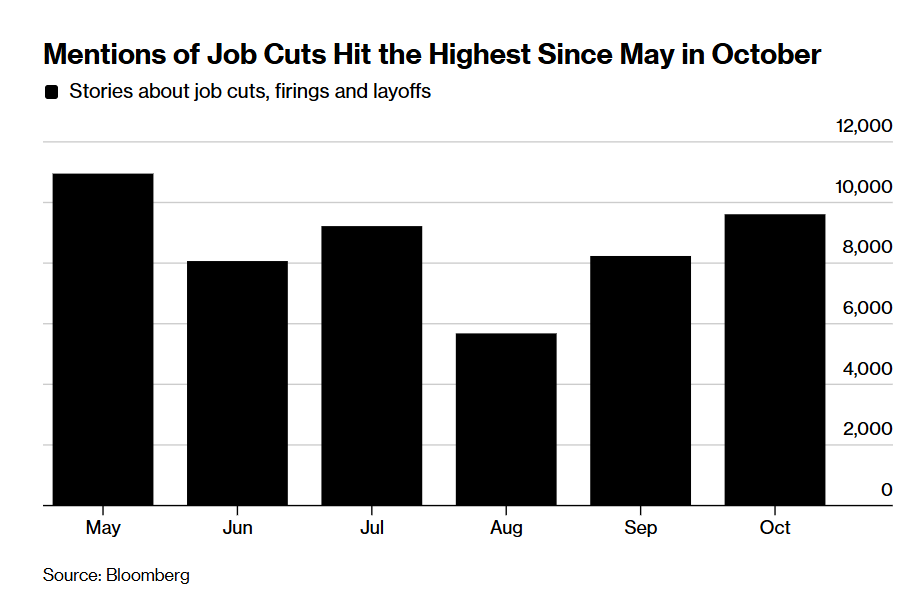
As shown in the chart above, the number of layoffs mentioned in the news media in October rose to the highest level since May.
The market's reaction to the layoff announcement seems to depend on how investors judge the company's motives: whether to take the initiative to adjust staffing before the situation changes, or whether to act urgently in the face of threats. After PayPal and Microsoft announced their respective plans, their stock prices both rose slightly. In contrast, Volvo Cars said that in order to cope with its rapidly shrinking market in China, the company would step up its layoffs, and its stock price immediately fell sharply.
Chris Armstrong, a stock strategist at Berenberg Bank, said in an interview with the media on Tuesday: “How the stock price reacts largely depends on whether the market believes that the company actively adjusts with its own strength or is acting under tremendous pressure like Volvo.”
Figures disclosed by many companies show that the scale of staff reduction is considerable: Microsoft is providing voluntary termination compensation programs to 60,000 employees, equivalent to one-quarter of the total number of employees; Netflix is cutting 6% of its employees. Barclays is using artificial intelligence to cut costs and cut 5,000 jobs. Volvo Cars' move to further cut jobs involves 2,500 employees.
Violeta Todorova, senior research analyst at Leverage Shares, said, “Investors should ask the question: is this company laying off employees to grow or maintain operations? A profitable company streamlines management and invests saved money into technology, which may be good news in the long run. If the layoffs were only to fill the gap left by falling demand, that would be a warning and would not solve the fundamental problem.”
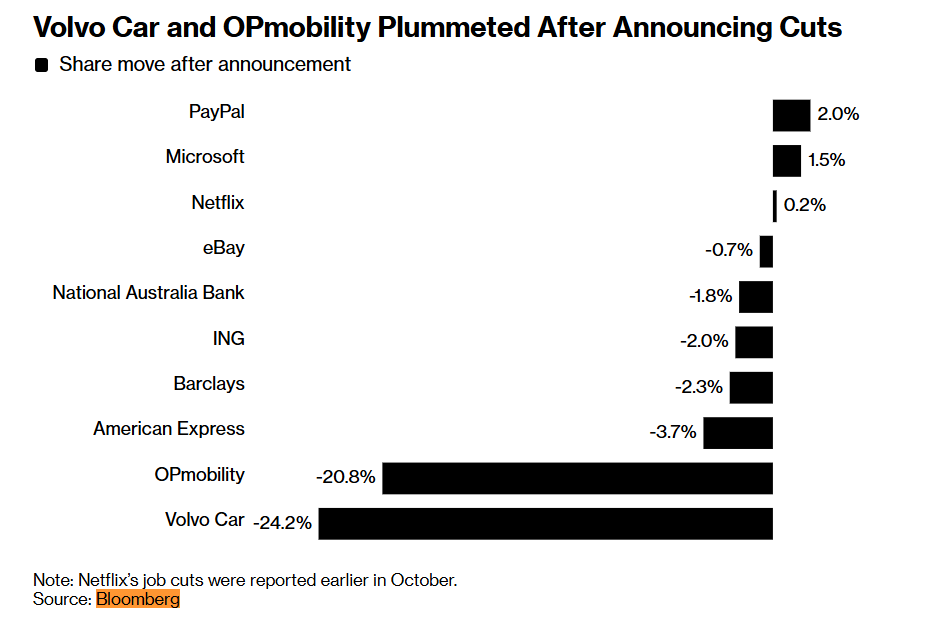
As shown in the picture above, after Volvo Cars and French auto parts supplier OpMobility announced layoffs, stock prices plummeted; note: Reports on Netflix's layoffs were released in early October.
Governments are also beginning to accept the idea that by using AI more widely, government personnel can be streamlined. The Netherlands plans to cut 25,000 civil service jobs over the next few years, hoping to save 3.5 billion euros (3.9 billion US dollars) every year through this AI-based efficiency improvement action.
According to Panmure Liberum strategist Joachim Clement, corporate layoffs are another sign that a cycle of rapid corporate revenue and profit growth is coming to an end since the end of the COVID-19 pandemic and the high inflation period in 2022 passed. Profit growth is likely to be more moderate in 2027 and 2028.
Clement said, “We have used all the easy cost savings measures, and it will be more difficult to cut costs further in the future. People expect productivity improvements brought about by AI, so that companies can increase profits even when revenue growth slows down. But we currently have no evidence that AI is increasing productivity outside of the tech industry.”
PayPal said that the number of employees in the company has been reduced by more than 2,000, management positions have been cut by more than a quarter, and the stock price rose after the news was announced. In contrast, French auto parts supplier OpMobility lowered its full-year profit forecast and announced plans to cut 770 jobs. The stock price recorded the biggest drop in three years.
According to data compiled by Bloomberg Intelligence, the number of S&P 500 companies announcing large-scale restructuring is expected to increase by about 20% year-on-year during this earnings season. In Europe, such announcements are being issued at a similar pace to a year ago.
According to comprehensive dynamic data compiled by Bloomberg Intelligence, when about 70% of the S&P 500 companies have announced results, 147 companies have disclosed restructuring expenses; in contrast, 178 companies have disclosed such expenses throughout the third quarter earnings season of 2025. According to current progress, the number of companies in the MSCI Europe Index that disclosed restructuring charges is expected to be the same as 60 a year ago.
Rajiv de Mello, chief investment officer from Gama Asset Management, said: “In most cases, layoffs mean businesses are becoming leaner and productivity is increasing. However, some industries are under pressure for different reasons, such as the automobile industry facing competition, while others are more sensitive to changes in interest rates. Investors are carefully screening companies to focus on companies that can integrate AI into their operations to increase productivity.”
Wall Street accelerates search for real AI efficiency winners amid a wave of layoffs in earnings season
In October, as cloud computing giants' cash flow was negative and the performance of chip giants linked to the AI infrastructure process after experiencing a sharp rise in stock prices, the NASDAQ 100 index fell about 6.7%, and the total market value of constituent stocks evaporated more than $2 trillion; the Philadelphia Semiconductor Index fell about 15.4%, and South Korea's SK Hynix and Samsung Electronics also fell 20.2% and 16.2%, respectively. The sell-off spread from American cloud computing giants to Asian memory chip makers, but the simultaneous fall in stock prices did not mean that the profit prospects of these companies deteriorated at the same rate.
What Ackman's Pershing Plaza looks at is the time difference between expenses and returns. According to its November 2 shareholder letter, by the end of the third quarter, the average share price increase of Microsoft, Meta, Amazon, and Alphabet during the year was only 8%, while the reported increase in earnings per share for this year was about 27%. The total capital expenditure of the four companies in 2026 is approximately US$740 billion according to the guidelines, and the market is expected to exceed US$1 trillion in 2027. Pershing is not questioning the high cost of construction, but rather whether the market has fully taken into account the money the new production capacity can make in the future. Take AWS as an example. According to Amazon management's estimates, the data center plant needs to be invested about 2 years in advance and can be used for more than 30 years after operation; servers are only purchased close to production. The recycling period is slightly shorter than 3 years, and they can be used for at least 5 to 6 years. Since the AI smart phone frenzy swept the world this year, enterprise customers have begun to be willing to continue to pay for AI services that actually reduce costs and increase efficiency. If AI agents accelerate their penetration into various industries and occupy an important share of business operations, it can be described as the key to transforming the efficiency of enterprise operations led by enterprise-level management applications into strong revenue and cash flow growth expectations for cloud vendors.
Anthropic's Claude and OpenAI's GPT‑6 Astra are changing the way technology companies cut costs: in the past, AI could write a response for employees; in the proxy AI workflow, agents could check orders, check refund rules, process refunds within the scope of authorization, and then write the results back to the work order system. There have also been similar changes in the R&D process: Codex, driven by the OpenAI Astra series of AI agents, can track down causes from bug reports, modify code, and run tests.
For the daily operation of an enterprise, the first thing that can be saved is the time employees spend searching, transcribing, and checking information between systems. The indicator that is really worth tracking is how much the total cost of solving each work order and fixing each defect has decreased after model reasoning, manual review, and rework are included on the premise that the problem resolution rate and service quality do not deteriorate.
European banking giant Barclays provided a sample to observe how AI is spreading from technology to finance. The bank is expanding cooperation with Anthropic to use Claude to speed up software development and transformation of old systems. It is estimated that by the end of 2026, half of the developers will use Claude Code; at the same time, Barclays plans to cut about 5,000 jobs during the year, of which about 60% are involved in development and other support functions. These two sets of numbers measure different things: the former is a tool adoption target; the latter is an overall cost reduction plan; it cannot be asserted based on this that all 5,000 jobs will be replaced by AI. What is more indicative of increased productivity is whether banks can deliver functions faster, maintain more systems, and maintain reliability after streamlining teams.
This also explains why stock prices reacted very differently to news of layoffs in this earnings season. PayPal reduced more than 2,000 employees, reduced management positions by more than a quarter, and used AI agents for customer service; the number of payment transactions increased 7% during the same period, and the company also raised its annual adjusted earnings per share guide from about $5.38 to $5.60, and the stock price rose accordingly. Volvo Cars also announced about 2,500 more layoffs, but faced weak demand, operating losses far exceeding expectations, and a year-on-year doubling of cash consumption, and a sharp drop in stock prices of about 24%. Wall Street is willing to pay a premium for “fewer people handling more business”; if the order itself is being lost, reducing the schedule will only reduce losses and will not be able to recover customers for the company.