


EN
Oil Stocks Screening Opportunity After Crude Falls 8%
Oil just dropped roughly 7–8%, yet long term price forecasts still sit in triple digits, and that mix of softer spot prices with higher forward expectations is creating a rare window. Short term swings in crude can knock integrated oil majors around, but they can also reset entry points before sentiment catches up. This piece walks through three global giants most exposed to this latest Iran driven move in the market and explains why their risk reward profile may look different after this pullback.
The three stocks below are just a small sample. The full screen surfaced 16 more large, integrated oil and gas companies with equally compelling narratives that are not covered in this article.
To go straight to the source and identify which majors best fit your own risk profile, analyze the Global Integrated Oil & Gas Majors screener.
ONEOK (OKE)
Overview: ONEOK is a large U.S. midstream operator that gathers, processes, transports, stores, and exports natural gas, NGLs, refined products, and crude oil. This provides investors with broad exposure to hydrocarbon flows across multiple energy value chain steps.
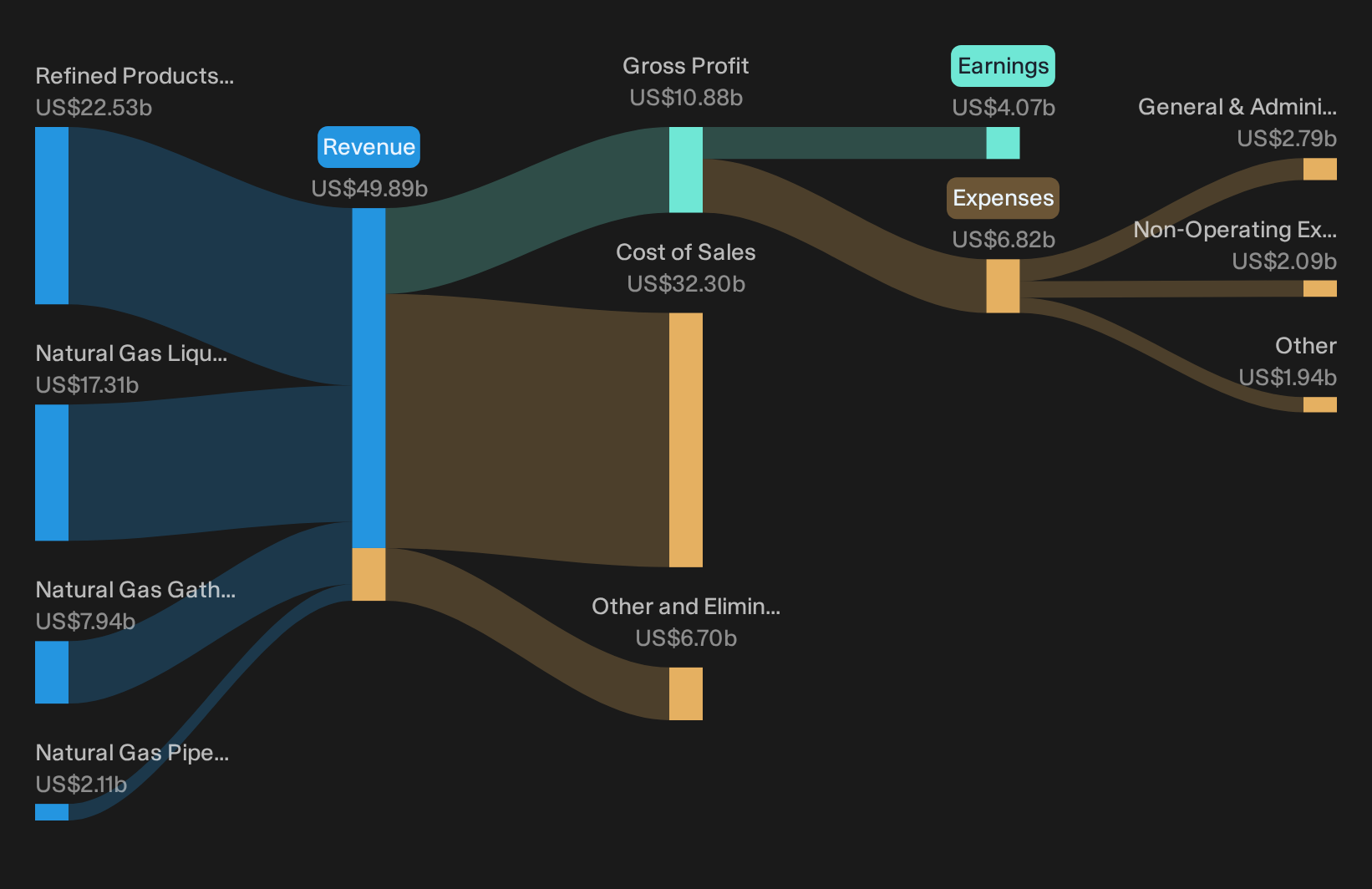
Operations: ONEOK generates almost all of its US$43.2b revenue in the United States, led by Refined Products and Crude at US$22.5b and Natural Gas Liquids at US$17.3b.
Market Cap: US$61.2b
ONEOK matters in this Global Integrated Oil & Gas Majors screen because its wide midstream footprint connects U.S. production fields to export docks and end users. This gives you volume-driven exposure to global energy demand without owning a pure producer.
"Persistent growth in global demand for U.S. natural gas and NGLs, together with rising liquids exports and LNG related gas production, is feeding higher utilization of ONEOK’s integrated midstream and export system, which directly supports future revenue and adjusted EBITDA.
What happens if a single integration step in that expanding Permian and export buildout fails to deliver the expected uplift in margins?
If that execution risk matters to you, read the full narrative for ONEOK to see how volume growth, capital spending and export exposure could be decoupling beneath the surface.
Hess Midstream (HESM)
Overview: Hess Midstream operates U.S. pipelines, processing plants, storage sites, and export terminals that move Hess and third party oil, gas, and water, giving investors midstream exposure linked to broader integrated energy activity.
Operations: Hess Midstream generates all of its US$1.6b revenue in the United States, with US$858.5 million from Gathering, US$614 million from Processing and Storage, and US$141.7 million from Terminaling and Export.
Market Cap: US$6.7b
Hess Midstream matters for this majors screen because it offers pure midstream exposure that still leans on long life upstream development and long term oil and gas demand. This can appeal if you want toll road style cash flows rather than direct commodity bets.
"Approximately 95% of 2026 revenues, declining to 90% in 2027 and 80% in 2028, are backed by minimum volume commitments, with about 85% of revenues on fixed fees with inflation escalators and the balance on annually reset cost of service contracts through 2033."
The real swing factor is what happens if one key production plan or contract reset changes the comfort investors feel around that cash flow visibility.
That comfort can shift quickly, so read the full narrative for Hess Midstream to see whether Hess Midstream’s contracted volumes are quietly masking bigger upside or brewing pressure.

Kinetik Holdings (KNTK)
Overview: Kinetik Holdings runs midstream infrastructure in the Delaware Basin, gathering, processing, transporting, and storing hydrocarbons and water for producers.
Operations: Kinetik Holdings generated about US$1.88b in 2025 revenue, with roughly US$1.88b from Midstream Logistics and US$35 million from Pipeline Transportation, entirely in the United States.
Market Cap: US$9.2b
For the Global Integrated Oil & Gas Majors theme, Kinetik Holdings brings a focused Delaware Basin link in the chain, tying local production to downstream demand and giving you pure midstream exposure where volumes and contract quality matter as much as commodity prices.
"Kinetik Holdings is progressing a large scale buildout in the Delaware Basin, with Kings Landing II sanctioned as a US$260 million, 300 MMcf/d gas processing plant expected online by mid 2028 and procurement already underway for another cryogenic plant."
What ultimately happens to Kinetik’s appeal depends on how one unresolved pressure shapes the balance between higher throughput and future cash generation.
That unresolved pressure is exactly why reading the full narrative for Kinetik Holdings can help you evaluate whether Kinetik Holdings’ buildout is quietly accelerating value or stretching the balance too far.

Seeking Alternatives Before Momentum Flies
Fresh themes keep breaking out while old ideas lose momentum quickly. Scan what is still under the radar and consider positioning before the crowd moves.
- Target potential income streams by reviewing 4 dividend fortresses, which is built to highlight issuers where payouts and balance sheet strength appear together before yields change.
- Explore early growth momentum by checking the 19 high quality undiscovered gems, which filters for under the radar quality before institutional money affects valuations.
- Review long term structural demand by assessing the 43 power grid technology and infrastructure stocks, which is aligned with grid upgrades and electrification while timing may still matter for entry.
Have feedback on this article? Concerned about the content? Get in touch with us directly. Alternatively, email editorial-team@simplywallst.com