


EN
Should Earnings Miss Require Action From Otter Tail (OTTR) Investors?
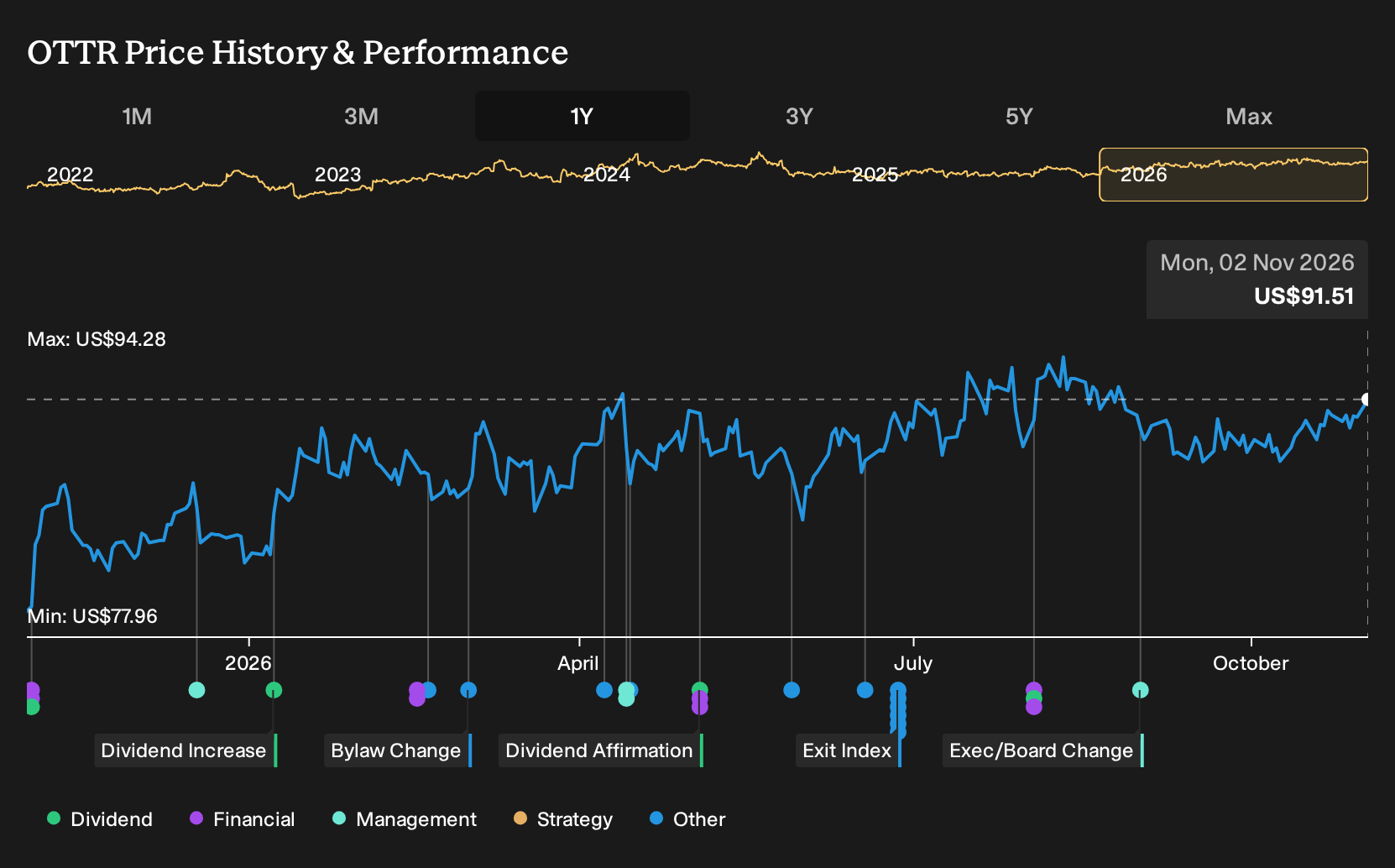
- Otter Tail reported third quarter 2026 revenue of US$320.51 million and diluted EPS of US$1.41, below the prior year period, while the Board declared a quarterly dividend of US$0.5775 per share payable on December 10, 2026.
- The company held its ground on 2026 diluted EPS guidance at a narrowed range of US$3.89 to US$4.19, signaling management’s focus on earnings stability despite softer recent profitability.
- We will now look at how Otter Tail’s affirmed full year earnings guidance, despite a weaker quarter, reframes the broader investment narrative.
Scan how Otter Tail’s earnings and dividend profile compares to a hand picked group of resilient, lower risk opportunities in our 29 resilient stocks with low risk scores built for capital preservation minded investors.
Otter Tail Investment Narrative Recap
To own Otter Tail, you need to be comfortable with a utility led plan that leans on a large capex program while Plastics earnings normalize. The third quarter showed softer net income and EPS against last year, so the near term question is whether execution in Electric and Manufacturing offsets that drag without stretching the balance sheet further.
The key short term swing factor is how quickly PVC pipe pricing and volumes stabilize, because that cash supports Otter Tail’s funding flexibility. Earnings pressure and high debt already sit on the risk list. This quarter adds evidence of margin strain but does not fundamentally change the long term capex driven thesis.
The most relevant announcement here is the narrowed 2026 diluted EPS guidance of US$3.89 to US$4.19. Holding the midpoint after a weaker quarter indicates that management still sees the utility and manufacturing engines carrying more of the load while Plastics resets. For investors, the question is how comfortable that feels given the recent earnings step down.
That guidance interacts directly with the main catalysts. Execution on the US$1.9b electric capital plan, large load development and renewables build needs to translate into steadier earnings. Otherwise, the lower PVC contribution and prior legal cash outflows take on greater importance. For those who follow analyst views, the Zacks Rank #3 framing remains secondary to this basic operating math.
Otter Tail's narrative projects US$1.4b revenue and US$202.6 million earnings by 2029. This assumes 2.6% yearly revenue growth and an earnings increase of about US$7.5 million from US$195.1 million today.
Uncover why Otter Tail's fair value indicates that it is in line with its current price.
Exploring Other Perspectives
Community fair value estimates for Otter Tail from the Simply Wall St Community span roughly US$72.92 to US$90.50 across 2 separate views, so private investors are clearly not aligned. There are also legal settlement risks, plastics earnings pressure and a large utility capex plan, which together can shift how you frame future performance. Consider exploring more of these contrasting opinions before deciding how Otter Tail fits your own approach.
Explore another Otter Tail fair value estimate, including one that suggests it could be worth as much as $90.50.
Decide For Yourself
Don't just follow the ticker. Dig into the data and build a conviction that's truly your own.
- A great starting point for your Otter Tail research is our analysis highlighting 5 important warning signs that could impact your investment decision.
- See our latest analysis for Otter Tail. The report includes a comprehensive fundamental analysis summarized in a single visual, the Snowflake, making it easy to evaluate Otter Tail's overall financial health at a glance.
Looking For More Ideas Beyond Otter Tail?
Once you have a view on Otter Tail, it can help to set that opinion against a wider watchlist of potential opportunities that fit different roles in your portfolio. The Simply Wall St Screener gives you a quick way to line up alternatives by quality, income profile or balance sheet strength, then compare them side by side.
- For investors who want income to do more of the work, scan a focused set of higher yielding opportunities through 4 dividend fortresses that meet strict payout and stability criteria.
- If capital preservation sits near the top of your priorities, weigh Otter Tail against a list of solid balance sheet and fundamentals (24 results) to see which businesses carry less financial strain.
- When you are hunting for potential mispricing, widen the lens with a curated group of 34 high quality undervalued stocks that pair stronger fundamentals with more modest expectations baked into their prices.
Have feedback on this article? Concerned about the content? Get in touch with us directly. Alternatively, email editorial-team@simplywallst.com