


EN
Fed Chair Kevin Warsh Just Drove a Dagger Through Wall Street's AI-Driven Rally With 6 Blunt Words
Key Points
Despite persistently elevated inflation, Fed Chair Warsh and the Federal Open Market Committee (FOMC) held interest rates steady on Oct. 28.
Higher interest rates are already changing borrowing dynamics within the AI arena.
AI companies may face interest rate pressure on two fronts.
For the better part of the last four years, the Dow Jones Industrial Average (DJINDICES:^DJI), S&P 500 (SNPINDEX:^GSPC), and Nasdaq Composite (NASDAQINDEX:^IXIC) have been virtually unstoppable, thanks in large part to the evolution of artificial intelligence (AI).
Empowering software and systems with the tools to make autonomous, split-second decisions promises to increase productivity and efficiency for most sectors and industries, and is widely viewed as a can't-miss investment opportunity. But AI stocks aren't infallible, at least according to Fed Chair Kevin Warsh.
Missed AI’s "Act 1"? Act 2 Could Be 15x Bigger. Most investors think they missed the AI boat because they didn't buy Nvidia in 2005. But according to our analysts, we’re only at the end of "Act 1"—the R&D phase. "Act 2" is the global rollout. Continue »
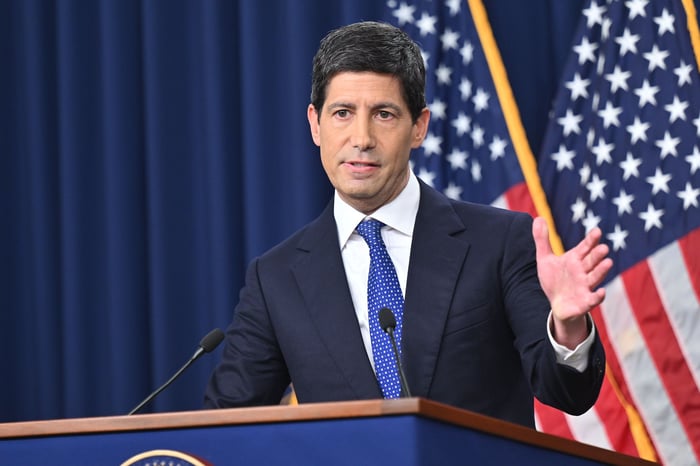
Fed Chair Kevin Warsh just leveled with investors about AI stocks. Image source: Official Federal Reserve Photo.
On Oct. 28, Warsh and his Federal Open Market Committee (FOMC) colleagues voted to hold interest rates steady amid a 67th consecutive month of annualized inflation above the Fed's long-term 2% target. While the FOMC's decision often dominates the headlines, it's Fed Chair Warsh's commentary with the press following the October FOMC meeting that's truly stirring the pot.
With just six blunt words, the head of the Federal Reserve drove a dagger through the stock market's No. 1 catalyst.
AI stocks aren't immune to rising interest rates
Following every FOMC rate-decision meeting, the sitting Fed chair delivers prepared remarks and then fields a handful of questions from the press.
Since taking over as Fed chair on May 22, Warsh has done away with forward-looking guidance in FOMC meeting statements and in his post-meeting discussions with reporters. In other words, getting direct answers or hints about what's to come has been challenging during Warsh's five-month tenure.
But in one of his more candid moments since succeeding Jerome Powell, Fed Chair Warsh opened up about the interest-rate sensitivity of AI companies:
Interest rates get in the cracks, interest rates affect directly or indirectly, almost everything... You've seen market participants that are discriminating between the kinds of investments they want to make. You've seen credit spreads for certain assets widen out, gap out. For others, you've seen some tightening in financial conditions, but not significantly.
It's this blunt six-word assessment, "interest rates get in the cracks," that's sent an unmistakable message to AI stock investors.
While some of Wall Street's hyperscalers are funding their data center build-outs through stock issuances and cash on hand, the otherworldly demand for AI hardware is being financed, in part, with debt. If borrowing costs continue to climb, they could adversely affect this expansion and near-term growth projections, forcing a re-rating of the second-priciest stock market in history.

Image source: Getty Images.
AI stocks may face interest rate pressure on two fronts
What makes the current interest rate climate especially tricky for AI stocks is that they could be hammered on two fronts.
The most obvious is that Warsh and the FOMC are expected to raise interest rates several times, beginning in December. The CME Group's (NASDAQ:CME) FedWatch Tool predicts a 72% chance of a 25-basis-point rate hike in December and a nearly 50% chance of 75 basis points in cumulative hikes by Sept. 15, 2027.
The last time US Treasury yields were this high, total US national debt stood at just $8.9 trillion. Today, US debt stands at $40.1 trillion. That's +$31.2 trillion more, or over 4.5 TIMES higher. This means every 1 percentage point in the average cost of servicing the debt now translates to ~$401 billion per year in interest expense. In 2007, the same 1 percentage point translated to just ~$89 billion. That’s an additional ~$312 BILLION in annual interest expense for every percentage point increase in borrowing cost. This is a vastly different situation than it was 19 years ago. The bond market matters more now than ever.
— The Kobeissi Letter (@KobeissiLetter) September 25, 2026
But the bond market may also punish AI stocks. Notably higher long-duration Treasury bond yields (specifically 10- and 30-year yields) can increase corporate borrowing costs. While elevated inflation is one reason long-duration Treasury yields have surged in 2026, it's not the only one. For instance, bond traders are also concerned about U.S. total debt surpassing $40 trillion and ongoing federal deficits.
This combination of forces pushing up lending rates is a potential disaster in the making for AI stocks.
Sean Williams has no position in any of the stocks mentioned. The Motley Fool has positions in and recommends CME Group. The Motley Fool has a disclosure policy.