


EN
How Investors Are Reacting To Philip Morris Stock As Sales Rise And EPS Falls
- Philip Morris International reported third quarter 2026 results with sales of US$11,438 million and net income of US$3,313 million, alongside lower basic and diluted EPS from continuing operations compared with the prior year period.
- The nine month figures showed higher sales of US$32,776 million but reduced net income and EPS, highlighting rising top line scale while profitability and per share earnings compressed over the period.
- The focus now turns to how Philip Morris International's lower EPS alongside higher sales could influence the existing smoke free transition investment narrative.
Philip Morris International Investment Narrative Recap
To own Philip Morris International, you need to be comfortable with a business that still uses cigarettes as a cash engine while pushing smoke free products like IQOS, VEEV, and ZYN. The latest quarter showed higher sales with lower earnings per share, which points to heavier investment and cost pressure. That mix keeps the smoke free transition story intact, but less tidy in the near term.
The key short term swing factor remains how quickly smoke free products scale relative to rising spend and the structural decline in combustibles. The biggest current risk is that higher U.S. investment and broader marketing outlay sit on margins longer than expected, while cigarette volume pressure and a high P/E leave little room for operational missteps.
The most relevant disclosure around these earnings is management’s ongoing focus on smoke free growth supported by cost savings. The firm reports smoke free gross margins near 70% alongside more than US$1.8b of gross cost savings already delivered out of a US$2b 2024 to 2026 program. That gives Philip Morris International room to keep funding U.S. expansion for ZYN and future IQOS ILUMA.
For you as a shareholder, the link between that cost program and this quarter’s softer EPS is important. Rising spend on ZYN campaigns, IQOS ILUMA preparation, and broader U.S. commercial build out may weigh on SG&A in the near term. The potential upside is that the cost savings program and multi category smoke free model continue to support earnings mix, while the risk is that elevated leverage and a rich P/E amplify any disappointment if execution slips.
What The Philip Morris International Forecasts Are Really Asking You To Believe
Philip Morris International's narrative projects US$49.8b in revenue and US$15.4b in earnings by 2029, based on analyst expectations of 5.4% yearly top line growth and an earnings increase of about US$4.6b from US$10.8b today.
Uncover why Philip Morris International's fair value indicates a valuation that is roughly in line with its current price.
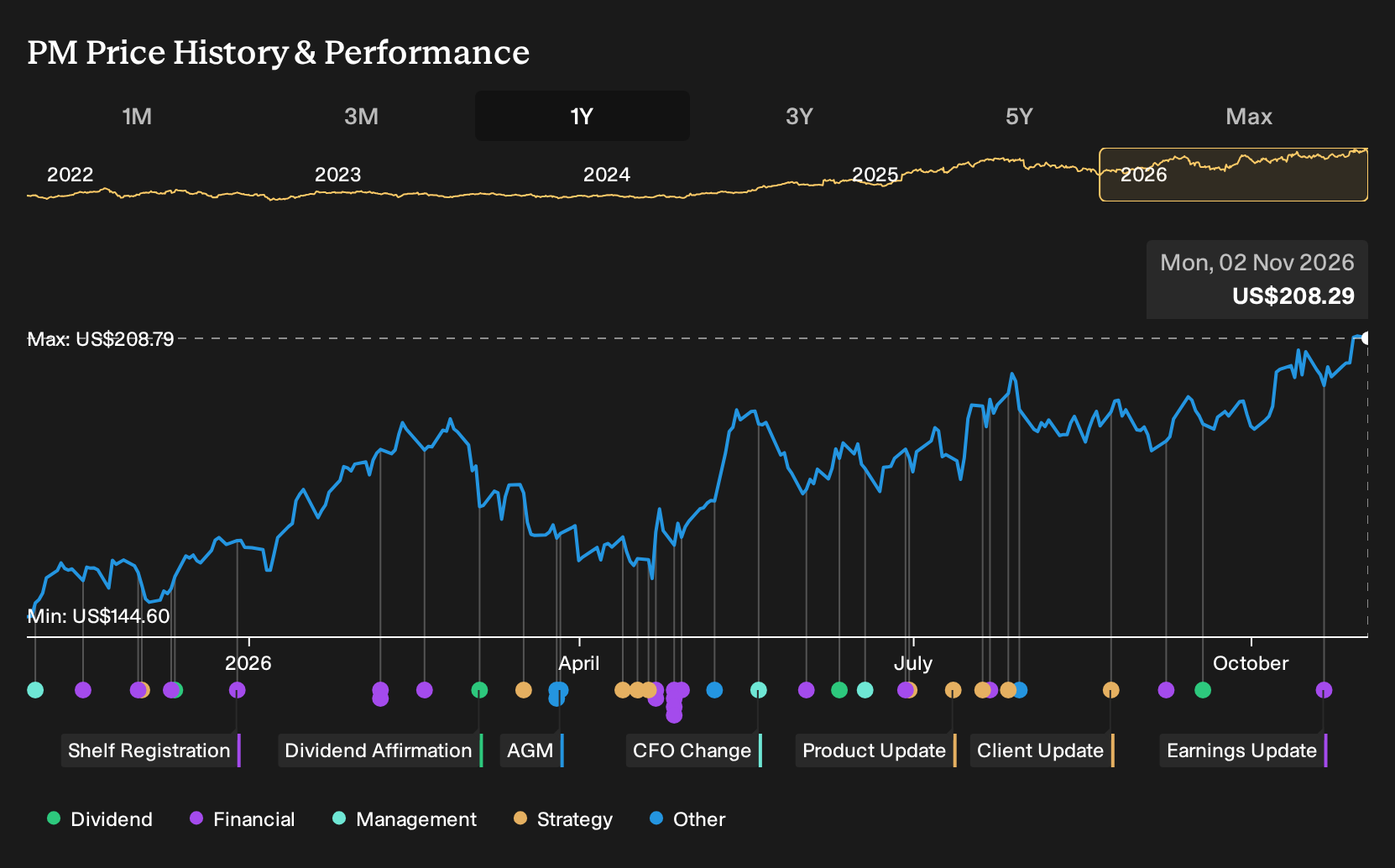
Exploring Other Perspectives
Lowest analysts frame regulation as the real swing factor for Philip Morris International. Before this earnings release, they were pencilling in around US$48.7b of 2029 revenue and US$15.3b of earnings, yet still argued the stock looked stretched. You now have two very different stories on the same numbers; it helps to explore both before deciding what feels realistic to you.
Explore 5 other Philip Morris International fair value estimates, including one that suggests as much as 85% downside from the current price!
Form Your Own Verdict
Don't just follow the ticker; dig into the data and build a conviction that's truly your own.
- A great starting point for your Philip Morris International research is our analysis highlighting 3 key rewards and 1 important warning sign that could impact your investment decision.
- See our latest analysis for Philip Morris International. The report includes a comprehensive fundamental analysis summarized in a single visual, the Snowflake, making it easy to evaluate Philip Morris International's overall financial health at a glance.
Looking For More Investment Ideas Beyond Philip Morris International?
If this Philip Morris International update has sharpened your view on earnings quality and risk, use that same lens to scan a wider field of opportunities with the Simply Wall St Screener. You can filter by balance sheet strength, income focus, or potential mispricing to build a watchlist that actually matches your goals.
- If capital preservation and consistency matter most to you, start with a group of resilient businesses through the 29 resilient stocks with low risk scores.
- Income focused investors who care about dependable payouts can review a curated set of high yield candidates by checking the 4 dividend fortresses.
- For those hunting for under the radar potential with solid fundamentals, widen your research list using the 19 high quality undiscovered gems.
Have feedback on this article? Concerned about the content? Get in touch with us directly. Alternatively, email editorial-team@simplywallst.com