


EN
Oil And Gas Stocks Retail Investors Are Screening After The Iran Supply Shock
Energy headlines have flipped from abstract geopolitics to something that can move portfolios, as U.S. strikes on Iran’s Qeshm Island refocus attention on supply risk around the Strait of Hormuz and the knock-on effects for upstream producers. That mix of worry and potential opportunity can leave investors either exposed or positioned. This article walks through three upstream stocks tied to this news and explains how each could be relevant to investors’ next steps.
The three upstream stocks in focus are only a sample, as the full screen surfaces 51 more listed producers and explorers with equally detailed stories that are not covered here. To go broader than these highlights, head straight into the Global Oil & Gas Exploration and Production (Upstream Energy Stocks) screener to identify, analyze, and prioritize the highest conviction upstream energy ideas for your watchlist.
Saturn Oil & Gas (TSX:SOIL)
Overview: Saturn Oil & Gas is a Canadian pure-play upstream producer that acquires, explores, and develops light oil fields across Saskatchewan and Alberta, giving direct exposure to crude prices.
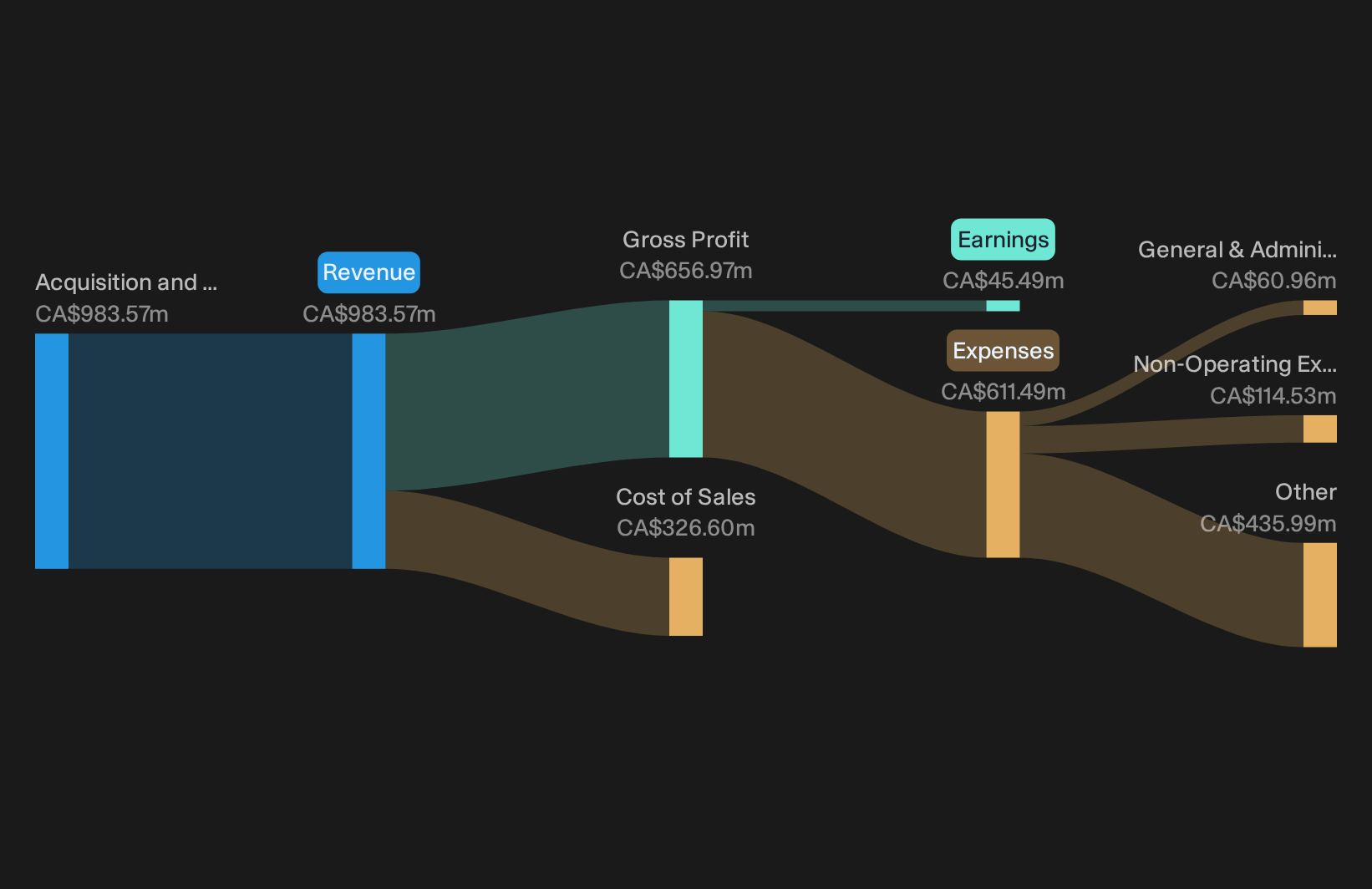
Operations: Saturn Oil & Gas generates about CA$983.6 million from acquiring and exploring petroleum and natural gas resources in Canada, with revenue fully Canada-based.
Market Cap: CA$1.7 billion
Saturn Oil & Gas matters in this upstream screen because it is tightly linked to crude pricing, so shifts in global supply risk can quickly feed through to cash generation, balance sheet decisions, and how management responds with capital plans.
"Saturn Oil & Gas carries a high level of net debt at $695 million and a leverage ratio of 1.3 times net debt to annualized adjusted EBITDA, which can make the company more exposed to commodity price downturns or rising interest rates. These factors can affect net margins and future earnings through increased debt service costs or more limited growth investment."
What happens to Saturn Oil & Gas margins and growth potential depends heavily on how one unseen pressure on its balance sheet evolves.
That hidden pressure on Saturn Oil & Gas could be a catalyst or a brake, and the full narrative for Saturn Oil & Gas shows how its debt profile might be quietly reshaping future options.
Sable Offshore (SOC)
Overview: Sable Offshore operates three offshore platforms and subsea pipelines in federal waters off California, producing and transporting crude oil and natural gas.
Market Cap: US$528 million
Sable Offshore plugs directly into the upstream theme of this screen, since its offshore platforms turn hydrocarbon pricing into real-world production decisions that matter whenever supply risk headlines flare.
"The shift to low-cost Perf Add and ESP optimization, where early intervals have produced 900 to 1,100 barrels per day compared with forecasts of 250 to 280 barrels per day at around $0.64 per barrel finding and development cost, points to a program that can expand production while supporting stronger net margins."
What happens if a single key execution step in that program changes the balance between higher volumes and the cost of chasing them?
That execution risk is exactly what the full narrative for Sable Offshore unpacks, showing how Sable Offshore’s program could accelerate value or quietly cap its upside potential.

EQT (EQT)
Overview: EQT is a major U.S. natural gas producer that explores for, produces, gathers, and markets gas and related liquids in Appalachia.
Operations: EQT generated about US$8.7b from upstream, US$1.3b from gathering, and US$0.6b from transmission, with roughly US$9.1b from U.S. customers.
Market Cap: US$34.6b
EQT sits in the middle of this upstream screen because it connects Appalachian gas fields directly to end users that care about reliable supply when global energy risk rises.
"The ramp-up of large-scale, long-term natural gas supply contracts to new AI data centers and power generation facilities in Appalachia beginning in 2027 and 2028 remains central to EQT capturing growing in-basin demand for its production."
What happens when one key assumption about how much gas those future customers actually pull through the system starts to shift?
If that demand curve for EQT bends even slightly, the full narrative for EQT shows how contracts, capital plans, and risk could be quietly decoupling behind the headlines.

Curious About What You Might Be Missing?
Fresh ideas do not stay under the radar for long. Catch potential breakout momentum before the crowd and while it matters. This is where you get in early.
- Scan for income workhorses that could keep paying when others pause by jumping into a curated set of 3 dividend fortresses built for staying power.
- Hunt for durable balance sheets before momentum traders arrive by running through a focused list of solid balance sheet and fundamentals (6 results) that filters out fragile stories.
- Track early movers in digital assets exposure while prices are still dropping in and out of favor with a targeted pool of 17 cryptocurrency and blockchain stocks.
Have feedback on this article? Concerned about the content? Get in touch with us directly. Alternatively, email editorial-team@simplywallst.com