


EN
Gamble on AI “copper to light”! MRVL.US (MRVL.US) bought Lumentum (LITE.US) for 115 billion dollars, but why did the market first use a sharp decline to cast a negative vote?
The Zhitong Finance App learned that at the key point where AI infrastructure is rapidly shifting from copper interconnection to optical interconnection, Maywell Technology (MRVL.US) chose a big gamble. On November 2, before the US stock market, Maywell Technology and optical component manufacturer Lumentum (LITE.US) announced that they have reached a formal agreement. Maywell Technology will acquire Lumentum in full stock. According to reports, the total value of this deal, which includes debt, is about 115 billion US dollars, and the equity value is about 102.5 billion US dollars, making it one of the largest mergers and acquisitions in the history of the technology industry. It is also more than ten times the previous largest acquisition by Maywell Technology — the $10 billion acquisition of network chip company Inphi in 2021.
According to the terms of the deal, each Lumentum shareholder will exchange 4.5 shares of Mewell Technology shares. The transaction consideration is equivalent to 1,132 US dollars per share, a 23.9% premium over Lumentum's last unaffected closing price of 913.95 US dollars on October 28, that is, before news of the merger and acquisition negotiations was made public. After the transaction is completed, Lumentum's original shareholders will hold approximately 33% of the combined company's shares, and Maywell Technology shareholders will hold approximately 67%. Matt Murphy, CEO of Mywell Technology, will continue as Chairman and CEO of the merged company, and the deal is expected to close in the first half of 2028.
Judging from the valuation, this price is not cheap. According to the calculation of LSEG data, 1,132 US dollars/share is about 33 times Lumentum's core operating profit for the next 12 months, while the median value in the industry is about 16 times, and the premium is more than double. In order to restrain the deal, the two parties set high break-up fees: if Maywell Technology's board of directors terminates the deal or Maywell abandons the deal in order to accept a third party's takeover offer, it must pay US$5.8 billion to Lumentum; if Lumentum withdraws under similar circumstances, it will have to pay US$2.9 billion to Maywell Technology; if the deal is blocked due to regulation, Maywell Technology will have to pay US$3.2 billion.
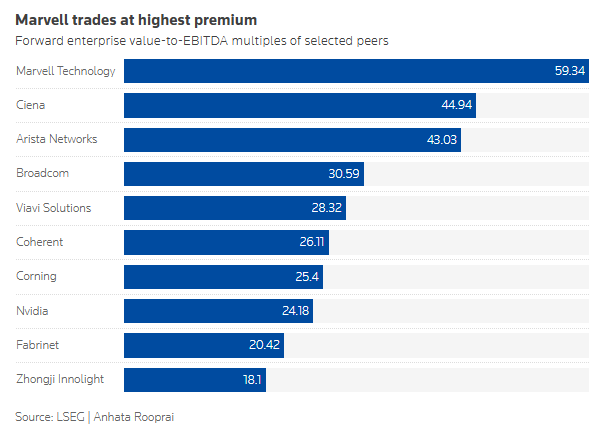
Strategic logic: bet on AI networks “turning copper into light”
Maywell Technology's management summarized the core logic of this deal as follows: AI networks are moving from copper interconnection to optical interconnection, and connectivity bottlenecks are becoming a key constraint on AI infrastructure expansion, and the two companies' product portfolios are highly complementary. After merging, they can provide closer collaborative design, end-to-end solutions, and speed up product launch.
Goldman Sachs pointed out in a research report that Maywell Technology believes that the potential market size (TAM) after the merger will expand from about 490 billion US dollars at the time of independent operation to about 550 billion US dollars, of which near-package optics (NPO) and co-packaged optics (CPO) bring about an incremental opportunity of about 60 billion US dollars.
At the specific product level, Maywell Technology produces digital signal processors in optical transceivers, while Lumentum produces lasers and other optical components. As hyperscale data centers need to transfer data between thousands of chips at extremely high speeds, traditional copper wires are becoming increasingly difficult to withstand the pressure of bandwidth and power consumption. By converting electrical signals into optical signals, optical transceivers have become a key component of the internal interconnection of AI data centers.
Murphy said in a statement that AI infrastructure is undergoing a fundamental structural shift to optical connectivity. This is an opportunity for a generation of talents to emerge, and the merged company hopes to “shape the next era of AI connectivity.”
In addition to product collaboration, supply chain assurance is another main line. Goldman Sachs Research reports that the combination of Lumentum's internal indium phosphide (InP) wafer manufacturing capability with Maywell Technology's supply chain ecosystem is expected to enhance supply assurance and manufacturing flexibility in a market where demand for AI driving components exceeds supply. Currently, demand for optical connections in AI computing power construction is growing rapidly, and supply bottlenecks have become an important variable in the industrial chain.
The deal also has a clear “NVDA.US (NVDA.US) ecosystem” color. According to the report, Nvidia has invested 2 billion US dollars each in Maywell Technology and Lumentum this year, and Murphy said in an interview that the deal will benefit Nvidia because it combines two key Nvidia suppliers and is a “double bet on supporting Nvidia.” Nvidia did not respond to requests for comment.
Maywell Technology itself is also continuing to enhance optical interconnection. The company completed the $3.5 billion acquisition of Celestial AI in February of this year; in August, it also reached a chip supply agreement with Google (GOOGL.US), with sales of up to 120 billion US dollars by fiscal year 2033. Google also has the right to acquire $12.2 billion in Mywell Technology shares.
On Investor Day, Maywell Technology predicts that revenue for the 2031 fiscal year will reach 70 billion to 90 billion US dollars, of which about 37.5 billion US dollars will come from the interconnect business; the company expects the interconnect market to grow at an annual rate of 65% to 65 billion US dollars by 2030.
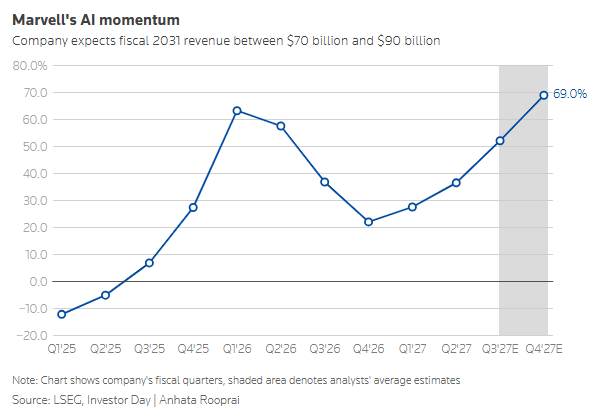
Financial collaboration and market cold water
Maywell Technology expects the company's annual revenue to exceed US$21 billion after the merger, and the adjusted operating margin is in the lower 40% range; within one year after completion of the transaction, Maywell Technology's non-GAAP earnings per share will be enhanced. The supporting factors include stronger growth, expanded profit margins, and normalized cost coordination of more than 1 billion US dollars, and the collaboration mainly comes from cost of sales (COGS).
Although management drew a clear strategic picture, the capital market first gave negative feedback. Maywell Technology's stock price closed down 12.7% to $171.41 on Monday; Lumentum closed down 18.6% to $684.40, becoming the worst performing component of the S&P 500 on the same day, and the biggest one-day percentage decline since April 3, 2025.
Earlier, there were reports last Thursday that after negotiations between the two sides, Maywell Technology's stock price fell 13% on the same day and fell 10% on Friday; Lumentum rose 0.6% and fell 8.6% on the two days, respectively. Lumentum's closing price on Monday was a sharp discount from the $1,132 acquisition price, reflecting not only the impact of Mewell Technology's share price fluctuations on the exchange value, but also the market's pricing on transaction completion prospects and consolidation risks.
Analysts' questions focused on valuation and cycle position.
Axel Rudolph, chief technical analyst at IG Group, said that this is a huge bet, and investors have reason to ask if Maywell Technology is paying too much and taking too many risks at the same time.
A team of analysts at Morgan Stanley, led by Meta Marshall, pointed out last week that Lumentum's stock price is already significantly higher than its historical valuation. The current valuation does reflect the company's track position and room for growth in the AI wave, but once market supply and demand return to balance, Lumentum's gross margin level may be a normalized repair that will drag down profits; “At a time when optical demand and pricing are unusually strong, we question the appeal of such large-scale acquisitions at potential cyclical peaks.”
The deeper background is that AI trading itself is being tested by reality. Currently, the cash consumption and debt of tech giants such as Amazon (AMZN.US) and Alphabet (GOOGL.US) are rising, deepening market concerns about AI construction costs and triggering the recent sell-off of chip stocks.
In addition, the Democratic Party's overall victory in the US midterm elections this week may add new obstacles to core data center construction, and data center projects are already facing strong local opposition in places such as Texas and Australia.
The Nasdaq Composite Index fell 5.3% in October, the worst monthly performance since March 2025. William Blair analyst Richard de Chazal said that investors previously preferred to view new cloud vendors as weak links in the AI chain, and assumed that hyperscale cloud service providers had sufficient traditional business profits to finance huge AI investments and cover capital costs, but after financial reports from Alphabet, Amazon, Meta (META.US), and Microsoft (MSFT.US), this assumption is changing, and investors are beginning to wonder whether future revenue growth can match the current investment scale and seek diversification and protection.
Bank of America economist Claudio Irigoyen also mentioned that the tightening of global financial conditions is a first-order risk. AI capital expenditure is interrelated with financial conditions, and rising interest rates reflect at least part of the increase in the supply of financing AI investments.
“Investors' concerns about the main line of AI continue to heat up. As capital expenditure expands, risks become more prominent. Will these investments eventually pay off? Will AI be implemented and popularized faster than expected?” Irigoyen said in the research report.
Wall Street is not one-sided, however, bearish.
Citibank analyst Heath Terry's team believes that underestimating big tech giants may be a misjudgment. Terry said in the research report, “Despite rising earnings expectations for the third quarter and continued limited infrastructure supply, we still believe that the market has underestimated the AI-based revenue growth potential of hyperscale cloud vendors.”
According to Citibank data, the total revenue of the four companies Amazon AWS, Meta, Google, and Microsoft grew by more than 25% year-on-year in the third quarter; based on the giant's capital expenditure plans, the combined revenue of the four companies is expected to grow by about 30% in 2027.
Based on this, the bank is still optimistic about the ability of these large technology companies to fully reap AI dividends, even if capital investment continues to rise.
Citi estimates that the total global investment in AI will reach about 1.7 trillion US dollars in 2027, an increase of 64% over 2026; next year, the four largest hyperscale cloud vendors will account for about 64% of the total global AI investment. “Although there are bottlenecks in equipment supply, supervision, and financing, we expect that enterprise-side AI implementation will accelerate and support the main AI investment market.”