


EN
What’s Behind Boston Beer Company (SAM) Stock’s Latest Move?
Why Boston Beer Company Stock Is Back in Focus
Boston Beer Company (SAM) has returned to the spotlight after mixed third quarter results, updated full-year loss guidance, and higher brewery asset impairment charges drew fresh attention from investors.
The latest quarterly update and narrowed full-year loss guidance have coincided with a sharp swing in sentiment. Boston Beer Company’s 1-month share price return of 32.16% and 90-day gain of 20.23% have lifted year-to-date share price performance to 10.77%, even though 3-year and 5-year total shareholder returns of 34.75% and 54.97% declines still point to a long road back.
Spot emerging turnarounds alongside Boston Beer Company by scanning our hand picked 19 high quality undiscovered gems that pair resilient fundamentals with under the radar share price moves.After a more than 30% jump in a month, while full-year guidance still points to a loss, Boston Beer Company now forces a harder question: Is most of the rerating already in the rearview mirror or not yet priced in?
Most Popular Narrative: 11% Overvalued
Boston Beer Company closed at $221.37, while the most followed narrative pegs fair value at $199 using a 7.24% discount rate. As a result, the gap now leans against new buyers rather than in their favor.
The current valuation implies the share price does not fully reflect Boston Beer Company’s progress on gross margin expansion, the growth of Sun Cruiser into a roughly US$0.5b retail brand and the benefits of a net cash balance with no debt.
See why 14 investors see Boston Beer Company as 11% overvalued.
Result: Fair Value of $199 (OVERVALUED)
Still, the Boston Beer Company story can break if category volumes keep sliding or if the US$191m aluminum can dispute ultimately drains meaningful cash.
Find out about the key risks to this Boston Beer Company narrative.
Another View: Boston Beer Company Looks Cheap On Sales
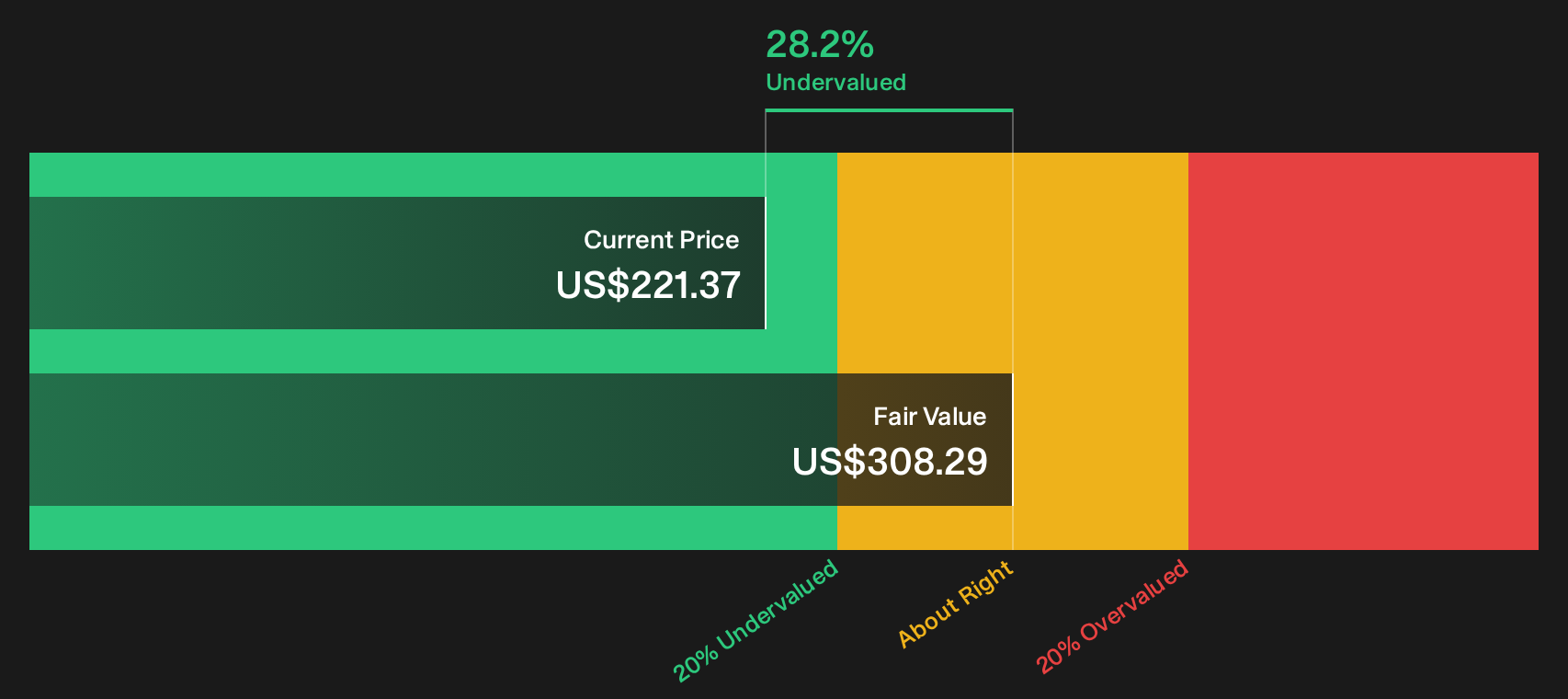
The DCF fair value of $308.29 points one way, yet Boston Beer Company trades on a P/S ratio of 1.2x, which is lower than both the US Beverage industry average of 1.3x and the peer average of 2.2x. If the market ever moved closer to the fair ratio of 1.2x, would that leave much upside from here, or would it mainly create valuation risk if growth disappoints?
Investors who want to see how this picture holds up as assumptions change can walk through the SWS DCF model in detail, step by step, with the full calculation laid out in our tools. Look into how the SWS DCF model arrives at its fair value.
Next Steps
Mixed signals on Boston Beer Company often lead to split opinions. Act before the next sentiment swing by stress testing the upside case yourself through the 3 key rewards.
Looking for more Boston Beer Company sized opportunities?
If Boston Beer Company has you rethinking what is possible after a sharp move, do not stop at one ticker when a wider opportunity set is a few clicks away.
- Target resilience first by zeroing in on companies with strong financial footing using the list of solid balance sheet and fundamentals (24 results).
- Hunt for mispriced quality by scanning the 34 high quality undervalued stocks that couples robust fundamentals with potentially appealing entry points.
- Prioritise staying power by reviewing the 29 resilient stocks with low risk scores that highlights businesses with more measured risk profiles.
Have feedback on this article? Concerned about the content? Get in touch with us directly. Alternatively, email editorial-team@simplywallst.com