


EN
Earnings Ahead Could Test The Case For Qualys Stock And AI Security
- Qualys is preparing to report results for the quarter ended September 2026, with Wall Street expecting year over year earnings and revenue growth that could influence sentiment when the figures are released.
- The business is leaning into AI driven risk operations and cloud based cybersecurity, using its Enterprise TruRisk Management platform to broaden use cases and deepen customer adoption beyond traditional vulnerability management.
- We will look at how Qualys' investment narrative is affected by the upcoming earnings report and its AI focused security push.
Scan how Qualys' AI driven security push compares with other potential breakout candidates by reviewing the hand picked 40 profitable AI stocks that aren't just burning cash list before earnings season heats up.
Qualys Investment Narrative Recap
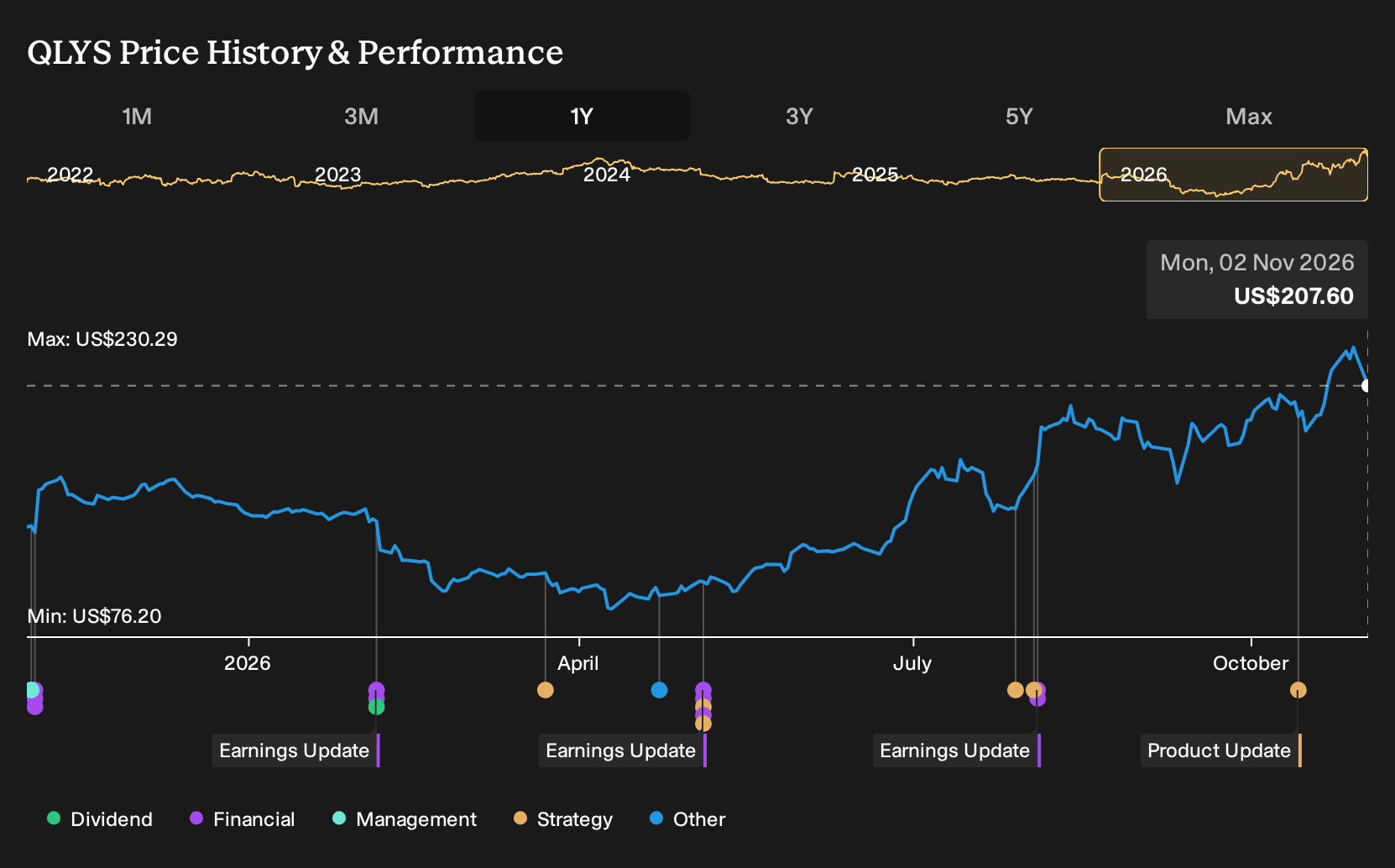
To own Qualys, you need to believe its cloud based, AI driven risk operations platform can keep pulling more security budgets onto a single, integrated system. The near term swing factor is the November 9 earnings release and how bookings, TruRisk adoption and partner traction line up against already detailed mid single digit revenue growth expectations.
The biggest operational risk is that rapid change in AI security makes Qualys' internally built agents look dated, which could push up R&D and pressure margins if customers move to faster moving rivals. If the upcoming report does not clearly link Enterprise TruRisk Management, ETM and Patch Management to stronger new business, that risk will feel more immediate than this quarter's headline numbers.
The most relevant recent development is Qualys' push into an AI centric risk operations model through its Enterprise TruRisk Management platform and Agentic AI capabilities. That rollout ties directly into the current earnings setup, because the thesis now leans on TruRisk and newer modules like CSAM, ETM, TotalCloud and Patch Management driving broader platform usage rather than just traditional vulnerability management.
If customers keep consolidating tools onto TruRisk, that can support higher average spend per account and reinforce net profit margins at 29.4%. The flip side is clear. If billings growth stays in the high single digit range and these AI led modules do not show up as a bigger slice of bookings, investors may focus more on competition risk and the possibility that Qualys' growth profile reflects a mature security vendor rather than a fast expanding platform story.
Qualys Forecasts And Valuation Setup
Qualys' current analyst framework ties the AI heavy risk operations story to specific revenue and earnings targets that extend to the back half of the decade. Analysts are working off 7.8% yearly revenue growth assumptions over the next three years and a profit margin profile that moves from 29.4% today to 27.8% by 2029. That backdrop helps explain why investors are so focused on whether the upcoming results and TruRisk adoption trends line up with this model or start to challenge it.
Consensus forecasts point to earnings of US$244.9 million by 2029, based on an earnings per share estimate of US$6.85 and an expectation that share count gradually declines over the next three years. Current earnings sit at US$206.5 million, so the implied increase in profit is US$38.4 million. That is roughly an 18.6% uplift from today's level, which indicates what the TruRisk and Agentic AI rollout would need to support for this narrative to remain intact.
On the top line, analysts are anchoring their view on Qualys around an expected US$881.4 million of revenue and US$244.9 million of earnings by 2029, paired with a P/E of 30.4x on those projected profits. In simple terms, the story is that a cloud based, AI driven security platform would be generating higher absolute revenue and income, but at a slightly lower margin and a lower earnings multiple than investors are currently paying for the stock today.
Qualys' narrative projects US$881.4 million revenue and US$244.9 million earnings by 2029. This is built on 7.8% yearly revenue growth and an earnings increase of US$38.4 million from US$206.5 million today.
Uncover why Qualys' fair value indicates a potential 10% downside to its current price, leaving little room for error.
Exploring Other Perspectives
The sharpest contrast comes from how bearish analysts frame competition risk for Qualys. Instead of worrying most about execution on TruRisk, they focus on customers shifting spend toward bundled cloud security, which could leave 2029 earnings near US$206.9 million on revenue of about US$881.3 million. That is far below the US$244.9 million earnings that consensus pencilled in before this November 9 report, and it shows how wide the opinion gap already is. Use that spread as a prompt to compare several viewpoints, then assess how the upcoming numbers might influence each of those narratives.
Explore 2 other Qualys fair value estimates, including one that suggests as much as 10% downside from the current price.
The Verdict Is Yours
Disagree with existing narratives? Extraordinary investment returns rarely come from following the herd, so consider conducting your own research and forming your own view.
- A great starting point for your Qualys research is our analysis highlighting 3 key rewards that could impact your investment decision.
- See our latest analysis for Qualys. The report includes a comprehensive fundamental analysis summarized in a single visual, the Snowflake, making it easy to evaluate Qualys' overall financial health at a glance.
Looking For More Investment Ideas Beyond Qualys?
Qualys might be front of mind today, but your watchlist will usually be stronger when it includes a mix of different business types and risk profiles. Use the Simply Wall St Screener to widen your opportunity set and test how Qualys compares with other candidates on quality, resilience and income potential.
- If you want potential mispricing first, scan companies that look attractively valued on both earnings and balance sheet strength through the 34 high quality undervalued stocks.
- If capital preservation matters most to you, filter for stocks that show steadier fundamentals and lower overall risk scores using the 29 resilient stocks with low risk scores.
- If you prefer to hunt for less followed opportunities, search for fundamentally solid businesses that attract less market attention via the 19 high quality undiscovered gems.
Have feedback on this article? Concerned about the content? Get in touch with us directly. Alternatively, email editorial-team@simplywallst.com