


EN
How Higher Charge Offs At First Hawaiian (FHB) Has Changed Its Investment Story
- First Hawaiian reported third quarter 2026 results with net interest income of US$174.1 million, net income of US$63.73 million, earnings per share of US$0.52 and net loans and leases charged off of US$21.95 million.
- The board affirmed a quarterly dividend of US$0.26 per share while credit costs rose, which highlights a tension between shareholder payouts and a higher level of charge offs.
- The focus now shifts to how First Hawaiian's investment narrative incorporates higher net charge offs in the context of its broader earnings profile.
First Hawaiian Investment Narrative Recap
To own First Hawaiian, you need to be comfortable with a regional lender that relies on steady net interest income and disciplined credit through economic swings in Hawaii and its broader Pacific footprint. The recent quarter kept that story intact on revenue, although net income and earnings per share were lower than a year ago. The sharp step up in net loans and leases charged off to US$21.95 million makes credit quality the most important near term watchpoint.
The key upside catalyst still sits with execution on the TriCo Bancshares combination, along with the cost efficiencies and broader customer reach that are expected from it. Higher charge offs introduce more uncertainty into how earnings might trend into that deal closing, but they do not yet overturn the core integration and scale narrative. The biggest risk now is that credit costs stay elevated at the same time as funding pressures or Hawaiian economic softness affect margins.
The dividend affirmation at US$0.26 per share is the announcement that matters most in light of this spike in net charge offs. Management effectively signaled that it is keeping cash returns to shareholders flat even as credit costs affect earnings. That may appeal if you prioritise income and see current credit issues as manageable.
For a catalyst driven investor, the payout decision frames the near term balance of risk and reward. If First Hawaiian maintains its earnings capacity while absorbing higher loan losses, the current dividend level could remain sustainable alongside the planned TriCo integration benefits. If credit trends stay challenging or worsen, the board might eventually need to choose between funding growth, supporting capital, and keeping that dividend unchanged.
What The Current Forecasts Assume For First Hawaiian
Analysts are building a fairly specific roadmap for First Hawaiian over the next few years. Their models point to revenue growing by 27.7% a year, with profit margins edging up from 32.3% today to 33.8% by 2029. On that basis, earnings today of US$284.9 million are projected to reach US$620.2 million by 2029, which is an increase of about US$335 million. Those same forecasts imply that by the 2029 financial year, the bank would be generating about US$1.8b of revenue.
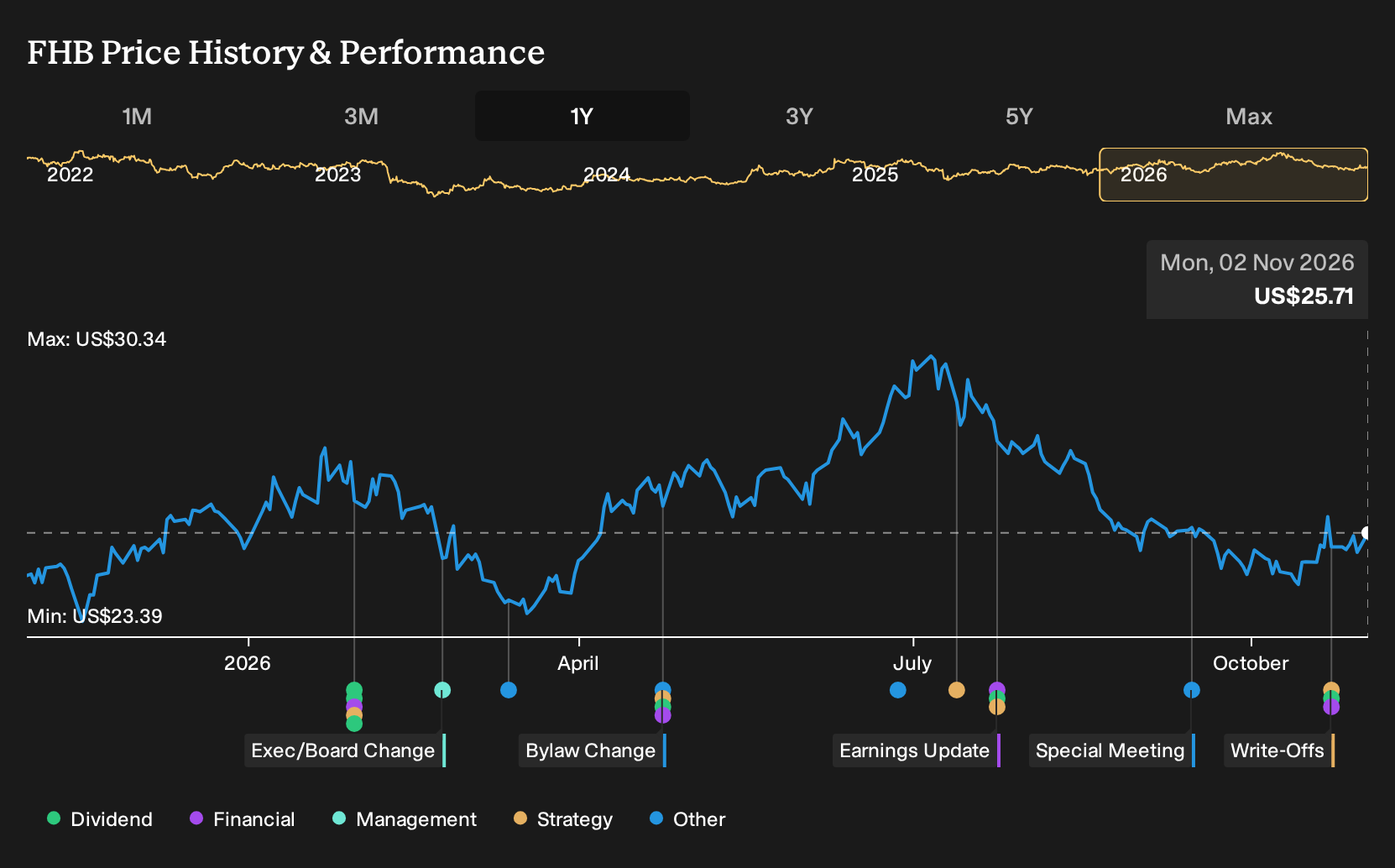
Valuation work in the consensus report links those operating assumptions to a specific trading range. To line up with the analyst view, you would be assuming roughly US$1.8b of revenue and US$620.2 million of earnings in 2029. In that scenario, First Hawaiian would be trading on a 6.9x P/E multiple at that point, compared with 10.8x today and a current US Banks sector multiple of 11.6x. The current consensus price target of US$29.78, which sits between a high of US$34.00 and a low of US$26.00, is 15.2% above the recent share price of US$25.26.
First Hawaiian's narrative projects about US$1.8b of revenue and US$620.2 million of earnings by 2029. This requires forecast annual revenue growth of 27.7% and an earnings increase of roughly US$335 million from current earnings of US$284.9 million.
Uncover why First Hawaiian's fair value indicates a 16% potential upside to its current price, which could narrow quickly.
Exploring Other Perspectives
Two fair value estimates from the Simply Wall St Community span a wide band, from about US$29.78 up to roughly US$57.28, which shows how far opinions on First Hawaiian can stretch. These are private investors, not professionals, reacting to the dividend affirmation, higher charge offs, and the pending TriCo deal. Use that spread as a prompt to explore several sharply different viewpoints before you decide how this bank fits your own risk and return priorities.
Explore another First Hawaiian fair value estimate, including one that suggests it could be worth just $29.78.
Decide For Yourself
Don't just follow the ticker. Dig into the data and build a conviction that's truly your own.
- A great starting point for your First Hawaiian research is our analysis highlighting 4 key rewards that could impact your investment decision.
- See our latest analysis for First Hawaiian. The report includes a comprehensive fundamental analysis summarized in a single visual, the Snowflake, making it easy to evaluate First Hawaiian's overall financial health at a glance.
Looking For More Investment Ideas Beyond First Hawaiian?
Once you have a view on First Hawaiian, it can help to compare it with other opportunities that line up with your risk profile, income needs, and preferred business quality. The Simply Wall St Screener can surface groups of stocks that share similar traits, so you can stress test your thesis instead of relying on a single bank.
- If capital preservation comes first for you, consider starting with a basket of 29 resilient stocks with low risk scores that score well on resilience and measured volatility.
- If value is your priority, you could scan a 34 high quality undervalued stocks that pair stronger fundamentals with prices that sit below many analysts' fair value estimates.
- If balance sheet strength matters most, focus on a list of solid balance sheet and fundamentals (24 results) that combines healthier leverage profiles with more robust fundamentals.
Have feedback on this article? Concerned about the content? Get in touch with us directly. Alternatively, email editorial-team@simplywallst.com