


EN
Could Zip Store Payments Change The Bull Case For Best Buy Stock (BBY)?
- Zip Co Limited has already expanded its flexible payment partnership with Best Buy into physical stores nationwide, letting eligible shoppers use Zip tap to pay in person as well as online, alongside a broader shift toward in-store flexible payments.
- Best Buy’s deeper integration of buy now, pay later options into the checkout flow could influence how customers mix bigger-ticket electronics purchases with services, advertising and membership offerings over time.
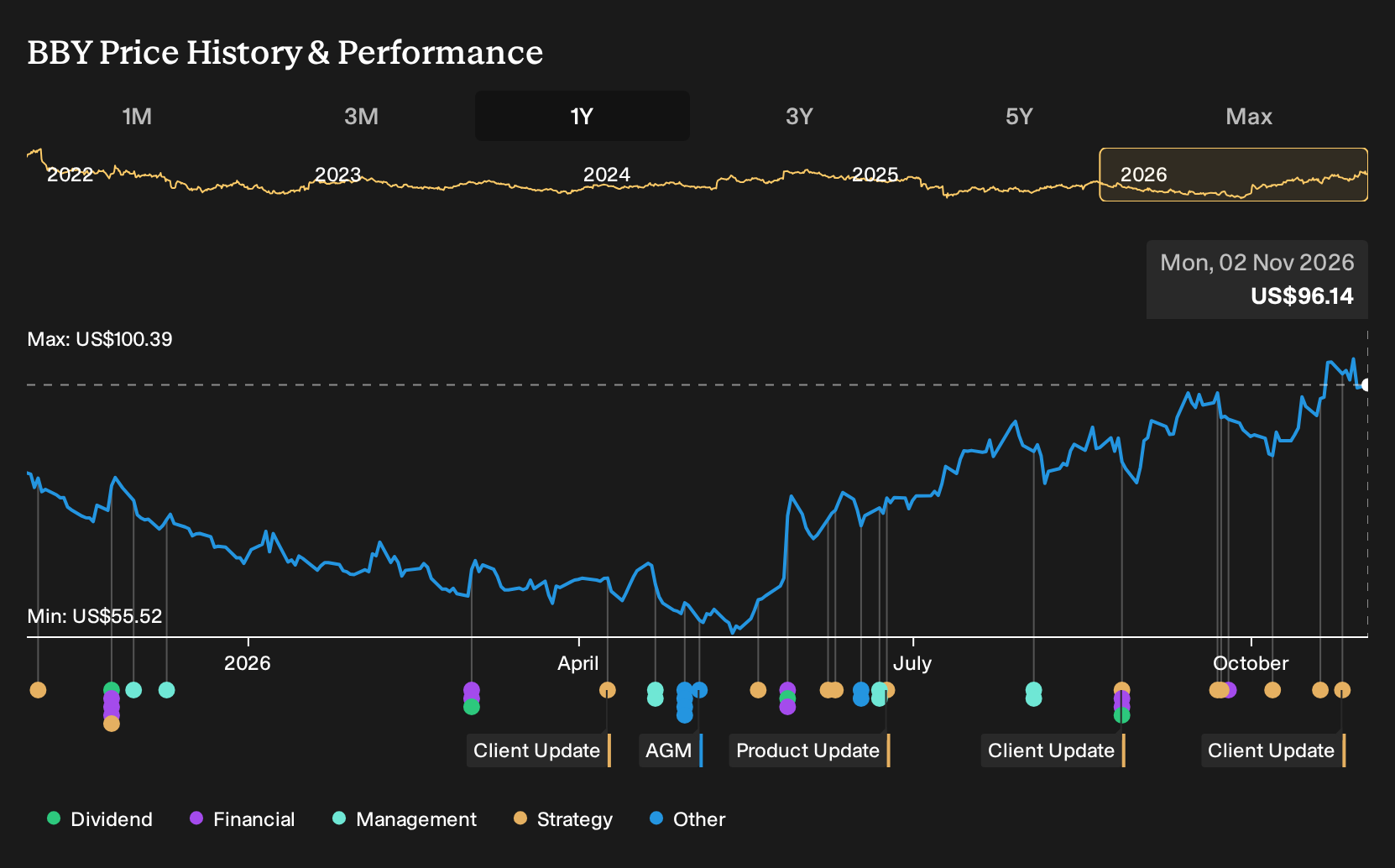
- We will now look at how Best Buy’s expanded Zip-powered in-store flexible payments could influence the broader investment narrative around BBY.
See how Best Buy’s flexible payments story compares with other retailers by running your own shortlist from our hand picked list of solid balance sheet and fundamentals (24 results).
Best Buy Investment Narrative Recap
To own Best Buy, you need to believe the retailer can keep people upgrading TVs, gaming gear and computers while growing higher margin services like ads, memberships and marketplace. The Zip rollout into stores supports that omnichannel pitch, though the direct impact on near term earnings drivers such as computing and appliance demand may be modest for now.
The bigger short term swing factor remains how product mix and promotions affect margins as customers manage fixed budgets. If shoppers trade down in key tech categories or attach fewer services, profitability could feel more pressure than sales. Execution around newer revenue streams still looks central to the risk reward balance.
The Zip partnership expansion into physical locations links directly to those service and mix catalysts. Letting shoppers use flexible payments in store can influence what size TV they pick, how much gaming hardware they bundle and whether they add installation, protection or membership offers at checkout.
That said, reliance on third party financing tools introduces its own operational questions. Best Buy still needs Best Buy Ads, marketplace gross merchandise value and memberships to cover higher SG&A tied to technology and marketing. Analysts currently describe BBY as a fast paced momentum stock, but the real test is consistent execution on these newer income streams.
Best Buy Earnings Assumptions Behind the Flexible Payments Story
Best Buy's narrative projects US$44.0b revenue and US$1.6b earnings by 2029, based on analysts' estimates. This rests on 1.4% yearly revenue growth and an earnings increase of about US$300m from US$1.3b today.
Uncover why Best Buy's fair value indicates a 10% potential downside to its current price, which leaves little room for error.
Exploring Other Perspectives
One alternate view treats Best Buy’s higher margin ecosystem, especially Best Buy Ads and Marketplace, as the real story. Those bullish analysts were modeling about US$45.0b of revenue and US$1.6b of earnings by 2029, with a P/E of 16.5x, before this Zip expansion. You can compare these more optimistic assumptions with your own and decide whether the new information could influence your view.
Explore 5 other Best Buy fair value estimates, including one that suggests the potential for as much as 91% upside from the current price!
Reach Your Own Conclusion
Don't just follow the ticker; dig into the data and build a conviction that's truly your own.
- A great starting point for your Best Buy research is our analysis highlighting 5 key rewards and 1 important warning sign that could impact your investment decision.
- See our latest analysis for Best Buy. The report includes a comprehensive fundamental analysis summarized in a single visual, the Snowflake, making it easy to evaluate Best Buy's overall financial health at a glance.
Looking for more investment ideas beyond Best Buy?
Once you have a view on Best Buy, it can help to widen the lens and compare it with other businesses that fit different risk and income profiles using the Simply Wall St Screener.
- If capital protection ranks high for you, start with a basket of companies that score well on resilience metrics through the 29 resilient stocks with low risk scores.
- Income focused investors can hunt for dependable cash generators by scanning a curated set of higher yielding payers via the 4 dividend fortresses.
- For those hunting for less crowded ideas with solid fundamentals, broaden your watchlist by running the 19 high quality undiscovered gems.
Have feedback on this article? Concerned about the content? Get in touch with us directly. Alternatively, email editorial-team@simplywallst.com