


EN
Jazz Pharmaceuticals (NASDAQ:JAZZ) surprises with Q3 2026 sales, full-year sales guidance is optimistic

Biopharma company Jazz Pharmaceuticals (NASDAQ:JAZZ) beat Wall Street’s revenue expectations in Q3 2026, with revenue rising 10.4% year on year to $1.24 billion. The company’s full-year revenue guidance of $4.81 billion at the midpoint came in 1.6% above analysts’ consensus estimates. Its non-GAAP loss of $3.88 per share was 63.4% below analysts’ consensus estimates.
For more on Jazz Pharmaceuticals, read our free full research report.
Jazz Pharmaceuticals (JAZZ) Q3 2026 highlights:
- Revenue $1.24 billion vs S&P analysts’ consensus estimates of $1.21 billion (10.4% year-on-year growth, 2.8% beat)
- Adjusted EPS -$3.88 vs S&P analysts’ consensus estimates of -$2.38 (63.4% miss)
- Revenue guidance The company lifted its revenue guidance for the full year to $4.81 billion at the midpoint from $4.68 billion, a 2.9% increase
- Operating margin -33.3%, down from 5.1% in the same quarter last year
- Market capitalization $14.02 billion
"Our third-quarter performance reflects sustained execution across the business and gives us confidence to raise our full-year total revenue guidance," said Renee Gala, president and chief executive officer of Jazz Pharmaceuticals. "At the same time, we continue to strengthen the drivers of our future growth, with the approval and rapid launch of Ziihera in first-line HER2-positive GEA and the acquisition of Actio, which adds ABS-1230 and deepens our pipeline in rare, refractory epilepsies. Jazz is moving with momentum and urgency to advance practice-changing medicines that deliver meaningful benefit for patients and durable value for shareholders."
Revenue growth
A company’s long-term revenue performance can indicate its overall quality. Any business can deliver a good quarter or two, but many enduring ones grow for years. Jazz Pharmaceuticals’s revenue grew at a decent 10.5% compounded annual growth rate over the last five years. Its growth was slightly above the average healthcare company and shows its offerings resonate with customers.
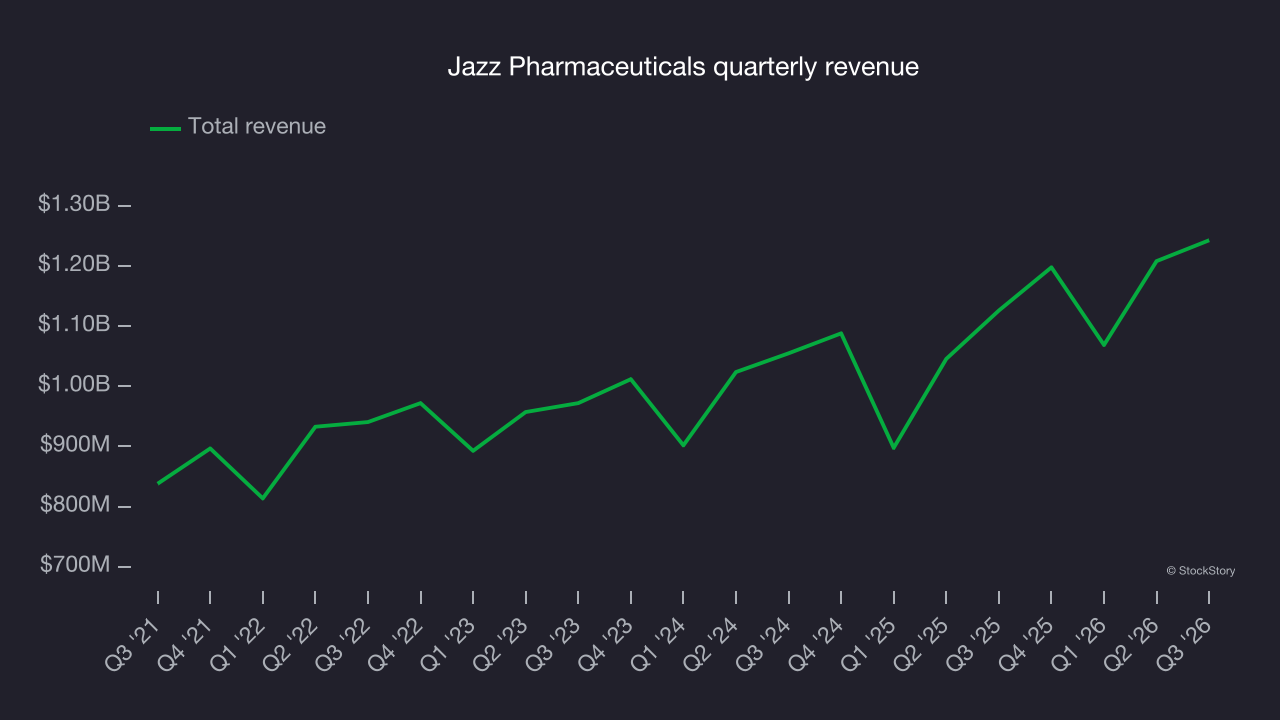
Long-term growth matters most, but within healthcare, a half-decade historical view may miss recent innovations or disruptive industry trends. Jazz Pharmaceuticals’s annualized revenue growth of 8.7% over the last two years is below its five-year trend, but the results were still respectable. 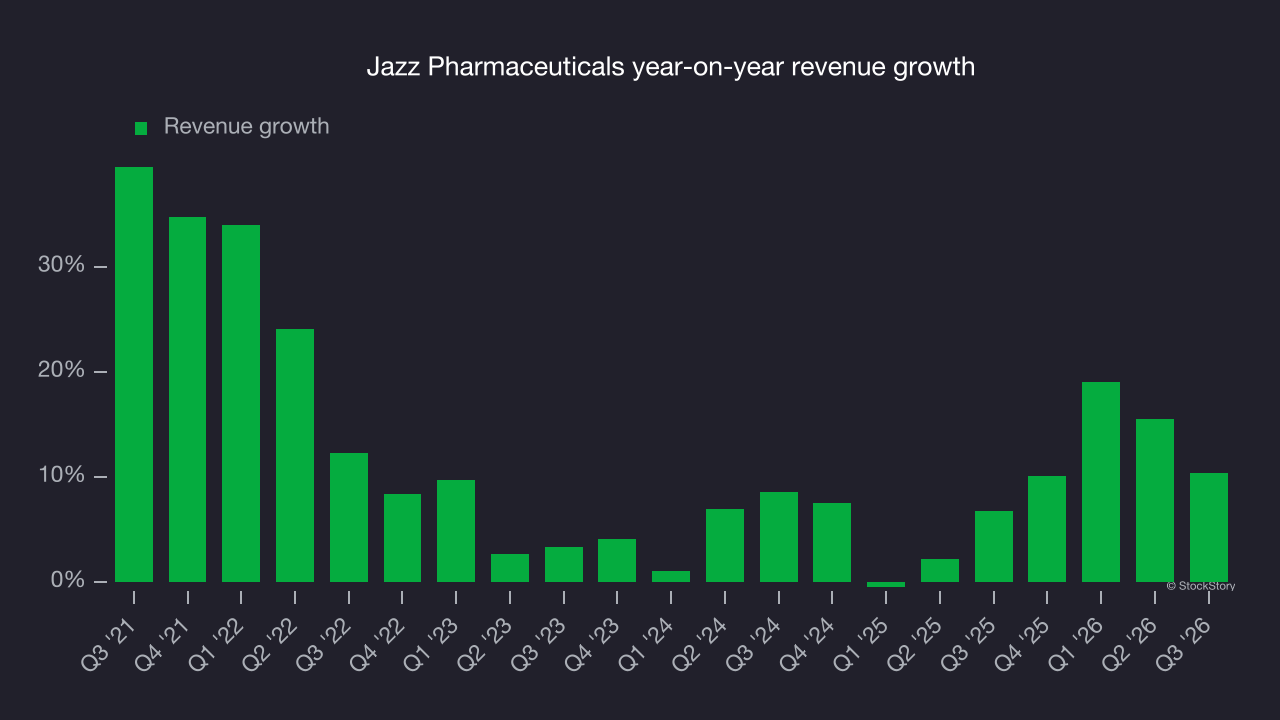
This quarter, Jazz Pharmaceuticals reported year-on-year revenue growth of 10.4%, and its $1.24 billion of revenue exceeded Wall Street’s consensus estimates by 2.8%.
Looking ahead, sell-side analysts expect revenue to grow 4.1% over the next 12 months, according to S&P, a deceleration versus the last two years. This underwhelming projection implies its products and services will face some demand headwinds.
Adjusted operating margin
Adjusted operating margin is one of the best measures of profitability because it tells us how much money a company takes home after subtracting all core expenses, like marketing and R&D. It also removes various one-time costs to paint a better picture of normalized profits.
Jazz Pharmaceuticals has performed well over the last five years. It demonstrated high profitability for a healthcare business, with an average adjusted operating margin of 31.3%.
Looking at the trend in its profitability, Jazz Pharmaceuticals’s adjusted operating margin decreased by 22.1 percentage points over the last five years. The company’s two-year trajectory also shows it failed to get its profitability back to the peak as its margin fell by 18.3 percentage points. This performance was poor overall, showing its expenses were rising and it couldn’t pass those costs on to its customers.
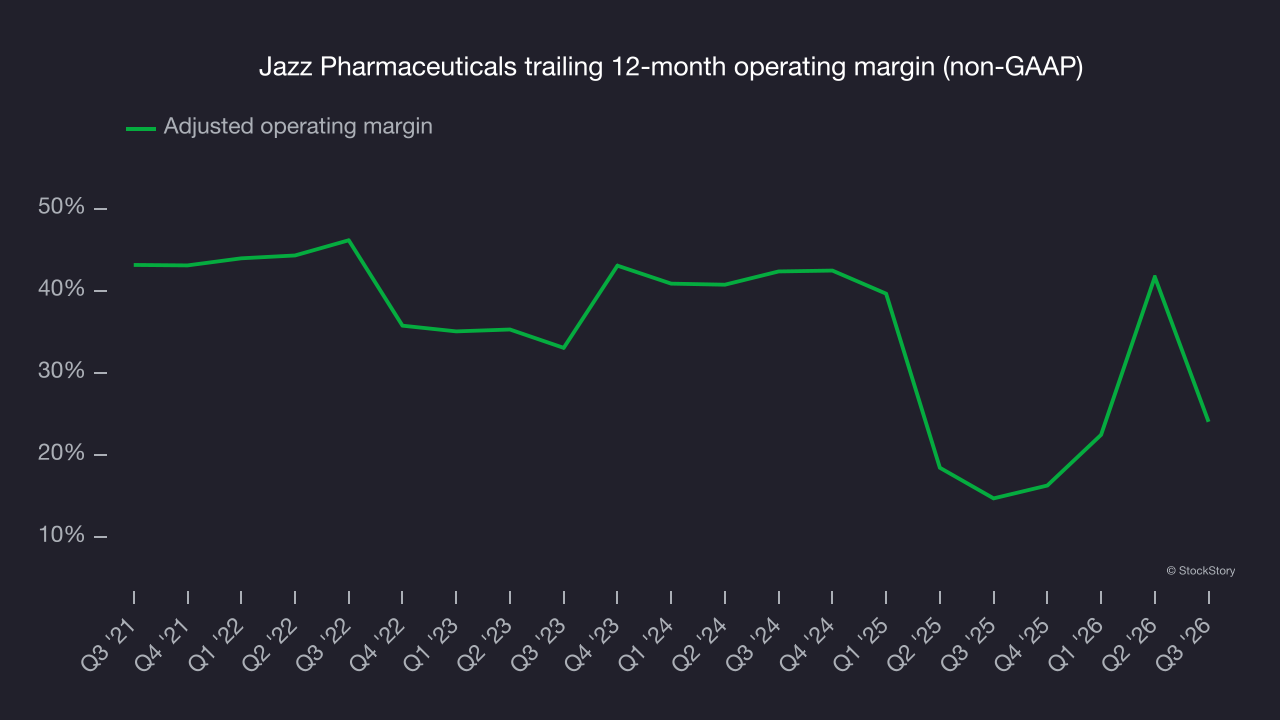
This quarter, Jazz Pharmaceuticals generated an adjusted operating margin of negative 33.3%, down 66.1 percentage points year on year. This contraction shows it was less efficient because its expenses grew faster than its revenue.
Earnings per share
We track the long-term change in earnings per share (EPS) for the same reason as long-term revenue growth. Compared to revenue, however, EPS highlights whether a company’s growth is profitable.
Jazz Pharmaceuticals’s EPS declined by 1.6% annually over the last five years while its revenue grew by 10.5%. This indicates the company became less profitable on a per-share basis as it expanded.
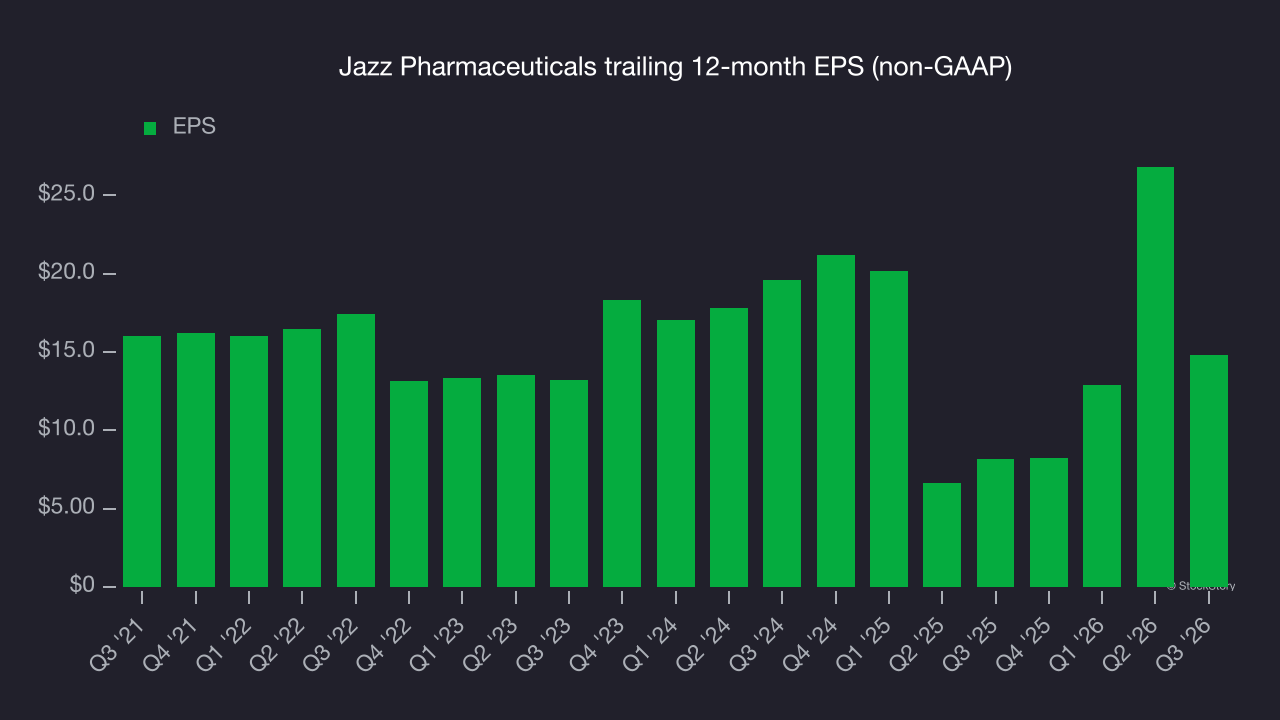
Diving into the nuances of Jazz Pharmaceuticals’s earnings can give us a better understanding of its performance. As we mentioned earlier, Jazz Pharmaceuticals’s adjusted operating margin declined by 22.1 percentage points over the last five years. Its share count also grew by 5.6%, meaning the company not only became less efficient with its operating expenses but also diluted its shareholders. 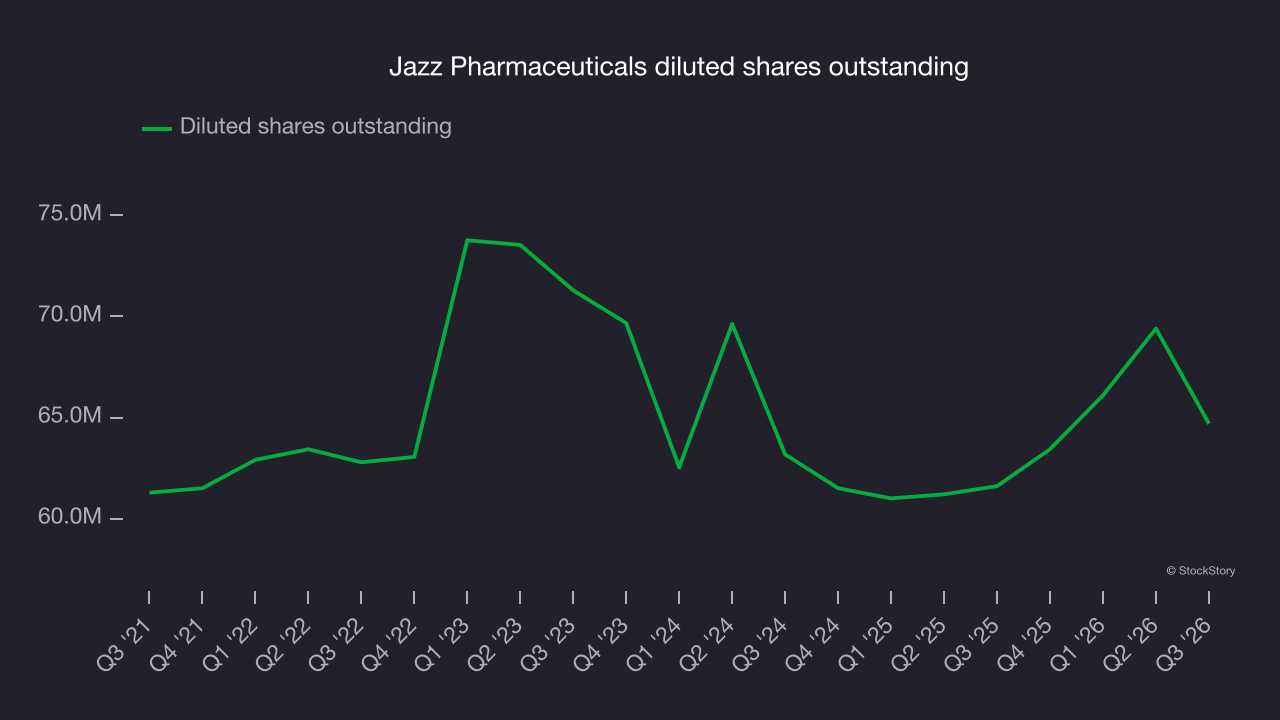
In Q3, Jazz Pharmaceuticals reported adjusted EPS of negative $3.88, down from $8.13 in the same quarter last year. This result missed analysts’ consensus estimates. Over the next 12 months, Wall Street expects Jazz Pharmaceuticals’s full-year EPS to grow 73% from $14.81 to $25.63, according to S&P.
Key takeaways from Jazz Pharmaceuticals’s Q3 results
Jazz Pharmaceuticals delivered a mixed quarter with some key positives: Revenue beat analysts’ consensus estimates, and full-year revenue guidance topped Wall Street’s consensus. EPS, however, missed expectations. Shares remained flat at $214.57 immediately after the results.
When assessing Jazz Pharmaceuticals at its current price, the latest quarter matters, but longer-term fundamentals and valuation are far more important in deciding whether the stock is a buy. Read more in our full research report here (it’s free).