


EN
Bill Ackman Isn’t Sweating Meta Platforms’ AI Spending. In Fact, He Says META Stock Is ‘Incredibly Undervalued.’
Meta Platforms (META), the tech giant behind Facebook, Instagram, WhatsApp, and Threads, rarely stays out of the headlines. Sometimes it is for its dominance in social media, and sometimes for its rather expensive ambitions in artificial intelligence (AI). With billions of dollars flowing into chips, talent, and data centers, Meta is surely not interested in playing catch-up in the AI race. But with spending climbing and investors questioning how quickly these investments will pay off, the company’s AI ambitions have also become a source of market anxiety.
Not everyone, however, seems bothered by the bill. Billionaire investor Bill Ackman, the founder and CEO of Pershing Square Capital Management, is firmly in Meta’s corner. Known for taking large positions in companies he believes are undervalued, Ackman is not losing sleep over Meta’s growing AI budget. Currently, Pershing Square holds roughly 3.2 million Meta shares, representing approximately 9.3% of its total portfolio.
Ackman recently defended the company’s spending plans, arguing that Meta has more than enough financial muscle to fund its AI ambitions. With more than $80 billion in cash and no net leverage, the company is hardly stretching its balance sheet to keep up with the AI race. More importantly, Ackman believes these investments are already translating into faster business growth, with AI helping Meta improve its operations and accelerate its core business.
He also brushed aside the stock’s post-earnings volatility, suggesting that short-term market reactions are not necessarily a fair reflection of a company’s underlying strength. After all, a bad trading day does not automatically make a good business a bad investment.
For Ackman, META stock remains an “incredibly undervalued” opportunity. But does the stock really deserve that confidence? Let’s take a closer look at Meta.
About Meta Stock
Meta Platforms hardly needs an introduction. What started as Facebook in a college dorm room back in 2004 has turned into a digital empire, bringing Instagram, WhatsApp, Messenger, and Threads under one roof. From helping people stay connected to keeping them endlessly scrolling, Meta has become a part of everyday digital life for billions. But apparently, social media was not enough.
The company is now betting heavily on artificial intelligence, augmented reality, and its ambitious metaverse plans. Wall Street has rewarded some of that ambition handsomely, although ads are still the company's overwhelming moneymaker, with META stock soaring nearly 369.5% over the past decade. Today, META boasts a market capitalization of roughly $1.57 trillion and sits comfortably among the “Magnificent Seven.”
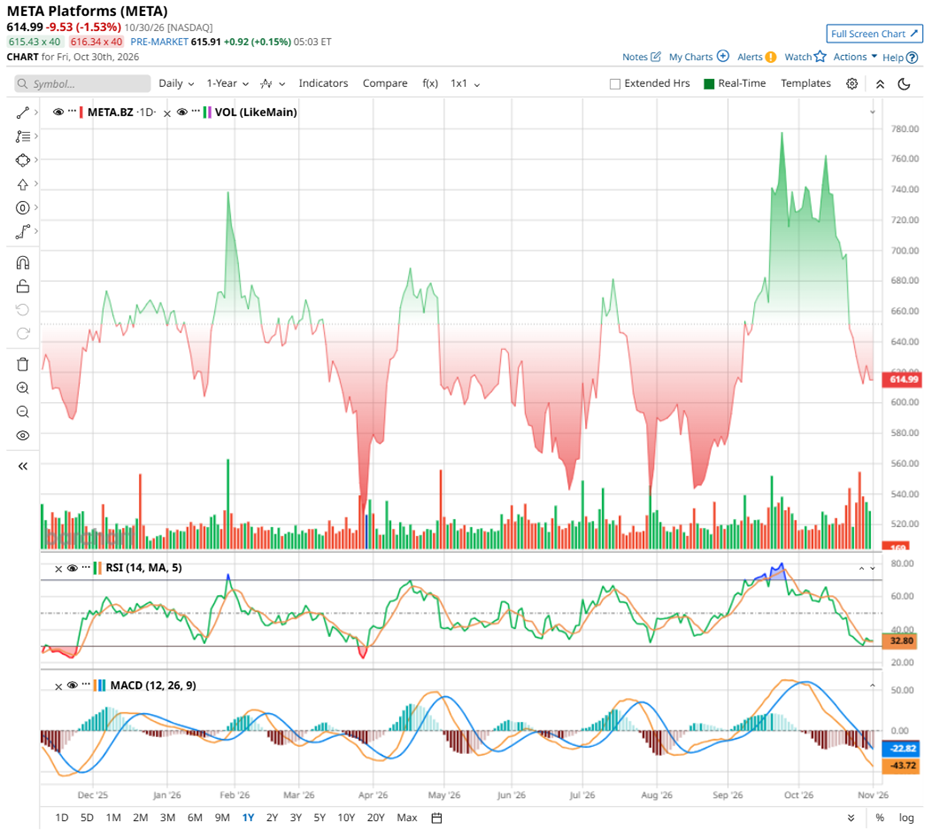
However, META stock has had a rather uncomfortable run lately, and investors seem to be running out of patience with its increasingly expensive AI ambitions. Shares slid over 15% in October alone, despite the company delivering solid Q3 results. A post-earnings drop of nearly 7% reflected concerns over heavy AI infrastructure spending, negative free cash flow, a hefty litigation charge, and a broader AI sector selloff. As a result, the stock now trades well below its September peak, down roughly 21% from its 52-week high of $779.82, with a 7% decline in 2026.
Meta’s AI ambitions are starting to come with some hefty bills. Massive capex, negative FCF, and concerns about how quickly these investments will translate into returns have made investors increasingly cautious. The concerns have also caught the attention of credit rating agencies, with S&P Global Ratings assigning Meta a negative outlook, citing uncertainty surrounding elevated infrastructure spending and future cash flows.
Then came another potential headache. Meta’s reported plans to raise $95 billion through public equity financing and introduce a non-voting Class C share structure, expected to take effect in early 2027, have raised questions about potential shareholder dilution. For existing investors, the prospect of additional shares is hardly something to celebrate.
And just when the stock needed a break, legal troubles added another layer of uncertainty. A New Mexico jury found Meta liable for violating state consumer protection laws, and a judge ordered the company to pay a massive $25 billion penalty. So, between expensive AI ambitions, financing concerns, credit-rating pressure, and legal headaches, META has certainly given investors plenty to think about.
The weakness is also reflected in META’s technical indicators. The 14-day RSI stands around 33, suggesting the stock is approaching oversold territory after retreating from September’s overbought levels. Meanwhile, the MACD oscillator paints a more bearish picture, with negative histogram bars and the MACD line trading below the signal line. Both lines are also trending downward, indicating that selling pressure continues to outweigh buying momentum.
Valuation-wise, META stock doesn’t look like a bargain at first glance, trading at 20.57x forward earnings and 6.12x forward sales—a premium to its sector peers. But the stock is still trading below its own historical valuation levels. With AI opening new monetization opportunities, strengthening advertising performance, and supporting further earnings growth, today’s premium may not look quite so unreasonable down the road. After all, a stock is not necessarily expensive just because it costs more; sometimes, the growth potential has not caught up with the price tag yet.
A Snapshot of Meta’s Q3 Earnings Report
Meta reported its stronger-than-expected third-quarter numbers on Oct. 21, generating revenue of $64.6 billion, up 26% year-over-year (YoY). Strong advertising demand, better user engagement, and AI-driven improvements in monetization helped fuel the growth. Its adjusted EPS amounted to $7.40, excluding the impact of the legal charge of $9.9 billion in Q3.
Ad impressions increased 10% YoY, while the average price per ad rose 14% annually. It seems Meta is getting more eyes on its platforms and convincing advertisers to pay more for them. Not a bad combination.
The numbers become even more interesting when we look at where the money is coming from. Family of Apps, which includes Facebook, Instagram, WhatsApp, and Messenger, contributed 99.3% of total revenue, generating $64.16 billion, up 26.4% YoY. Advertising alone brought in $63.06 billion, increasing 25.9%, as stronger engagement, user growth, and ad-load optimization supported monetization. Other revenue jumped 59% to $1.1 billion, largely driven by WhatsApp’s paid messaging services and subscriptions. Reality Labs revenue, meanwhile, slipped 5.7% annually to $443 million as weaker Quest headset sales outweighed growth in AI glasses.
But Meta is not putting all its AI eggs in the advertising basket. Its newly launched Muse personal agent and Muse Wonder frontier AI model are opening another potential revenue stream. Within roughly six weeks, Muse attracted over 10 million users across the U.S. and Canada, with about 25% using it on a given day. Shopping has emerged as its leading use case, accounting for more than a quarter of active users, with average purchases exceeding $200.
Meta sees opportunities to monetize the platform through commerce fees, premium subscriptions, and business services. Better still, it expects Muse’s computing efficiency to improve more than tenfold over the coming year, potentially making the service cheaper to operate as adoption grows.
Of course, building an AI empire does not come cheap, and Meta’s cash flow tells that story rather clearly. The company ended the September quarter with $82.4 billion in cash, cash equivalents, and marketable securities, against approximately $83.7 billion in debt. Operating cash flow improved to $32.8 billion from $30 billion a year earlier. However, capital expenditures, including finance lease principal payments, surged to $34.9 billion, driven by investments in servers, data centers, and network infrastructure. Consequently, free cash flow turned negative at $2.1 billion.
Meta also announced plans to introduce a new non-voting Class C common stock, with shareholders expected to receive one additional share for every existing share. The distribution is expected to effectively create a two-for-one stock split in January 2027.
Looking ahead, management estimates Q4 revenue to be between $73 billion and $76 billion, factoring in an approximately 1% foreign currency headwind to annual growth. However, Meta has also raised its 2026 expense outlook to $175 billion to $179 billion, including the litigation charge. Its capex forecast now stands in the $135 billion to $145 billion range.
Reality Labs offers some relief, with Meta expecting operating losses to decline in 2026 and narrow further in 2027. More importantly, management anticipates strong revenue growth through 2027, supported by improving advertising performance, AI advancements, and emerging monetization opportunities.
Meanwhile, analysts tracking Meta anticipate its Q4 revenue to be around $75.2 billion, while EPS is expected to be $8.16, reflecting a decline of 8.1% YoY. Looking ahead, Wall Street expects the social media giant to earn $29.01 per share in FY2026, with earnings climbing to $33.91 per share in FY2027. That points to a healthy 16.9% annual growth.
What Do Analysts Expect for META Stock?
Despite the spending concerns and legal headaches, Wall Street is not exactly giving up on META stock. Most analysts remain optimistic, with several raising their price targets on expectations of continued AI-driven growth.
JPMorgan lifted its target to $940 from $920 and maintained its “Overweight” rating after Meta’s Q3 report. Canaccord maintained its “Buy” rating with a $950 target on META stock after the company announced roughly $35 billion in underwritten equity offerings late last month. The brokerage firm believes the dilution is manageable given Meta’s growth prospects, noting that the proposed issuance represents only a mid-single-digit percentage of outstanding shares, with most of it deferred until 2027 or later.
KeyBanc’s Justin Patterson moved its target to $905, Cantor Fitzgerald raised META’s price target to $860, and BMO Capital increased it to $685, citing strong earnings, revenue growth, and AI momentum.
Of course, not everyone is cheering. While keeping its “Buy” rating, TD Cowen trimmed its target price to $850, factoring in the impact of legal charges. Piper Sandler lowered META’s price target to $850 from $875, while maintaining an “Overweight” rating. The brokerage firm acknowledged stronger core business momentum and raised revenue estimates but flagged higher operating expenses and capex tied to Muse and AI investments. Its estimates exclude any potential revenue from Muse.
Wells Fargo, meanwhile, reiterated its “Overweight” rating and $995 price target following Meta’s proposed $95 billion equity financing plan. The brokerage firm believes the raise should cover its anticipated funding gap for 2027, although the larger financing requirement could signal that elevated AI infrastructure spending will continue for longer than expected.
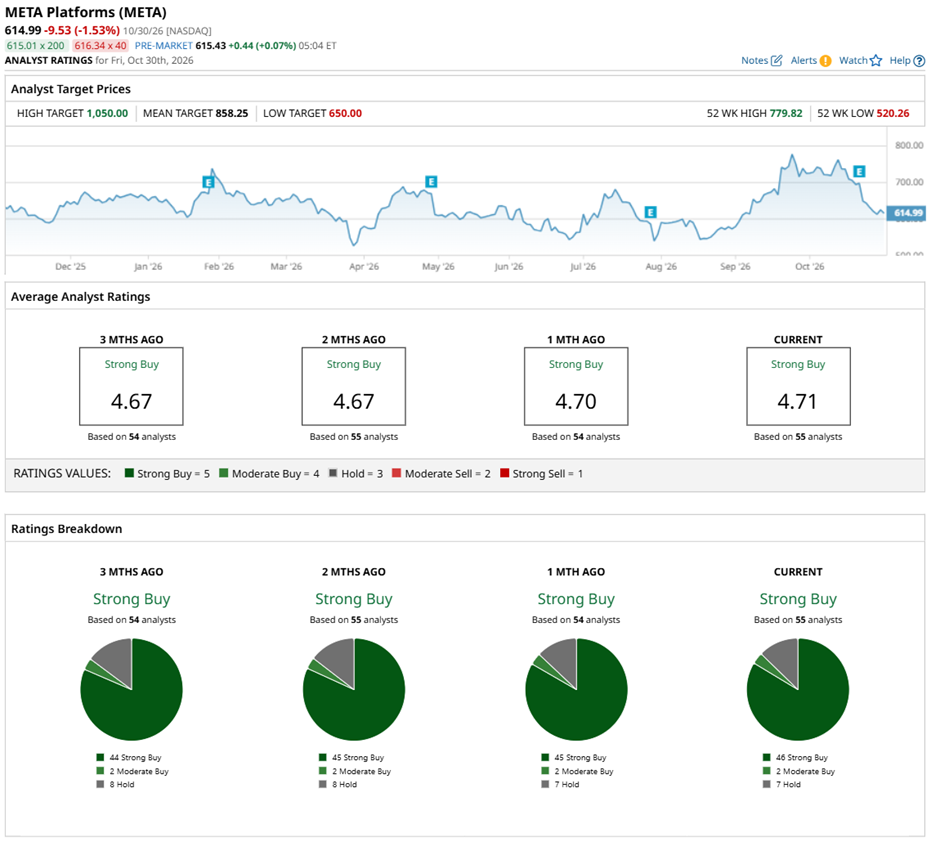
Apparently, Meta’s expensive AI ambitions have not scared Wall Street away, with analysts overall maintaining a bullish “Strong Buy” stance. Of the 55 analysts offering recommendations, 46 are giving it a solid “Strong Buy,” two suggest a “Moderate Buy,” and seven advise a “Hold.”
META’s average analyst price target of $858.25 implies a 39.6% upside potential. Meanwhile, the Street-high price target of $1,050 suggests that the stock can still rally as much as 70.7% from here.
On the date of publication, Sristi Suman Jayaswal did not directly have a position in any of the securities mentioned in this article. All information and data in this article is solely for informational purposes. For more information please view the Barchart Disclosure Policy here.