


EN
The US has set off a wave of data center referendums: AI infrastructure expansion is blocked locally, and investment of hundreds of billions of dollars is being tested
The Zhitong Finance App notes that voters in dozens of US counties and cities will soon have the opportunity to participate in promoting some policies to slow data center development. From Nevada to Georgia, local governments are giving residents the chance to vote on policies that tax, regulate, or even ban artificial intelligence infrastructure. This could put hundreds of billions of dollars of investment at risk and cause trouble for so-called hyperscale cloud vendors such as Meta Platforms (META.US) and developers such as Applied Digital (APLD.US).
According to Ballotpedia data, more than 40 measures relating to data centers will be voted on in the November 3 midterm elections.
As voters review these proposals, opposition to the new data center continues to rise across the US, highlighting that AI has become a key issue in the midterm elections. Quinnipiac's September poll found that 72% of voters would oppose building new data centers in their communities, up from 65% in the March poll.
While data centers power ubiquitous AI tools like ChatGPT or Claude, residents who learn that the data center will be located in their own communities are often worried about air and noise pollution and higher utility bills. They are also concerned about local officials providing tax benefits to developers and signing confidentiality agreements with private interests, leaving voters in the dark.
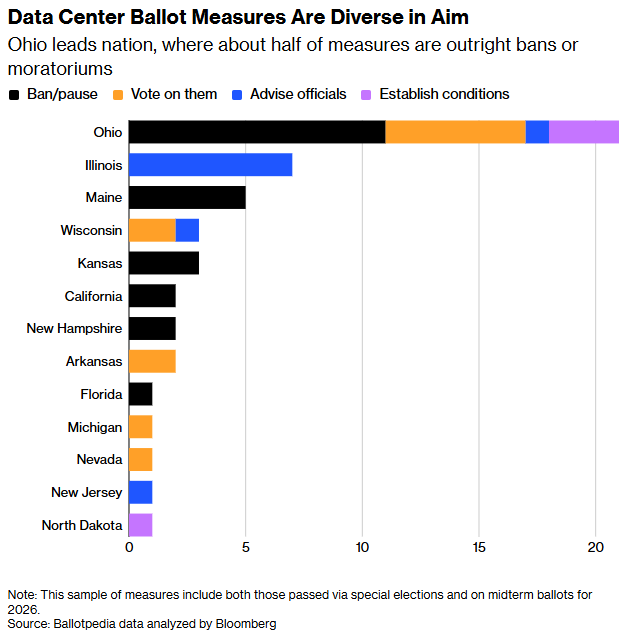
Data center related voting proposals have different goals
However, in some cases, activists have successfully blocked construction of data centers. According to the Data Center Watch report, at least 45 projects worth $68 billion were blocked in the second quarter due to local opposition.
AI-related referendums are now providing voters with a new way to express their opposition.
Megan Mullin, an environmental politician at UCLA, said, “Local referendum measures are a tool people can use at a time when people feel helpless about some of the broader forces that shape our future.”
Bans and dismissals
Some measures even threaten to completely ban data centers. This is likely to happen in the Los Angeles suburb of Alhambra, where the city is likely to follow in the footsteps of nearby Monterey Park. In Ohio, about a dozen communities will vote on the ban, with most measures targeting large facilities.
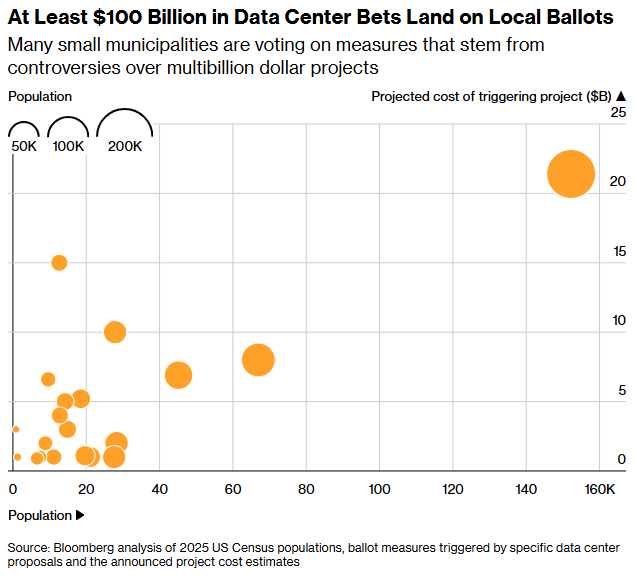
Data center investment projects of at least $100 billion will be submitted to a local vote
Pikua is one of them, and Meta is trying to build a data center there. Local voters will also decide whether to remove the mayor and two city councilors who supported the construction of AI infrastructure in this city with a population of about 20,000.
Another eviction occurred in Yukon, Oklahoma, where local residents will decide where Mayor Brian Pillmore will stay. Some voters want him to resign because he supports a proposed $1 billion Beltline Energy data center along Route 66.
Pillmore said he welcomed communication on local development matters, but he thought the project was a rare long-term source of investment for the small city, and he estimated that the project could increase local revenue by as much as 75%.
“A city like Yukon must consider every card you play,” he said.
Yukon is one of many small towns in the US seeking economic growth. Dan Diorio, executive vice president of state policy and government affairs at the Data Center Alliance, an industry advocacy organization, said data centers may be the answer, bringing investment and high-paying jobs without a college degree.
Diorio said the facilities generate “significant” tax revenue and help fund schools, transportation, and public safety. “Referendum measures to restrict or ban data center development will send a signal to the outside world that the region does not welcome commerce” and “deprive local communities of opportunities to compete for investment and employment.”
Community participation
Some communities aren't necessarily against data centers, but they do want to have a bigger say in the planning process. In Harwood, North Dakota, news that a $3 billion project is underway prompted resident Michael Swartz to try to completely reform the way the city handles industrial development.
After Mayor Harwood signed a confidentiality agreement with Applied Digital, which is building a nearby facility, he drafted a bylaw amendment to make the decision-making process more transparent and include more community input.
In September 2025, when plans for this large-scale project of 280 megawatts were revealed, residents raised many concerns, but less than a month later, construction began.
Swartz said in an interview: “A $3 billion decision falls to a community of only 800 people and should not take just three weeks to finalize.”
The goal of his measure, known as “Article 10,” is to require large-scale projects to undergo information disclosure, independent review, and public participation.
Similar measures could give residents in other regions more influence. Voters in Grove City, Ohio can amend the bylaws to require a referendum on development projects that exceed a certain threshold of scale, water use, and energy use. If passed, a referendum initiative in Janesville, WI would give citizens the right to vote on a project costing more than 450 million US dollars on a long-abandoned GM factory site.
UCLA's Mullin said the surge in such measures “shows that Americans recognize that in many communities that have a real impact on their future, they have been excluded from negotiations.”
zoning rules
Another type of measure has the power to limit the selection of data center locations. In Wilmington, Ohio, voters will vote on the rezoning of the land surrounding the proposed Amazon (AMZN.US) data center.
However, the situation in Boulder City, Nevada showed the limits of such initiatives. Earlier this year, activists successfully blocked a proposed $3 billion data center to be built on all of the city's turtle sanctuaries.
But soon after, the developer obtained approval on a neighboring plot controlled by the Federal Land Administration.
Although Boulder City residents will soon decide whether to allow data centers to be built on the reserve, the incident highlights one limitation of this wave of referendums: voters can rewrite local development rules, but legislation cannot cross the boundaries of the jurisdiction.
Mullin said that local restrictions may simply shift development to regions with weaker political power and fewer organizational resources. She also added: “Furthermore, for better or worse, such measures will limit the hands and feet of future leaders in these places.”
Despite this, efforts to restrict development through a referendum will continue beyond November 3. In December, voters in Clarksville, Arkansas will decide whether to approve a $55 billion bond decree to build the ServerFarm data center. Previously, residents successfully challenged the city council's approval decision.
Last month, residents of Covita County in Georgia submitted a petition signed by more than 14,000 people to withdraw approval for a vast $17 billion park and ban future data center construction in the region. After awaiting a judge's decision, this referendum is likely to be on the ballot in January next year.