


EN
DoorDash (DASH.US) outperforms NASDAQ in a wave of tech sell-offs! Officially announced the $17 billion acquisition of Instacart, supermarket delivery and retail advertising drive value revaluation?
The Zhitong Finance App learned that US takeout delivery leader DoorDash (DASH.US) officially announced that it plans to acquire Instacart for about 17 billion US dollars. What is really worth market repricing and balancing is the user portal and online delivery network formed by food and beverage takeout, which is expected to further connect the integration of online procurement, online and offline retail advertising, and the digital service ecosystem of merchants. The “DoorDash + Instacart: Impact on Retailers” research report recently released by Wall Street financial giant Morgan Stanley shows that thorough integration of the two platforms may enhance comprehensive competition and negotiation capabilities for delivery economy, consumer reach, and retail media monetization. Among them, grocery retailers that lack their own delivery networks will inevitably face more obvious bargaining pressure; Walmart and Target, which own Spark and Shipt, are relatively better able to withstand the impact.
On October 29, the day of the announcement of the acquisition transaction, financial report, and future outlook, DoorDash's stock price rose 5.61% when technology stocks in the US stock market collectively plummeted, and the Nasdaq 100 index fell 1.38% during the same period; based on the closing of October 23 to 30, DoorDash's stock price fell only slightly by 0.22% throughout the week, and still significantly outperformed the Nasdaq 100 Index, which has the title of “global technology stock weather vane”, by about 1.76 percentage points. This relative resilience reflects the market's joint support for the strong expansion of comprehensive digital retail entity operating performance after the merger and expectations of mergers and acquisitions collaboration.
Following DoorDash's financial disclosure and official announcement of the acquisition at the performance conference last week, this major acquisition can be described as moving from a potential bid to a formal agreement: InstaCart had contacts with DoorDash and Uber, and finally DoorDash announced the deal on October 29, with a nominal consideration of $65 per share, a 26% premium over the closing price before the rumor on October 22. At least 75% of the total consideration was no more than 25% in cash or stock. The deal is expected to be completed by the end of 2027 or the first half of 2028. Currently, the two parties are still operating independently. DoorDash hopes to expand the supermarket business through this integration and enhance the ability to compete with Amazon and Walmart for long-term resilient household spending across the US.
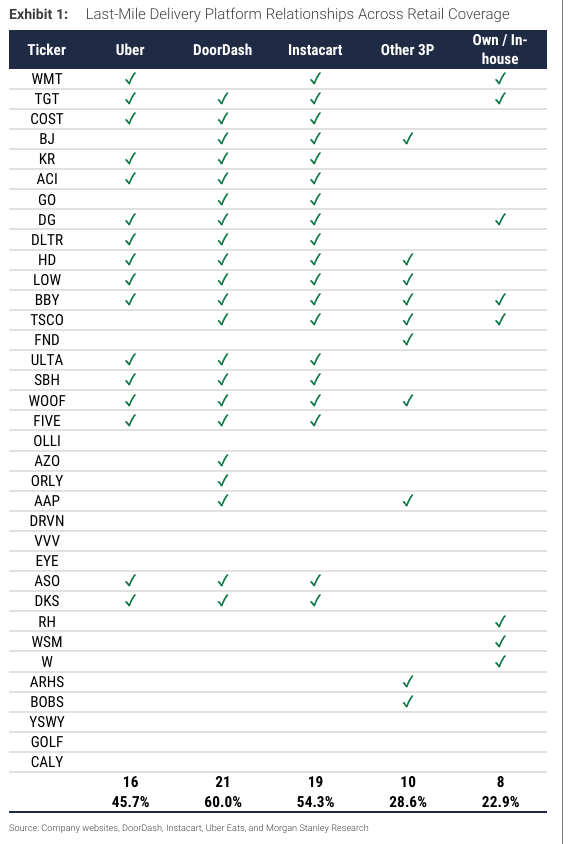
Wall Street financial giant Damo's “DoorDash + Instacart: Impact on Retailers” report focuses the deal on “how to redistribute last-mile bargaining power”: out of the 35 retailers it covers, DoorDash and Instacart serve 21 and 19, respectively, with coverage rates of 60% and 54.3%; Uber covers 16 companies and 10 other third parties, and only 8 have their own ability to perform contracts.
A team of analysts from Damo emphasized that the integration of the two major platforms may significantly enhance the ability to negotiate delivery economics, consumer reach, and retail media monetization. Among them, grocery retailers that lack their own delivery networks deserve the most investors' attention — that is, it may significantly enhance the bargaining power of physical business platforms after the merger of DoorDash and InstaCart in terms of delivery charges, consumer reach, and retail advertising revenue distribution. Among them, grocery retailers that lack their own delivery networks may face more obvious bargaining pressure; Morgan Stanley analysts added that they have Spark and Shipt's Walmart and Target are relatively better at resisting the impact. The report ultimately points to the same investment proposition: the importance of scale and vertical integration is increasing, and platform concentration may further widen the competitive gap between different retailers.
Extending from takeout entry to home shopping: DoorDash bought a more complete profit chain
DoorDash has developed into a local business platform covering restaurants, supermarkets and other retail, covering more than 40 countries through brands such as DoorDash, Wolt, and Deliveroo, and providing delivery, software and advertising services to merchants. Instacart is centered on e-commerce in American and Canadian supermarkets, connecting more than 2,200 retail brands and nearly 100,000 stores. Its business includes consumer shopping platforms, enterprise technology platforms, and advertising services.
Dama analysts mentioned in the research report that the two are mainly complementary — DoorDash is good at high-frequency instant consumption and delivery scheduling, and Instacart has accumulated centralized household procurement scenarios, as well as product catalogs, store picking, out of stock replacement, and strong supermarket e-commerce ecosystem capabilities. If the integration goes well, DoorDash can take on more consumer demand in existing user relationships, and at the same time extend merchant services from “delivering goods to the home” to “helping merchants complete the wave of online business expansion”. In addition to food delivery services, DoorDash currently provides supermarket delivery for fresh food, daily necessities, etc. If the merger is successfully completed, it will further integrate Instacart's product selection, picking, and replacement capabilities to strengthen the online e-commerce service ecosystem of the huge “online order - pick and fulfill - delivery to home” supermarket system from food and beverage takeout to home supermarket procurement.
If the acquisition and integration go well, the expansion of the supermarket and merchant service business is expected to improve DoorDash's revenue and profit prospects by improving contract execution efficiency and advertising monetization capabilities. This expansion is expected to improve DoorDash's fundamentals along two paths. First, the increase in orders in the same region and in different time periods helps to improve the utilization rate of delivery personnel and dilute fulfillment and inventory management costs; product and inventory information is more accurate, and can also reduce shortages, refunds, and repeated deliveries. Second, product-level purchasing behavior brought about by household procurement can improve advertisement matching and performance measurement within the scope of contracts and data usage rights, and expand the brand's ability to bear the budget.
Instacart's third-quarter advertising and other revenue reached US$331 million, up 23% year over year, accounting for about 30.2% of total revenue, which already reflects monetization value other than transaction revenue. DoorDash management expects to achieve a net annual revenue of about 500 million US dollars in the third year after delivery, but the planned investment in the first year exceeds the total collaborative revenue for that year, and a positive net synergy will only be formed in the second year. Therefore, valuation increases may require a process of “improving delivery efficiency — re-investment of services — growth of orders and advertising — release of net profit”.
After the merger, the physical platform is stronger, who can keep profits? Damo focuses on retailers' autonomy to fulfill contracts
Grocery retailers are the most direct stakeholders in this integration. Morgan Stanley pointed out that Costco (i.e. “market opener”), Kroger, Albertsons, BJ's, and Grocery Outlet all use DoorDash and InstaCart at the same time. The growth of food e-commerce and the expansion of retail advertising have opened up additional revenue space for these companies, but the cost and organizational complexity of building a wide-ranging distribution network on their own is very high.
However, the Dama analyst team emphasized that after the merger of the two important partners, ordinary retailers in the US may get better technology and contract fulfillment services, while also reducing the choice of independent bargaining and switching platforms. What we really need to track is how much profit new online sales can leave after deducting platform fees and picking and delivery costs, and how advertising revenue, membership relationships, and customer reach capacity are distributed between the two parties.
This also explains why Morgan Stanley is still bullish on Walmart and Target in anticipation of a strong merger synergy between DoorDash and InstaCart: Walmart's Spark network and Target's Shipt enable them to reserve more options between their own fulfillment and third party partnerships, thereby better controlling service quality and unit order costs. Platform integration may enhance DoorDash or enhance the strategic value of retailers' own networks; both can be established simultaneously. The appendix to the Damo research report shows that Walmart and Target's existing ratings are “overrated” and “overrated” for another US retail giant, Costco (that is, “market opener”), but the latter is still in the dual-platform cooperative observation group that the report is concerned about — that is, because Costco uses DoorDash and InstaCart at the same time, it may still be affected by changes in the bargaining relationship after the integration of the two platforms; Damo's overall view on the retail and e-commerce industry is still “consistent with the market.”
Earnings reports and consolidated collaborative growth expectations support the strong resilience of DoorDash's stock price. Wall Street is arguing about the speed of collaborative cashout
DoorDash's stock price has recently significantly outperformed the tech stock market. First, it is supported by operating data. Third-quarter revenue of US$4.616 billion, up 34% year over year, higher than FactSet's estimate of US$4.56 billion; diluted earnings per share of US$1.06, higher than expectations of US$0.55 and US$0.81 for the same period last year. The total number of orders placed on the platform was US$33.941 billion, up 36% year on year. Excluding Deliveroo's combined impact, it still increased 23%; net profit to mother was US$466 million, up 91% year on year, and free cash flow was US$787 million, up 9% year on year.
In particular, the growth rate of total food orders in the US continues to improve. The growth rate of supermarkets and retail businesses is more than double that of the catering business, which is enough to positively explain to market investors that acquisitions are based on a basic market of continuous growth. Total orders for the fourth quarter were estimated at US$35.4 billion to US$36.4 billion, with adjusted EBITDA of US$900 million to US$1.1 billion. Operating cash out and supermarket expansion together form a reasonable explanation for its relative resistance to decline, but stock price performance alone cannot confirm that global capital has systematically moved from AI trading themes to local consumer platforms.
After the deal was announced, Wall Street analysts' positive judgments focused on complementary businesses, but target price adjustments were inconsistent. Based on the closing price of $178.99 on October 30, Wedbush raised DoorDash from “neutral” to “outperforming the market”, and raised the target price from $220 to $230, corresponding to about 28.5% potential increase; Needham maintained “buying,” but lowered the target price from $265 to $235, which corresponds to about 31.3%. Needham believes the deal has strategic and financial value, and DoorDash's technical platform restructuring will help integrate and achieve collaboration, but regulatory approval is still the biggest variable.
More cautious institutions pay more attention to the time difference between investment and return. UBS remained “neutral,” with the target price falling from $225 to $213, corresponding to a potential increase of about 19.0%, while lowering the 2027 and 2028 adjusted EBITDA forecasts by 2% and 6% to include profit margins, consolidation, and regulatory risks in the valuation; Wells Fargo maintained “equal rights”, and the target price fell from $230 to $200, corresponding to about 11.7%, although the strong catering business prompted it to slightly increase its total order volume and EBITDA forecast for 2027. For investors, DoorDash's revaluation space ultimately depends on whether the acquisition can finally be implemented under the heavy pressure of antitrust, whether the larger order network can continue to reduce unit fulfillment costs, improve advertising monetization capabilities, and form continuous incremental and strong cash returns after re-investment and acquisition financing costs.