


EN
Will Ripple Custody Expansion Change Bank of New York Mellon Corporation Stock Narrative
- Ripple announced in October 2026 that it expanded its collaboration with BNY, adding XRP and RLUSD to BNY’s institutional Digital Asset Custody platform and exploring tokenized trade finance use cases on the XRP Ledger.
- The move deepens Bank of New York Mellon Corporation’s role in stablecoin and tokenization infrastructure, tying its custody scale directly to emerging institutional blockchain workflows such as supply chain finance.
- We will examine how Bank of New York Mellon Corporation’s investment narrative intersects with BNY’s expanded XRP and RLUSD custody role.
Scan how BNY’s push into tokenization compares with peers by reviewing the hand-picked 19 cryptocurrency and blockchain stocks that are building out institutional blockchain infrastructure today.
Bank of New York Mellon Investment Narrative Recap
To own Bank of New York Mellon Corporation you need to believe its core fee engine in custody, asset servicing and data can stay resilient while efficiency programs keep margins in check. The Ripple custody expansion fits that view as one more way to keep BNY embedded in institutional plumbing rather than a swing factor for the whole investment case.
The near term swing issue is whether expense discipline continues to support positive operating leverage after roughly US$2b of efficiency savings. Any slip that lets costs run ahead of revenue would matter more than incremental digital asset fees, while pricing or mandate pressure in Investment and Wealth Management remains a key risk to watch.
The most relevant reference point for this Ripple news is BNY’s earlier expansion of its digital asset work with Circle, where USDC became the first supported stablecoin on the Digital Asset Custody platform and BNY joined the Open USD initiative with shared reserve yield economics. That move framed how the firm might treat stablecoin custody as a fee and yield sharing opportunity.
Seen alongside the new XRP and RLUSD support, that earlier USDC step underlines a pattern. Management is trying to plug blockchain based instruments into existing custody, data and collateral workflows so that digital asset activity can ride on top of the existing platform model and AI heavy infrastructure. Execution risk sits in technology, control frameworks and demand from institutional clients rather than in any single token partnership.
What The XRP And RLUSD Move Means For Bank of New York Mellon Corporation’s Targets
Bank of New York Mellon Corporation’s push deeper into digital custody sits on top of a much bigger earnings and revenue story that analysts are already mapping out. The XRP and RLUSD additions plug into that story rather than rewrite it, since the core assumptions in the current research focus on fee engines, margins, and capital discipline.
The consensus framework sketched out today assumes BNY keeps its revenue curve pointing to steady single digit growth, while margin work and buybacks do more of the heavy lifting in profits per share. In plain terms, the firm is expected to keep doing what it already does at scale, then layer tokenization and stablecoin activity into existing custody, collateral and data rails as a supporting act.
Ripple’s XRPL activity, and the new RLUSD support, sit alongside the earlier Circle and USDC relationship as examples of that supporting act. The common thread is that Bank of New York Mellon Corporation is positioning its digital asset custody stack so that institutions can treat stablecoins and tokenized claims as another asset type inside the same operational and control framework they already use for funds, bonds and cash.
For readers, the important question is how this fits with the earnings path that analysts have already put numbers around, rather than whether one token partnership can move the needle on its own. Forecasts today still anchor on fee resilience, operating leverage and capital returns, with blockchain tied to those themes instead of replacing them.
Bank of New York Mellon's narrative projects US$24.4b revenue and US$7.4b earnings by 2029. This aligns with a 4.5% yearly revenue growth rate and implies an earnings increase of about US$1.4b from US$6.0b today.
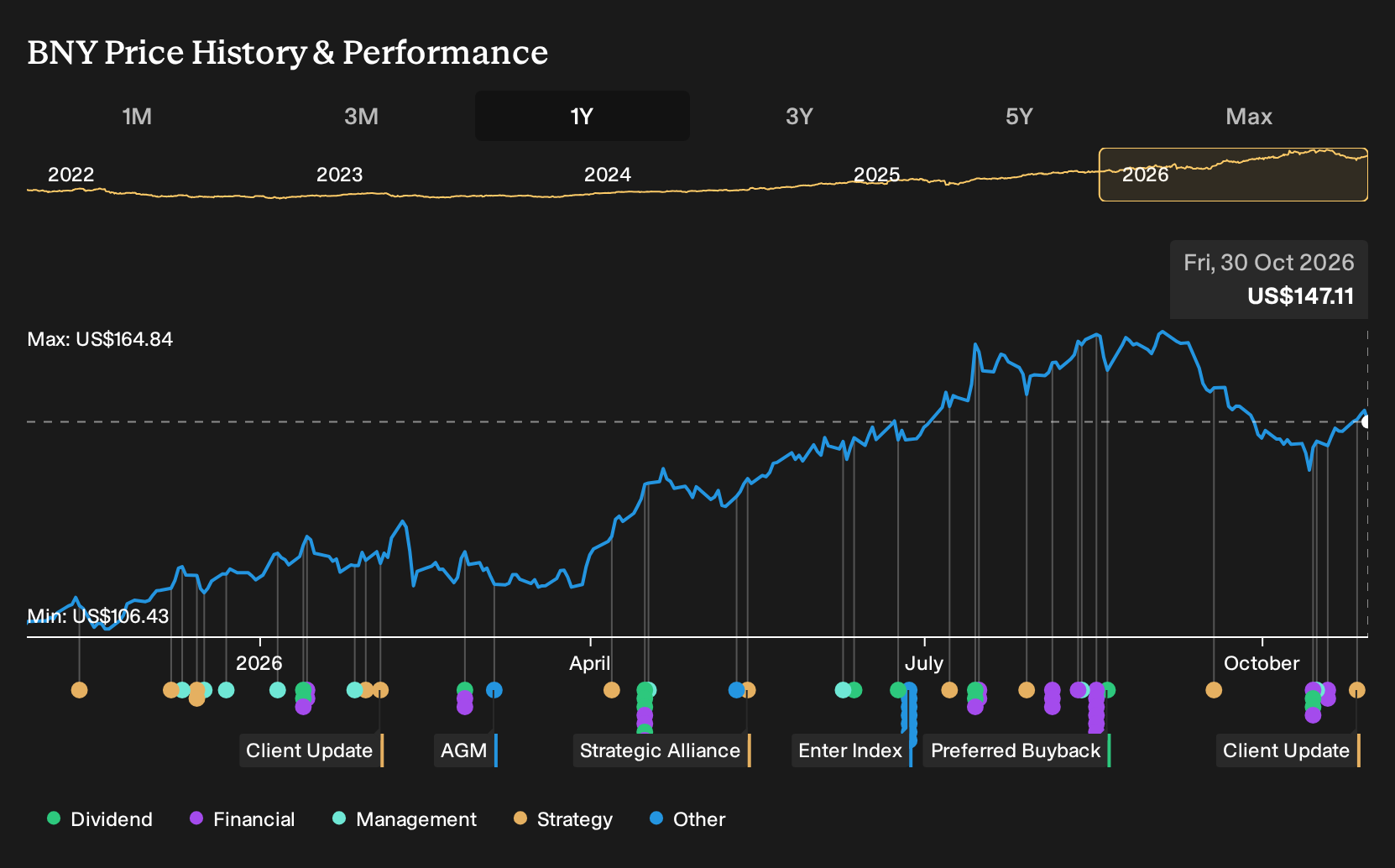
Uncover why Bank of New York Mellon's fair value indicates an 11% potential upside to its current price that could narrow quickly.
Exploring Other Perspectives
Two fair value estimates from the Simply Wall St Community cluster in a tight US$148.75 to US$163.36 band, yet they still reflect different confidence levels in Bank of New York Mellon Corporation’s fee resilience. Weigh these views against risks around mandate pressure, cost control and P/E compression, then explore several alternative viewpoints before deciding how this story fits your portfolio.
Explore another Bank of New York Mellon fair value estimate, including one that suggests it could be worth just $148.75.
Reach Your Own Conclusion
Don't just follow the ticker; dig into the data and build a conviction that's truly your own.
- A great starting point for your Bank of New York Mellon research is our analysis highlighting 4 key rewards that could impact your investment decision.
- See our latest analysis for Bank of New York Mellon. The report includes a comprehensive fundamental analysis summarized in a single visual, the Snowflake, making it easy to evaluate Bank of New York Mellon Corporation's overall financial health at a glance.
Looking For More Investment Ideas Beyond Bank of New York Mellon Corporation?
If you want to balance your view on Bank of New York Mellon Corporation with other opportunities, it can help to scan a few focused stock sets that line up with your own risk and income preferences.
- For investors who care most about resilient business models and fewer surprises, start with a 29 resilient stocks with low risk scores that already clear strict risk filters.
- If dependable income is a priority, check out a group of 5 dividend fortresses that combine higher yields with fundamental checks.
- When you want to get ahead of the crowd, review a curated pool of 19 high quality undiscovered gems that pair solid financials with lower investor attention.
Have feedback on this article? Concerned about the content? Get in touch with us directly. Alternatively, email editorial-team@simplywallst.com