


EN
3 Stocks Tied To Treasury Trading Flows And Rate Sensitive Fees
When the chair of the Federal Reserve is seen as caring more about Washington’s borrowing bill than inflation, the ground under rate-sensitive financials quietly shifts. Yields move, trading pipes hum, and some intermediaries find fresh profit pools while others face pressure. This article walks through how that tension touches the Treasury market, then spotlights three stocks from our U.S. Rate-Sensitive Financials and Treasury Market Intermediaries screener that appear especially exposed to this story.
The three examples below are only a starting sample, as the full U.S. Rate-Sensitive Financials and Treasury Market Intermediaries screen surfaced 17 more businesses with equally compelling rate and Treasury market stories that are not covered here. To see the complete list, analyze different risk profiles, and identify your own highest conviction angles, head straight into the U.S. Rate-Sensitive Financials and Treasury Market Intermediaries screener.
WisdomTree (WT)
WisdomTree gives this screener a different angle, since it packages rate-sensitive and Treasury-linked exposures into ETFs and digital wrappers that everyday investors actually use.
"WisdomTree's early investments in blockchain, tokenization and digital asset infrastructure are now tied to a growing base of tokenized assets, which reached about US$1.3b by September 2026."
What matters from here is how one quiet shift in where higher yielding assets sit on the platform ends up shaping fee margins.
WisdomTree is an ETF sponsor and asset manager offering equity, currency, fixed income and alternative ETFs, index licensing, 401(k) ETF platforms and advisory services, with a market value of about US$3.1b.
That margin question is where the story really starts to get interesting, and the full narrative for WisdomTree unpacks how WisdomTree’s fee engine could be accelerating or stalling.

SEI Investments (SEIC)
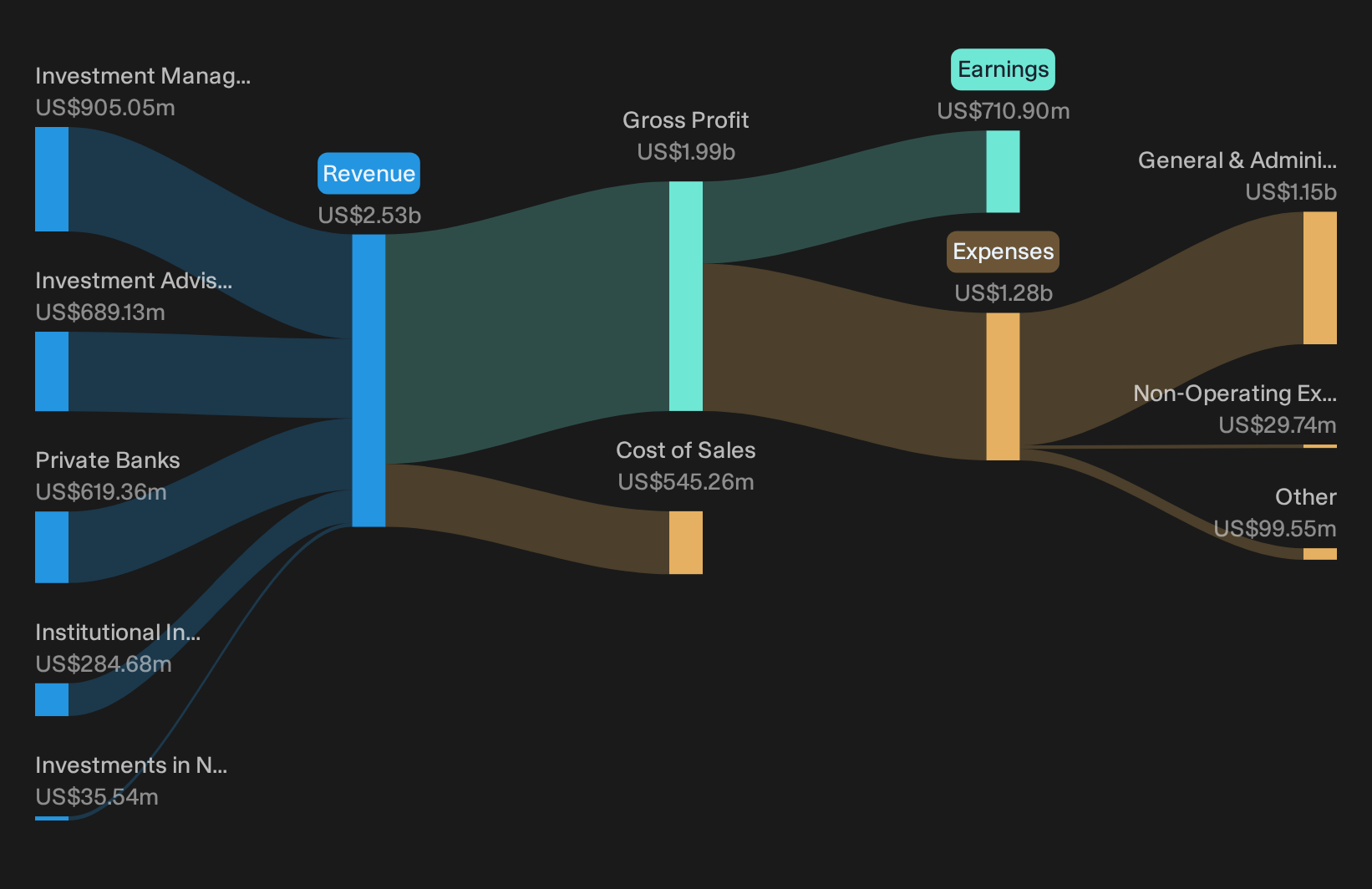
SEI Investments taps into the screener theme through its fee-based exposure to client portfolios that hold bonds and rate-linked products, while its real draw is a broad outsourcing platform for wealth, retirement and investment processing that ties together asset management and technology.
SEI Investments runs a global investment services platform, earning about US$905 million from Investment Managers, US$689 million from Investment Advisors and US$619 million from Private Banks. With a market value near US$12.4b it sits firmly in the mid-sized asset servicing tier.
"SEI Investments is seeing strong demand from large asset managers to outsource complex fund administration and back-office work, particularly in alternatives, with recent wins that shift historically internal operations onto SEI platforms, which can add fee-based revenue and support earnings as these mandates ramp."
What really matters next is how one quiet shift in where those higher margin services sit in SEI Investments’ mix affects overall profitability.
That mix shift in profitability is the real story, and the full narrative for SEI Investments maps where SEI Investments may be quietly accelerating fee power beyond headline outsourcing wins.
Cboe Global Markets (CBOE)
Cboe Global Markets plugs directly into this screener’s theme because its exchanges, clearing arms and rate linked derivatives are where institutional investors actually trade around Treasury moves and volatility, making its business closely tied to how actively those markets are flowing.
Cboe Global Markets runs a global network of options, equities, futures and FX venues that monetize rate and volatility hedging, with about US$2.7b from Options, US$1.7b from North American Equities, US$424 million from Europe and Asia Pacific, US$140 million from Futures and US$106 million from Global FX, and a market value near US$32.8b.
"Cboe's Data Vantage (market data, analytics, and index licensing) is demonstrating consistent double-digit revenue growth, supported by high-margin, recurring subscription sales, which enhances the predictability and profitability of earnings. Cboe's significant reliance on its proprietary S&P index options franchise and the upcoming need to renew its long-term partnership with S&P creates concentration risk; any material change or non-renewal in that relationship could disrupt core revenue streams and impact future earnings."
What really matters for investors now is how one quiet shift in who relies on its rate sensitive contracts changes the balance between steady fees and trading driven upside.
As that reliance on rate linked contracts evolves, the full narrative for Cboe Global Markets shows how Cboe Global Markets could be quietly decoupling risk from its trading heavy earnings mix.

Seeking Fresh Alternatives Before They Fly
Market momentum rarely waits. Fresh ideas can move from quiet to breakout quickly, and the best entry points can disappear before the crowd reacts, so investors may want to act promptly based on their own research and objectives.
- Spot potential turnarounds early and scan the 33 high quality undervalued stocks that pairs balance sheets with cash generation before any momentum story is fully recognized by the wider market.
- Explore structural themes and review the 54 AI infrastructure stocks powering data centers, chips and energy systems while these picks may still be less widely followed.
- Evaluate potential income opportunities and inspect the 5 dividend fortresses that targets higher yielding payers before any changes in yields or prices occur.
Have feedback on this article? Concerned about the content? Get in touch with us directly. Alternatively, email editorial-team@simplywallst.com