


EN
How Quarterly Results And Payouts At Huntington Bancshares Have Changed Its Investment Story
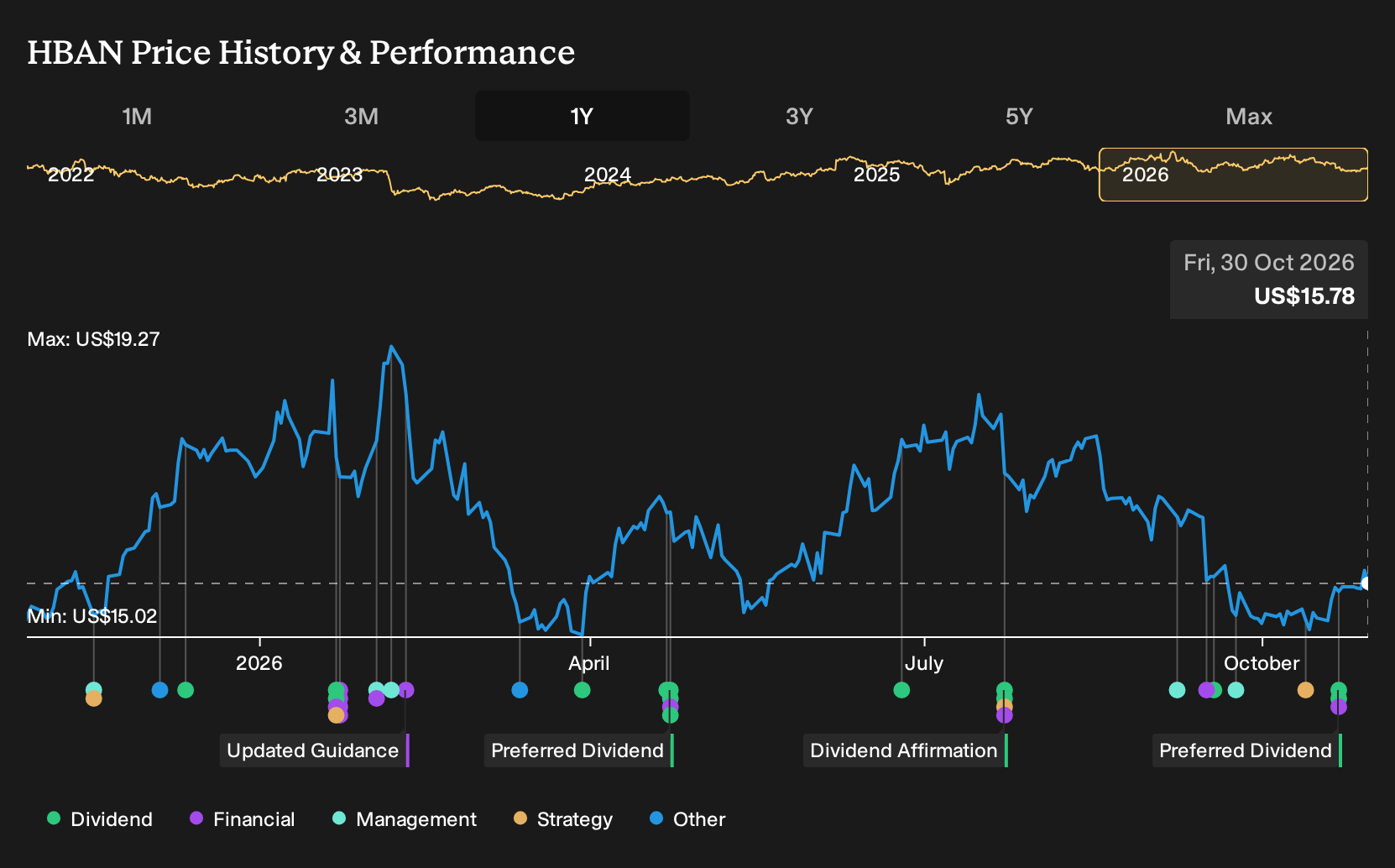
- Huntington Bancshares reported third quarter 2026 results with net interest income of US$2,069 million and net income of US$721 million, alongside affirmed common dividends, multiple preferred dividends and an update on its completed US$150 million share repurchase tranche.
- The mix of higher net interest income, lower earnings per share and continued capital returns through dividends and buybacks gives investors a clearer view of how Huntington Bancshares is balancing profitability, funding costs and shareholder payouts.
- This article examines how Huntington Bancshares' investment narrative aligns with its third quarter earnings shift and ongoing capital return program.
Scan how Huntington Bancshares' latest dividend and buyback moves compare with other banks returning cash to investors by reviewing our curated 5 dividend fortresses in one place.
Huntington Bancshares Investment Narrative Recap
To own Huntington Bancshares, you need to be comfortable with a story built on integrating Veritex and Cadence, expanding across Texas and the Carolinas, and leaning more on fee income while funding costs stay elevated. The latest quarter shows higher net interest income and net income but lower earnings per share, so margin pressure and share count still matter.
The near term catalyst is whether revenue synergies and cost efficiencies actually show through as funding costs and deposit pricing competition stay intense. The biggest risk is that integration complexity, ongoing expenses or stubbornly tight loan spreads keep net interest income and returns below what management is aiming for.
The most relevant update for that thesis is the common dividend affirmation at US$0.155 per share for January 2027. Keeping the payout unchanged alongside earnings where per share figures are under pressure indicates that management is holding the current capital return mix steady rather than reacting sharply to quarterly noise.
For you, that common dividend level and the parallel preferred dividends frame Huntington Bancshares as a bank leaning on income distribution while working through net interest margin constraints. The key watchpoints from here are whether fee businesses such as payments and wealth management keep offsetting funding costs and whether future quarters show progress toward the revised 2027 return targets.
What The Huntington Bancshares Consensus Is Pricing In
Analysts looking at Huntington Bancshares are effectively asking you to weigh a handful of moving parts at once. Revenue growth assumptions, margin shifts, credit costs and capital returns through dividends and buybacks all feed into their models. The result is a fairly specific picture of what the bank may need to deliver over the next few years for current pricing and targets to make sense.
On the top line, the consensus view builds around projected revenue expansion of 11.7% a year over the next three years. That pace sits on top of the Veritex and Cadence integrations, the Texas and Carolinas build out and the tilt toward fee-heavy activities such as payments, wealth and capital markets. For you, the key question is not whether 11.7% is high or low in isolation. The real test is whether that growth rate looks achievable given the funding cost pressure and the more competitive deposit market that Huntington Bancshares is already describing in its guidance.
Profitability assumptions move in tandem with that revenue story. Analysts currently model profit margins rising from 23.6% today to 32.9% in three years. That kind of shift implies tighter cost control, cleaner integration outcomes and more fee income helping to support earnings even if net interest margin stays constrained. If operating expenses from technology, regulatory requirements or partnership complexity creep higher than expected, that margin bridge gets harder to cross, which in turn affects how sustainable the current dividend and any future buybacks appear.
Consensus estimates also put concrete numbers on earnings. The analyst group is working with earnings of about US$2.3b today and a forecast of US$4.5b by around 2029, paired with expected earnings per share of US$1.74. That implies earnings roughly doubling, or about a 2x increase from the current level, even as analysts also factor in share count growth of 7.0% a year over the next three years. For Huntington Bancshares, that combination suggests the market is assuming operational progress outpaces dilution from new shares and any remaining integration costs.
Those earnings expectations fold directly into how the stock is being valued. The current analyst price target cluster centers on US$18.86 per share, versus a recent share price of US$15.73, with the most optimistic forecast at US$22.50 and the most cautious at US$17. This range shows some disagreement about how much credit to give Huntington Bancshares for its fee income strategy and regional expansion, but it is built on the same core idea that earnings reach US$4.5b by 2029 and that the stock trades on a P/E of 12.8x at that point.
That future P/E assumption sits below today’s 13.7x multiple for Huntington Bancshares but above the current US banks sector average of 11.6x. In practice, this means analysts are not assuming a dramatic rerating. Instead, they are expecting earnings growth and some modest multiple compression to do most of the work. If you believe the fee-led business mix and integration outcomes can support the higher margin and earnings profile implied in the estimates, that kind of valuation framework may look reasonable. If not, then the gap between today’s sector multiple and the projected 12.8x becomes harder to justify.
All of this is being discounted using a cost of equity in the mid 7% range, with analyst models referencing a 7.49% or 7.5% rate. That discount rate helps translate 2029 revenue and earnings forecasts back into a present value for Huntington Bancshares. For you as a reader, the exact number matters less than the direction of travel. Higher perceived risk would typically require a higher discount rate and a lower estimate of fair value, while improved visibility on integration, credit quality or fee stability could support a lower rate and a higher implied value.
Huntington Bancshares' narrative projects about US$13.7b in revenue and US$4.5b in earnings by 2029. This setup relies on 11.7% yearly revenue growth and an earnings increase of roughly 2.2b from current earnings of US$2.3b.
Uncover how Huntington Bancshares' fair value indicates a 20% potential upside to its current price, which could narrow quickly if Huntington Bancshares keeps meeting consensus expectations.
Exploring Other Perspectives
Two fair value estimates from the Simply Wall St Community span roughly US$18.87 to US$30.86, so some retail investors see Huntington Bancshares as close to recent analyst targets, while others attach a far richer appraisal. You are weighing those views against preferred and common dividend commitments, as well as integration and funding cost risks that could shift future outcomes.
Explore another Huntington Bancshares fair value estimate, including one that suggests it could be worth just $18.86.
The Verdict Is Yours
Disagree with existing narratives? Extraordinary investment returns rarely come from following the herd, so consider forming your own view.
- A great starting point for your Huntington Bancshares research is our analysis highlighting 4 key rewards and 1 important warning sign that could impact your investment decision.
- See our latest analysis for Huntington Bancshares. The report includes a comprehensive fundamental analysis summarized in a single visual, the Snowflake, making it easier to evaluate Huntington Bancshares' overall financial health at a glance.
Looking For More Investment Ideas Beyond Huntington Bancshares?
If the Huntington Bancshares story has sharpened your view on banks, you can use that momentum to build a wider watchlist with the Simply Wall St Screener. You can quickly filter for different income profiles, balance sheet strength and risk levels to build a line up that fits how you like to invest.
- For investors focused on income plus resilience, start with a short list of companies offering 5 dividend fortresses that may suit a more yield orientated portfolio.
- If capital preservation sits higher on your priority list, narrow the universe to businesses from our 29 resilient stocks with low risk scores and see which ones match your comfort level.
- When you want potential upside with quality fundamentals, scan through the 19 high quality undiscovered gems and decide which stories you want to research next.
Have feedback on this article? Concerned about the content? Get in touch with us directly. Alternatively, email editorial-team@simplywallst.com