


EN
Amazon (AMZN) Stock May Be Underpriced Despite AI Spending Fears
Amazon.com stock has given investors a bumpy ride lately, with a long run of gains over three years now rubbing up against fresh concern about heavy AI spending and weaker retail earnings. That mix puts the focus squarely on one issue for Amazon, whether the current share price is adequately backed by the profits it is generating today.
- Over the past 3 years, Amazon.com has returned 73.4%, which raises a clear question about how much of that performance is supported by its earnings power rather than sentiment around big themes like AI.
- Recent reports of large negative free cash flow driven by sizeable AI and data center investment mean any assessment of valuation now hinges on how investors weigh near term earnings pressure against the expectation of future profit from those projects.
- The analysts covering Amazon.com have run their own numbers. See what analysts think Amazon.com's shares could be worth.
The issue now is whether Amazon.com’s current valuation is justified by its earnings once those recent performance swings and investment plans are taken into account.
If you want to test the same earnings question that investors are asking about Amazon.com across a wider field of opportunities, scan through 54 AI infrastructure stocks.
Is Amazon.com Still Cheap on Earnings?
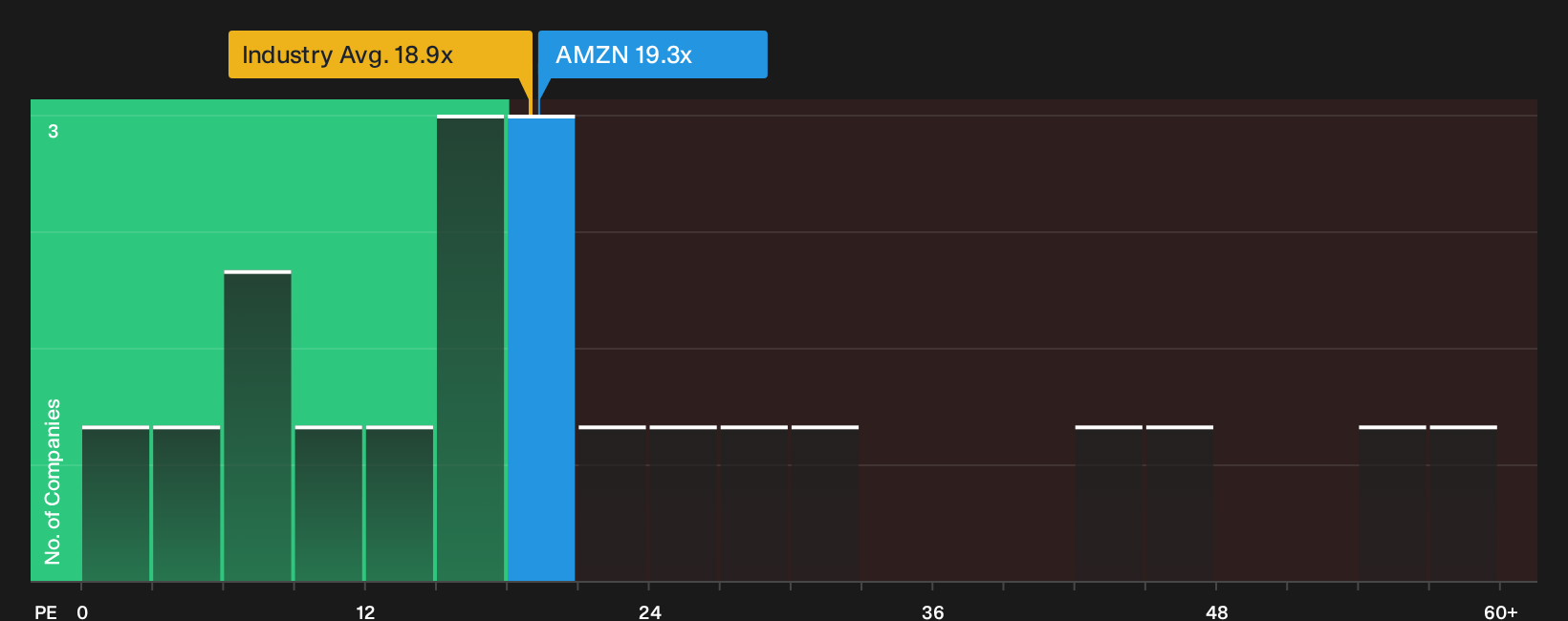
P/E is a clear way to think about Amazon.com here because investors are focused on how much they are paying for today’s earnings while AI spending squeezes reported profit. On this measure, Amazon.com trades on a P/E of 19.3x, which is slightly above the multiline retail sector average of 18.9x but below the peer group on about 25.0x. That mix indicates the stock is priced richer than a typical retailer yet still at a discount to similar large caps the market groups it with.
The valuation model that backs out a tailored fair multiple suggests Amazon.com would warrant a higher P/E than the current 19.3x, given its earnings profile and risk mix, so the shares appear undervalued on this framework. Because the latest earnings miss and heavy AI capital spending have pushed sentiment lower, that discount persists even after investors have reacted to the cash flow impact. To assess whether that gap compensates for the AI and retail uncertainty, it is worth looking more closely at how far the current P/E sits below the modelled fair level. Explore the numbers behind Amazon.com's P/E valuation.
The Amazon.com Narrative: What Would Justify Today's Price?
Simply Wall St Narratives pick up where the Amazon.com valuation puzzle leaves off by spelling out which paths for growth, margins and earnings would need to materialise for the stock to be worth noticeably more or less than it is today. Each narrative ties a specific fair value to a clear story about Amazon.com's potential catalysts and key risks, so you can track over time which version of events is closest to what actually unfolds on the ground.
Community views on Amazon.com split between investors who see AI spending as a temporary drag and others who worry the investment cycle stretches cash returns too far out.
Bull case: 47% undervalued
"Amazon is sacrificing short-term margins to secure long-duration dominance in AI infrastructure, advertising, and automated commerce..."
Discover why this Narrative puts Amazon.com at 47% undervalued.
Bear case: 12% overvalued
"The core debate is timing of cash flow conversion: if AWS/ads momentum persists, the current discount looks attractive; if capex and competition dominate, upside may take longer..."
Explore why this Narrative puts Amazon.com at 12% overvalued.
Amazon.com valuation still leaves one crucial angle unexplored
Before deciding how to treat Amazon.com in your portfolio, it is worth weighing a separate set of alerts that recent checks have raised on the business, which sit outside the valuation story entirely. Take a closer look at 2 warning signs (1 major) before settling on a valuation.
Have feedback on this article? Concerned about the content? Get in touch with us directly. Alternatively, email editorial-team@simplywallst.com