


EN
Best Buy (BBY) Stock Dropped, So What Is Driving Attention Now?
Why Best Buy Stock Is Back in Focus After New In-Store Partnerships
Best Buy (BBY) is back on investors’ radar after two customer facing moves. The retailer is rolling out Zip Co’s flexible payments nationwide and teaming up with IGN on a new in-store gaming experience.
Best Buy’s latest partnerships come as the share price has pulled back 4.7% over the past day and 4.2% over the week, while still posting a 30 day share price return of 8.7% and a year to date gain of 38.3%. Over a longer horizon, total shareholder return is 22.7% over one year and 64.7% over three years. These new in store moves follow a strong run that investors are now evaluating with updated expectations around growth potential and execution risk.
Scan how Best Buy’s in-store push compares with other retailers leaning into the same trend by reviewing our curated list of list of solid balance sheet and fundamentals (24 results)
Best Buy has already priced in a strong run on recent returns, while the partnerships with Zip and IGN are only just hitting stores. Is it worth paying today’s tag, or does patience make more sense?
Most Popular Narrative: 10% Overvalued
Best Buy last closed at $95.65, while the most followed narrative pegs fair value at $86.95 using an 8.68% discount rate. That gap puts extra weight on whether newer profit engines like ads, marketplace and memberships can carry more of the load.
The main thing that has to go right is that Best Buy continues to grow newer profit streams like Best Buy Ads and Marketplace, while keeping appliance, TV and computing customers engaged through better delivery, merchandising and membership rewards.
Best Buy’s current valuation implies investors are already pricing in a fairly valued, bullish case in which the company sustains mid single digit comparable sales growth, maintains an adjusted operating income rate around the mid 4% range, and keeps funding its dividend and store investments from ongoing cash generation.
See why 63 investors see Best Buy as 10% overvalued.
Result: Fair Value of $86.95 (OVERVALUED)
Still, if Best Buy Ads and Marketplace fail to scale as planned, or if tech shoppers trade down harder on big ticket items, that overvaluation narrative could crack.
Find out about the key risks to this Best Buy narrative.
Another Look At Best Buy’s Valuation
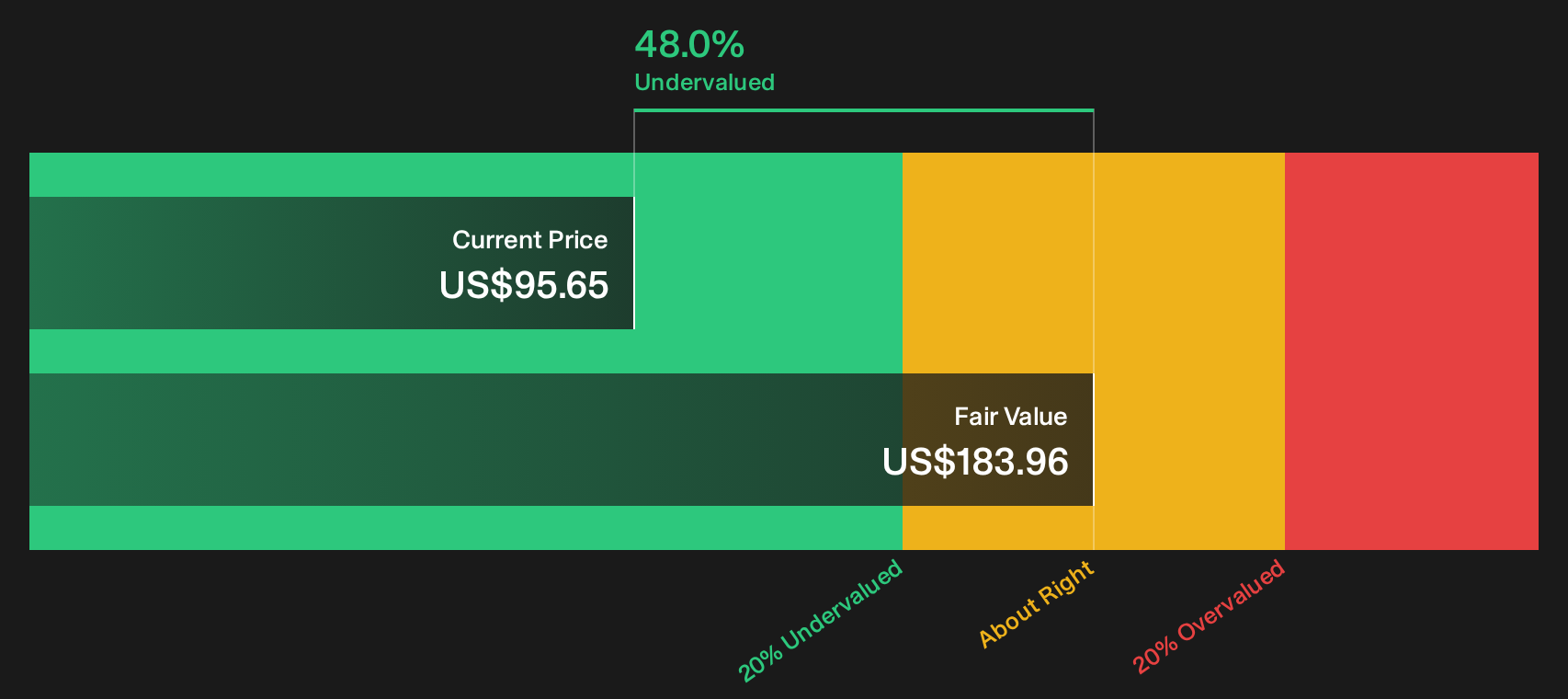
The fair value from the most followed narrative points to $86.95 and labels Best Buy as overvalued. A different lens tells another story. Our DCF model estimates future cash flows at roughly $183.96 per share, which frames the current $95.65 price as a steep discount. Which signal do you trust more?
If you want to see exactly how that cash flow based estimate was built out over time, Look into how the SWS DCF model arrives at its fair value.
Next Steps
If the mixed sentiment around Best Buy leaves you uncertain, act quickly: review the underlying numbers and carefully consider both sides through 5 key rewards and 1 important warning sign
Ready To Hunt Beyond Best Buy?
Do not stop at Best Buy. Apply the same discipline across the market and let targeted screeners surface ideas you might not identify on your own.
- Target resilient cash generators by reviewing companies that pass tough quality and balance sheet filters through the list of solid balance sheet and fundamentals (24 results).
- Focus on potential value gaps by scanning the 33 high quality undervalued stocks that pair strong fundamentals with a price that may not fully reflect them.
- Put income to work by assessing higher yielding payers in the 5 dividend fortresses while you evaluate whether those payouts look sustainable.
Have feedback on this article? Concerned about the content? Get in touch with us directly. Alternatively, email editorial-team@simplywallst.com